


By Ali Rıza Taşdelen
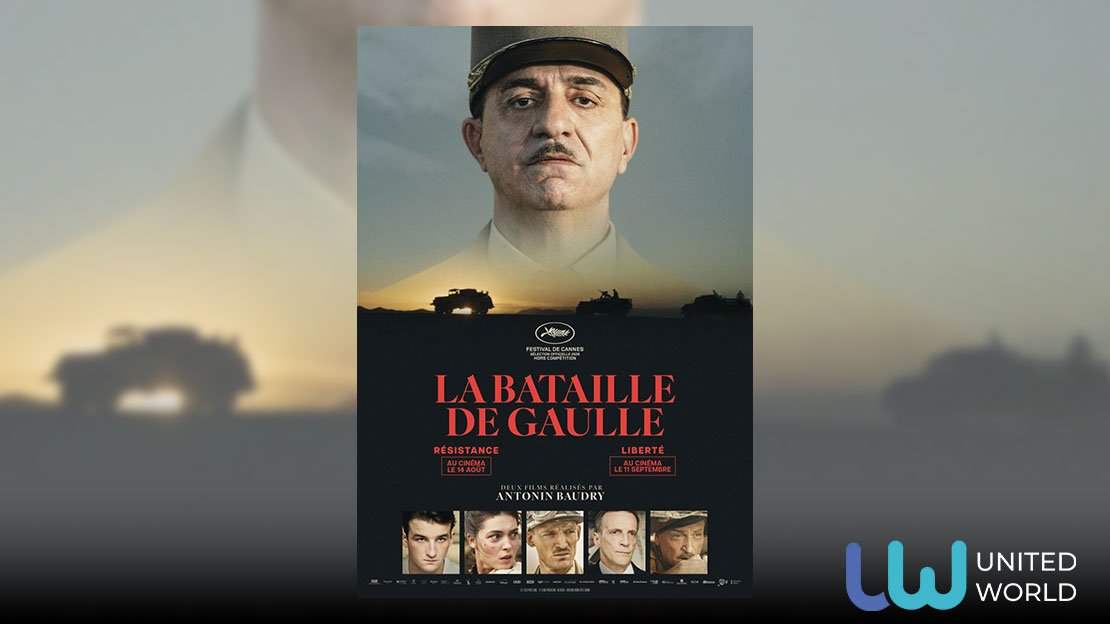
When I learned that the film La Bataille de Gaulle had opened in theaters, I headed straight to the cinema.
I had already seen some films about de Gaulle. But this one was different.
There has been some writing and discussion about de Gaulle’s struggle, during and after the war, against the US’ plans to bring France under its control. Yet for the first time, in La Bataille de Gaulle, that struggle against Washington’s designs was portrayed so explicitly on the big screen.
Since I am not a film critic, what I will focus on here is the film’s political content and de Gaulle’s struggle against US imperialism.
The struggle between De Gaulle and Roosevelt over French sovereignty
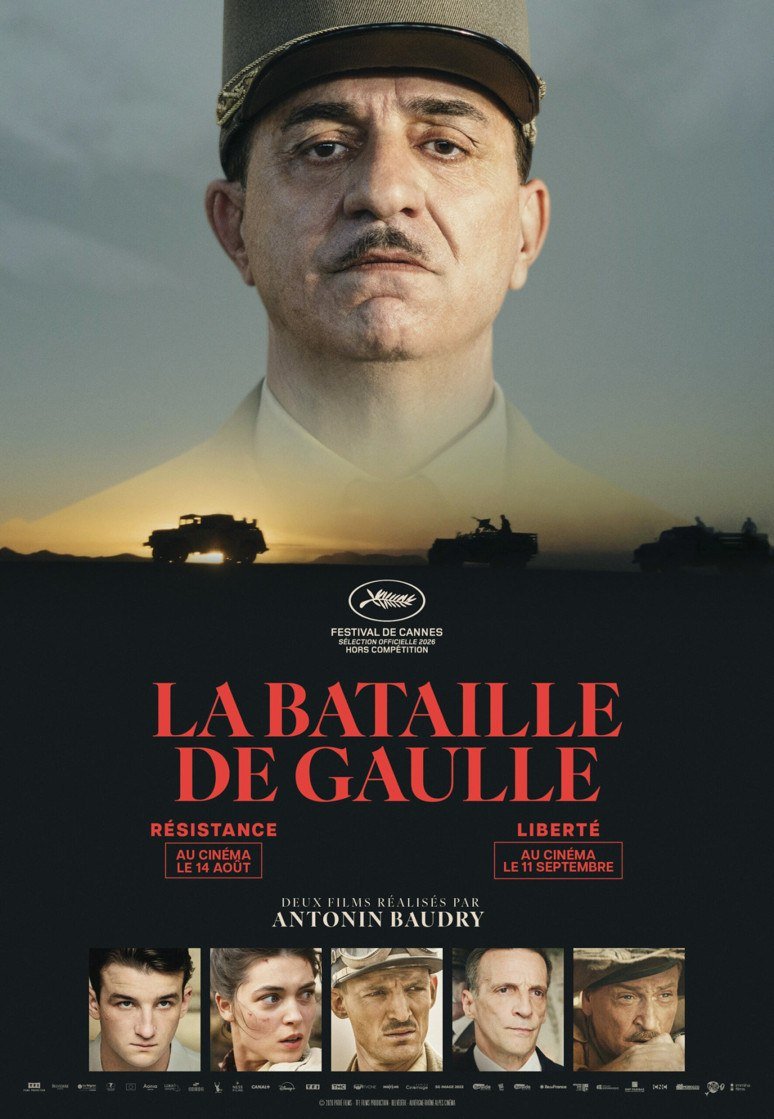
Directed by Antonin Baudry, La Bataille de Gaulle (De Gaulle’s Battle) is a five-and-a-half-hour historical film, released in two parts, with a distinctly political focus on Charles de Gaulle’s struggle during the Second World War. The screenplay was written by Antonin Baudry and Bérénice Vila. Simon Abkarian plays Charles de Gaulle, Simon Russell Beale portrays Winston Churchill, Thierry Lhermitte plays Henri Giraud, and Campbell Scott plays Roosevelt. Other important figures in the film include Jean Moulin, Philippe Leclerc and Fernand Bonnier de La Chapelle.
The film’s principal historical source is British historian Julian Jackson’s biography De Gaulle: Une certaine idée de la France. I am currently reading the book which is nearly a thousand pages. Pathé’s official press dossier for the film also states that the production was adapted directly from Jackson’s work. Jackson played an important role in the production as the film’s historical adviser.
According to statements by Baudry and screenwriter Bérénice Vila, what drew them to Jackson was his portrayal of de Gaulle not merely as a great statesman, but also as an intensely lonely, stubborn and difficult man who saw himself as the embodiment of France’s historical continuity.
Taken together, the two films form a historical panorama of roughly five hours. The first part, L’Âge de fer (The iron age), covers the years 1940-1942; the second, J’écris ton nom (I write your name) largely on 1942-1944.
In the film, the war is not treated simply as a military struggle between Germany and France. The fundamental question is who has the right to speak in the name of France. The Vichy regime? De Gaulle in London? Darlan and later Giraud in Algiers? Or the American and British allies who are winning the war?
For this reason, the central conflict of the film gradually shifts away from the war between Nazi Germany and France and becomes a struggle between de Gaulle and Roosevelt over French sovereignty.
Part one: l’âge de fer
The film opens with the French defeat of 1940.
The German armies invade France, and the French army collapses. The Communists disperse and go underground. The failure of the Socialists and the bourgeois Radicals brings Marshal Pétain to the fore. On June 17, 1940, President Albert Lebrun asks Pétain to form a government. The new government is established in Bordeaux, and Pétain intends to call for an armistice with Germany.
While much of the French state accepts defeat, the young General Charles de Gaulle, still largely unknown to the wider public, advocates resistance to the occupation.
As the Vichy government surrenders to Hitler, Charles de Gaulle is in London preparing to continue the struggle against the occupation. In his Appeal of June 18, 1940, he calls on the French people to keep fighting. On October 24, 1940, Pétain and Laval meet Hitler in the French town of Montoire-sur-le-Loir and shake his hand. Pétain formally declares his policy of collaboration with the Nazis.
The film’s entire plot is, in a sense, built upon this moment: when a state has been defeated, who is its legitimate representative? Pétain’s Vichy government? Or de Gaulle, who refuses to surrender? All of de Gaulle’s subsequent political struggle grows out of his answer to this question.
De Gaulle in London: alliance with Churchill and the first clashes
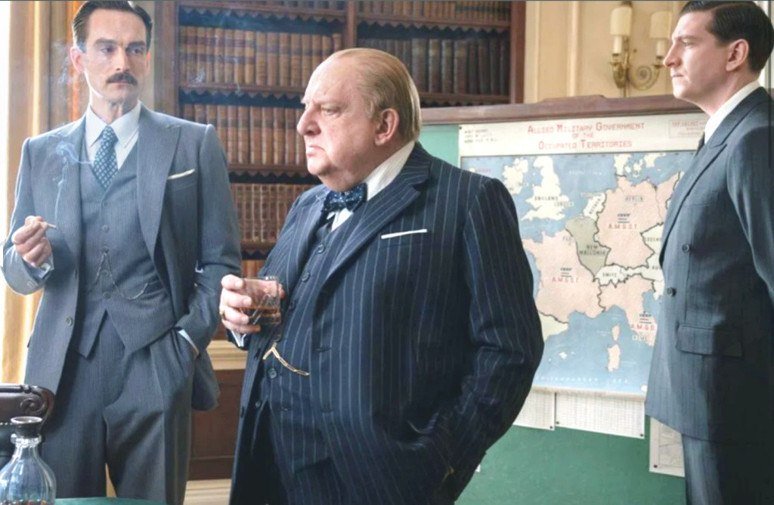
De Gaulle’s presence in London was initially of great importance to Winston Churchill. The British did not want France to be left entirely in the hands of the Vichy regime. Yet relations between Churchill and de Gaulle were never truly easy.
Both wanted France to continue fighting Germany, but they differed over the political position France should occupy once the war was over. Churchill’s overriding priorities were Britain’s security and victory in the war. De Gaulle, however, insisted on something else from the outset: France must not merely be liberated, it must liberate itself in its own name. That distinction would later become the basis of the much sharper conflict between Roosevelt and de Gaulle.
The birth of free France
Throughout the first film, particular emphasis is placed on just how isolated de Gaulle initially was.
He had no army. No money. No state. He couldn’t receive the support of the entire French population. Even among the Allies, confidence in him was limited.
Roosevelt wanted to sideline de Gaulle and instead supported General Henri Giraud, whom he regarded as more amenable. Churchill hosted de Gaulle in London and provided the logistical support that allowed him to remain there and address the French people by radio through the BBC. But with one eye constantly on Roosevelt, Churchill also didn’t take an unequivocal stance.
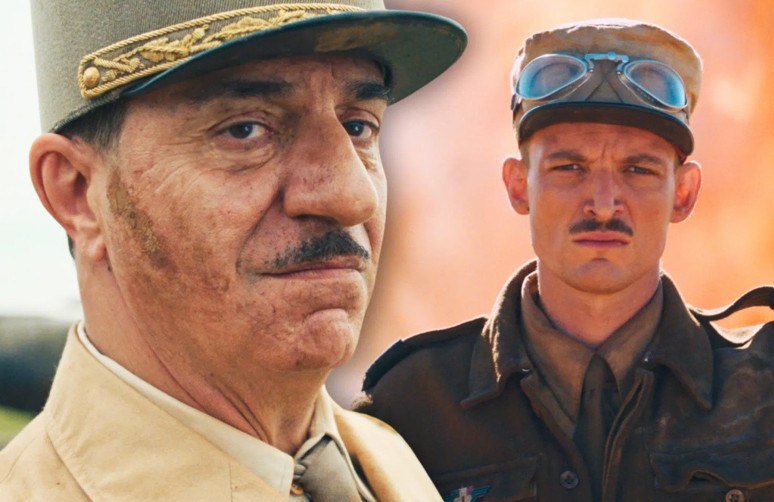
Nevertheless, the movement gradually expanded as French colonies and sections of the armed forces rallied to Free France. The film makes clear that de Gaulle’s political strength didn’t derive from military success alone. His real achievement was keeping alive the idea that “France was still at war.”
One of the major military high points of the first film is Bir Hakeim, a former Italian military position in the Cyrenaican desert of eastern Libya, roughly 70 kilometers inland from the Mediterranean coast and southwest of Tobruk. There, Nazi forces under General Erwin Rommel, whom Hitler had tasked with conquering North Africa, were held off by the newly formed Free French Forces rallied around de Gaulle. The resistance of the Free French troops in North Africa became one of the symbols that allowed de Gaulle to proclaim internationally, “France is still fighting.”
The US-British landings in North Africa (November 8, 1942)
Even before the US formally entered the war, the Roosevelt administration was closely following developments in France. For Washington, the central question was this: whom could it trust in determining France’s future?
Roosevelt did not trust de Gaulle. De Gaulle’s stubborn insistence that French sovereignty must remain in French hands deeply troubled him. As long as de Gaulle remained in the game, bringing France under control would be almost impossible.
Instead, Roosevelt believed that Washington could work with French military and political cadres in North Africa. This approach would prove decisive in the Allied landings there in 1942.
On November 8, 1942, Allied forces led by the US and Britain landed in French North Africa as part of Operation Torch. Militarily, the objective was to seize North Africa from the Axis powers and shift the balance of the Mediterranean war in favor of the Allies.
But de Gaulle was deliberately left out of the operation. Washington and London preferred to deal with the French authorities in North Africa not through de Gaulle, but through other figures. Two names came to the forefront: Admiral François Darlan and General Henri Giraud.
A controversial decision of the Allies
Admiral Darlan was one of the leading figures of the Nazi-collaborationist Vichy regime. He had commanded the French Navy and maintained his ties with the Vichy government.
His presence in North Africa at the time of the Allied landings presented the Americans with an important opportunity. Rather than endorsing de Gaulle’s claim to political legitimacy, the Roosevelt administration chose to collaborate with the Vichy-aligned French military and administrative structure already in place.
This decision became highly controversial, particularly in France. The contradiction was stark: a French official connected to the Vichy regime, which had collaborated with the Nazis, was temporarily accepted by the Americans as a legitimate interlocutor, while de Gaulle, who had continued fighting Germany, was politically excluded. Roosevelt justified this in terms of military necessity and pragmatism. De Gaulle rejected it outright.
On December 24, 1942, Admiral Darlan was assassinated by the young French resistance fighter Fernand Bonnier de La Chapelle. With Darlan dead, General Henri Giraud moved to the forefront. Giraud was not an ideological defender of Vichy in the strict sense. Yet because of his ties to the Vichy system and his background within its military establishment, he represented a radically different French political line from de Gaulle.
The Americans preferred Giraud. He commanded substantial military forces, could take charge of the French army in North Africa, and was regarded as easier to work with. Moreover, unlike de Gaulle, he did not represent an independent political center. In Roosevelt’s eyes, Giraud thus became the alternative French leader to de Gaulle.
The Anfa Conference held in Casablanca in January 1943 is one of the key political events linking the two halves of the film. Roosevelt and Churchill attempted to bring de Gaulle and Giraud together under a joint French leadership.
But the two generals represented fundamentally different political worlds: De Gaulle stood for Free France, the Resistance, and French sovereignty. Giraud represented pragmatic cooperation with the Allies.
Roosevelt had greater trust in Giraud, while Churchill moved back and forth between the two. On the one hand, Churchill felt Roosevelt’s pressure; on the other, he increasingly recognized de Gaulle’s growing influence over French public opinion and the Resistance. The famous photograph from Casablanca, de Gaulle and Giraud shaking hands in front of Roosevelt and Churchill, was, in reality, the visible surface of a far deeper political struggle.
The second film begins in the closing months of 1942 and carries the story through 1943 and 1944. By this point, the nature of the war changes.
In the first film, de Gaulle’s question is simply to exist.
In the second, the question becomes, “Who will govern France once France is liberated?”
In the second part, I will continue to recount de Gaulle’s story.