


A society builds its future upon the intellectual and cultural legacy left by its scholars, sages, and distinguished figures. Just as the writings of Ibn Battuta and Evliya Çelebi have illuminated the past and provided invaluable insights into the world they witnessed, scholars like Professor Salih Özbaran have made it possible for us to better understand entire historical periods through their meticulous archival research and scholarly contributions. Salih Özbaran is undoubtedly one of the living legends of Turkish historiography, whose dedication to historical inquiry and commitment to uncovering the past have left an enduring mark on our understanding of history. His legacy reminds us that preserving history is not merely about documenting the past, but also about illuminating the path for future generations.
Professor Dr. Salih Özbaran’s scholarship occupies an important place in the study of Ottoman expansion into the Indian Ocean and the competition between the Ottoman and Portuguese empires during the sixteenth century. His works has helped illuminate a dimension of Ottoman history that cannot be understood adequately through a narrative centred exclusively on Europe and the Mediterranean. By examining Ottoman and Portuguese historical records together, Özbaran brought greater depth to our understanding of the political, military, commercial, and administrative dynamics of the early modern world.
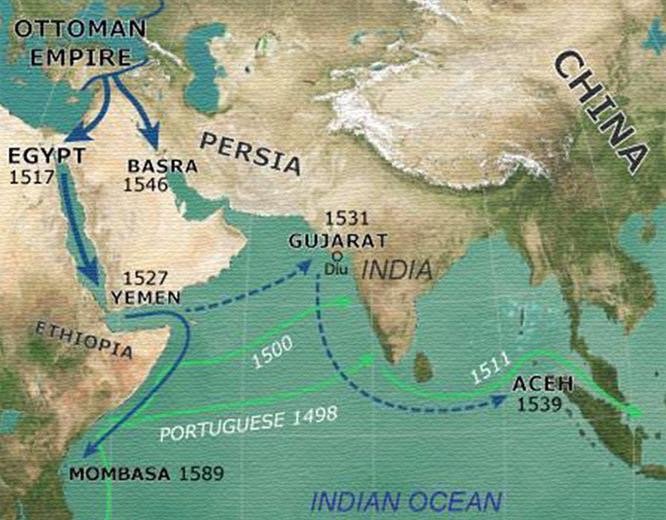
At the beginning of the sixteenth century, the Indian Ocean became a major arena of competition-between expanding imperial powers. Following their arrival on the western coast of India at the end of the fifteenth century, the Portuguese established strategic positions along important maritime routes. Their objective was to strengthen control over seaborne commerce and redirect established trade networks connecting the Indian Ocean, the Persian Gulf, the Red Sea, and the Mediterranean.
The Ottoman Empire, meanwhile, was consolidating its position in the eastern Mediterranean and the Middle East. The conquest of Egypt in 1517brought the Red Sea under Ottoman sovereignty, while subsequent expansion into Iraq and the Gulf region strengthened the empire’s capacity to engage with developments farther east.
These parallel expansions brought the two powers into competition over strategic ports, maritime security, commercial networks, and political influence across the Arabian Peninsula and the Indian Ocean. Their rivalry was not simply a sequence of naval encounters. It reflected competing imperial strategies and the importance of controlling the connections between Asian commerce and markets in the Middle East and Europe.
Salih Özbaran’s Contribution to Ottoman–Portuguese Studies
One of Özbaran’s major achievements was to make the Portuguese documentary record an integral part of the study of Ottoman history. Historians examining Ottoman activity in the Indian Ocean need to consider not only imperial decrees and administrative records preserved in Ottoman archives, but also Portuguese chronicles, reports, and correspondence. Each documentary tradition reflects its own institutional interests and political perspectives.
Özbaran’s research demonstrates the importance of reading these sources critically and comparatively. Portuguese documents can reveal how Ottoman activities were perceived by their rivals, while Ottoman records help explain the administrative and strategic calculations behind imperial policy. Read together, they offer a more nuanced reconstruction of events than either tradition can provide on its own. His 1985 study, A Review of Portuguese and Turkish Sources for the Ottomans in Arabia and the Indian Ocean in the Sixteenth Century, directly addresses this methodological challenge.
This approach is especially significant because the history of the Indian Ocean has often been narrated from the perspective of European maritime expansion. Özbaran’s work helps restore the Ottoman Empire to that broader history, showing that the empire was not merely a distant observer of European voyages, but an active political and military power involved in shaping developments across the region.
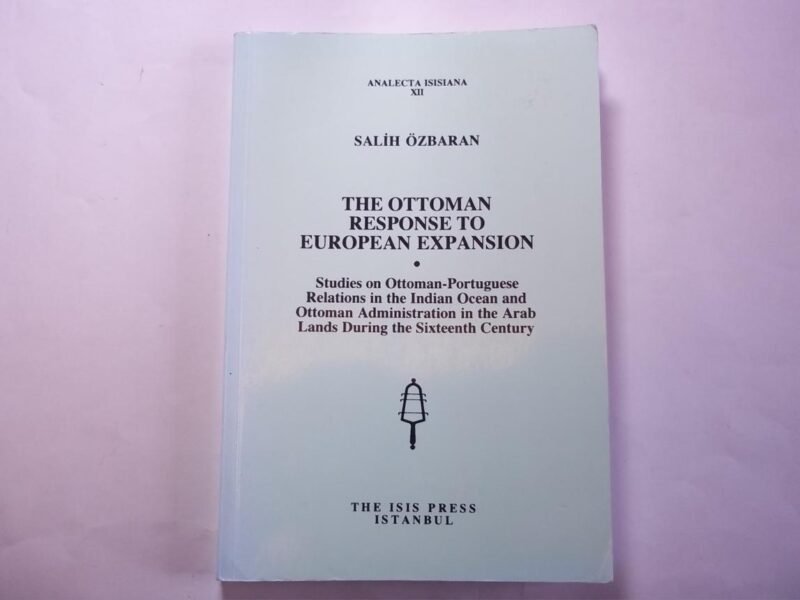
This foundational study examines the rivalry between the two powers in the Persian Gulf, covering the period from the Ottoman advance into Iraq to the next struggle for regional influence. It proved an important documentary and analytical basis for further research on Ottoman–Portuguese relations.
A major strength of Özbaran’s research is its refusal to reduce Ottoman–Portuguese relations to military confrontation alone. Naval expeditions and territorial contests were important, but they formed part of a larger struggle over commerce, regional authority, and the political geography of the seas.
The Red Sea and Persian Gulf connected the Ottoman territories of Egypt, Yemen, Iraq, and the Arabian Peninsula to commercial networks extending towards India and beyond. Ottoman policy in these regions therefore involved questions of provincial administration, logistical support, taxation, and the protection of established trade routes.
Portuguese maritime power challenged the w order, but the Ottoman response depended on a combination of military capacity political alliances, administrative consolidation, and regional cooperation. Understanding these interactions requires close attention to local circumstances rather than a simplistic account of two monolithic empires locked in permanent conflict. Özbaran’s studies are valuable precisely because they connect these different dimensions. They reveal how imperial rivalry operated in practice and why the Indian Ocean must be understood as a complex historical space shaped by multiple powers and interconnected societies.
Professor Dr. Salih Özbaran’s scholarship reminds us that history is not merely a story about the past. It is a demanding intellectual endeavour through which we come to understand the connections, conflicts, and choices that have shaped our world. Scholars who dedicate their lives to this endeavour deserve a far more prominent place in our universities and public life.
References
- Özbaran, Salih. The Ottoman Turks and the Portuguese in the Persian Gulf, 1534–1581.University of London, 1969.
- Özbaran, Salih. The Ottoman Response to European Expansion: Studies on Ottoman-Portuguese Relations in the Indian Ocean and Ottoman Administration in the ArabLands During the Sixteenth Century. Istanbul: The Isis Press, 1994.
- Özbaran, Salih. “A Review of Portuguese and Turkish Sources for the Ottomans in Arabia andthe Indian Ocean in the 16th Century.” Belleten49, no. 193 (1985)
- Özbaran, Salih. Ottoman Expansion towards the Indian Ocean in the 16th Century. Istanbul: Istanbul Bilgi University Press,2009.