


By Mehmet Enes Beşer
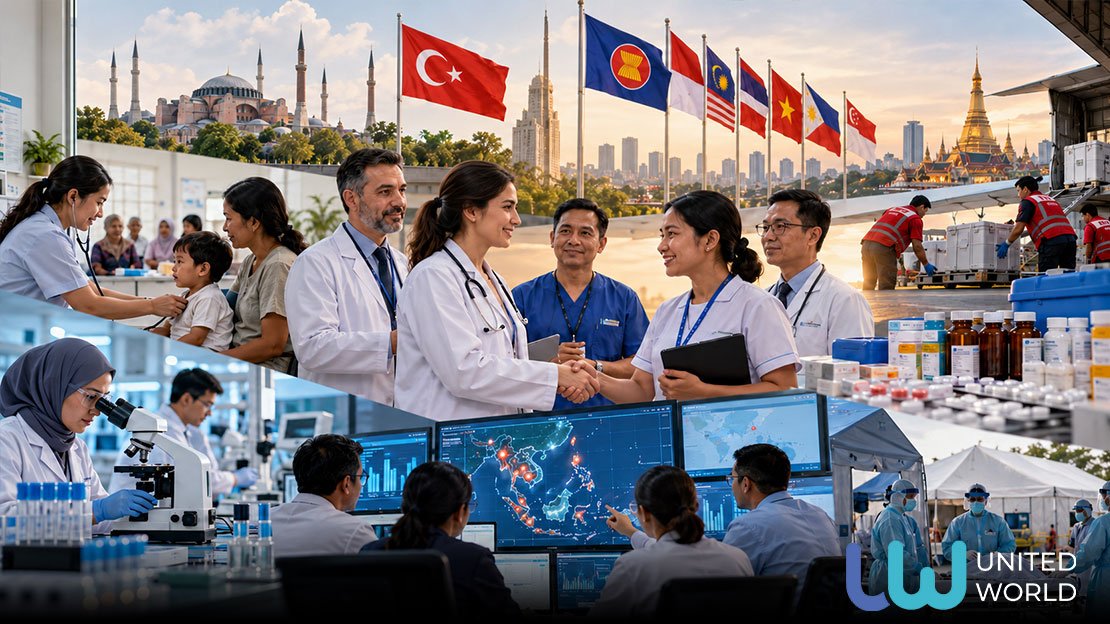
ASEAN’s 2026 report on health and wellness tourism arrived just as Türkiye was formally accorded Dialogue Partner status. The coincidence creates an easy but misleading agenda: combine Türkiye’s successful international-patient industry with Southeast Asia’s expanding medical-travel market. Ankara should resist making that the centerpiece. Türkiye will be more useful to ASEAN, and will build a more durable regional role, if it helps strengthen the systems that treat people before they ever need to cross a border.
Medical tourism is economically real. Official Turkish data record about 1.4 million visitors for health services and just over US$3 billion in revenue in 2025. The business can reward hospitals that improve accreditation, logistics and patient services. Yet recent Malaysian research finds that concerns over equitable access remain after more than a decade of government promotion. Medical tourism concentrates attention on mobile, paying patients and metropolitan hospitals; it says little about rural primary care, disease surveillance, medicine shortages or the capacity of district managers. It also places Türkiye in direct commercial competition with Thailand, Malaysia and Singapore, already leading ASEAN hubs. A partnership organized around patient capture would therefore be narrow and partly zero-sum.
ASEAN’s own policy calendar points elsewhere. Senior health officials spent May finalizing the 2026–2030 Work Programs of the ASEAN Health Sector, while regional mechanisms are advancing emergency coordination, drug security and medical-device regulation. These are the foundations that determine whether a health system absorbs shocks or sends patients into overcrowded tertiary care. Türkiye should align its new dialogue partnership with those priorities, not import a tourism sales pitch into a public-health agenda.
First, the partnership should focus on management and primary care. Türkiye’s Health Transformation Programe introduced nationwide family medicine and unified insurance arrangements, giving Ankara experience in scaling reforms across provinces, monitoring performance and expanding access. That experience is relevant, but not a model to export wholesale. Indonesia and the Philippines must serve dispersed island geographies, while Cambodia, Lao PDR and Timor-Leste will not seek the same package as Singapore or Thailand. The useful offer is therefore not a Turkish blueprint but joint problem-solving: district-management fellowships, hospital-quality teams, referral-system pilots and training in infection prevention, procurement and health-data use.
That distinction matters because more hospitals do not automatically mean stronger health systems. Medical tourism rewards high-end capacity, whereas public health depends on continuity: family doctors who detect hypertension, laboratories that report quickly, supply officers who prevent stock-outs and managers who keep essential services running during floods or outbreaks. Joint pilots should therefore be judged by avoidable hospital admissions, medicine availability, waiting times, vaccination coverage and continuity of care, not by the number of Turkish consultants hired or memoranda signed.
Second, Ankara should make production cooperation local rather than transactional. ASEAN has committed to drug security and self-reliance, has an ASEAN Pharmaceutical Regulatory Policy and maintains an ASEAN Medical Device Directive. Turkish firms could work with Southeast Asian manufacturers on generics, diagnostics, consumables and mid-range devices, but contracts should include supplier development, regulatory training and technology transfer. Simply shipping finished products from Türkiye would reproduce the dependency ASEAN is trying to reduce. Joint ventures will be viable only where local demand, procurement rules and quality-control capacity support scale; elsewhere, pooled purchasing and shared testing facilities may deliver more than a factory built for diplomatic display.
Vaccines and emergency preparedness provide a third track, but Ankara must be honest about its own stage of development. Türkiye is building a new vaccine production center, while TÜSEB is expanding international work in biopharmaceutical research. That makes joint research, clinical-trial networks and workforce exchanges plausible; it does not yet justify presenting Türkiye as ASEAN’s vaccine supplier. A better contribution would connect Turkish laboratories and epidemiologists to ASEAN’s emergency architecture, including the ASEAN Public Health Emergency Coordination System, through simulation exercises, genomic-surveillance protocols, laboratory-leadership training and pre-agreed channels for sharing data and essential supplies.
Ageing should be included from the beginning. ASEAN’s population structures are changing at very different speeds: some members are already ageing rapidly while others still have young workforces. OECD data on Türkiye’s long-term-care workforce underline that Ankara is a fellow reformer, not a finished model. The exchange should cover chronic-disease management, home-based care, rehabilitation and financing. Here too, the unit of cooperation should not be the flagship hospital. It should be the pathway linking community health workers, primary-care teams, municipal services, carers and specialist referral. ASEAN’s own population-policy discussions emphasize that demographic change is uneven; a single regional package would fail.
ASEAN and Türkiye should establish a five-year Health Systems Capacity Compact under the dialogue mechanism, co-designed with the Senior Officials Meeting on Health Development. It should fund no more than a handful of demand-led projects: one primary-care and hospital-management network; one medicines or devices production partnership; one emergency-preparedness program; and one healthy-ageing pilot. Participating governments should choose modules rather than accept a uniform package. Each project should publish baseline indicators, local-ownership rules and an exit plan, with independent review after three years. Projects that cannot show reduced stock-outs, faster outbreak reporting, stronger referral performance or trained local teams should not be renewed.
Türkiye can keep welcoming international patients. But a dialogue partnership built around selling treatments would reach the few people able to travel and leave ASEAN’s deeper health priorities untouched. The better test is whether cooperation makes ordinary care more reliable in a provincial clinic, a district hospital or a public laboratory. Health diplomacy becomes strategic when the partner remains useful after the visiting patient has gone home.