


By Mehmet Enes Beşer
On 21 July, ASEAN formally accorded Türkiye Dialogue Partner status. Within three days, Chinese coastguard vessels had again used water cannon against Philippine fisheries craft near Scarborough Shoal, after an earlier confrontation at Second Thomas Shoal injured a Filipino sailor. The timing was coincidental but instructive. Türkiye has gained a larger regional platform just as the South China Sea is becoming more dangerous for governments, crews and outside partners entering its security market.
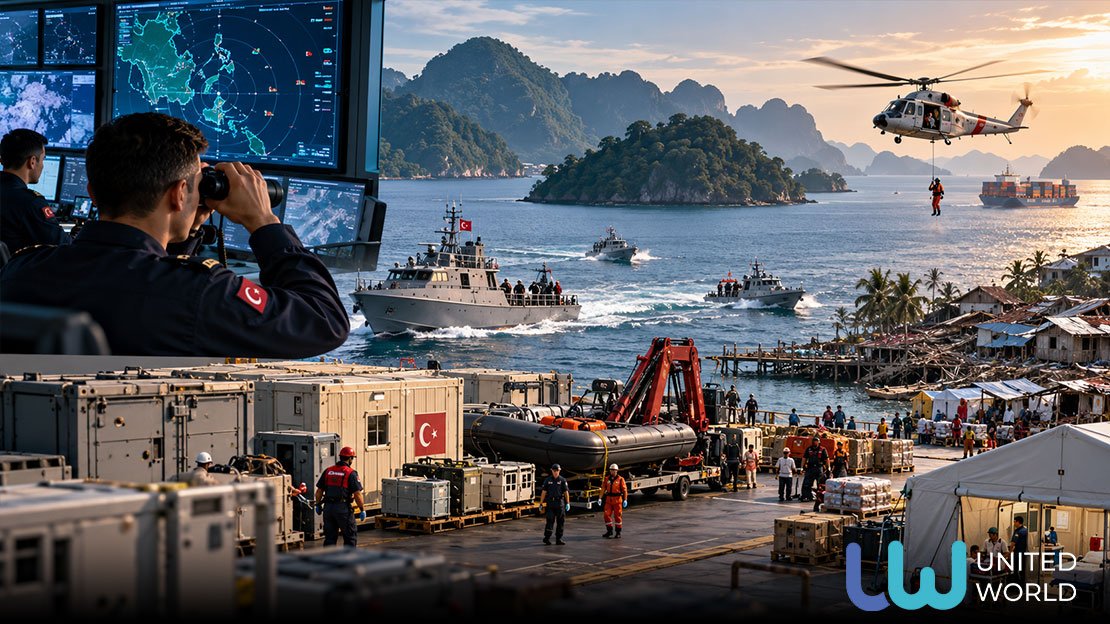
Ankara must not try to sell defense to Southeast Asian countries through the back door of alignment against China—let alone any other great power. Ankara should base its offer on maritime security: coast guard capacity, search and rescue, dealing with pollution, disaster logistics, civilian maritime security, and maintenance. Such systems do reinforce sovereignty. What makes a difference is that they meet regularly occurring demands for public security without forcing Türkiye to take on the same geopolitical dispute as its client.
Türkiye’s industrial footprint is already substantial enough for the distinction to matter. Malaysia operationalised the Turkish-built ANKA-S at Labuan in June for persistent maritime surveillance, while Turkish-built littoral mission ships are being delivered to its navy. Indonesia has contracted for 48 KAAN combat aircraft and entered joint-production arrangements for Turkish drones. Vietnam and Türkiye, meanwhile, agreed in May to expand cooperation in fields including search and rescue and non-traditional security. The portfolio now ranges from public-purpose maritime awareness to high-end combat power.
Those customers do not share one strategic posture. The Philippines is a United States treaty ally confronting China directly at sea. Vietnam’s “Four No’s” policy rejects military alliances and siding with one country against another. Indonesia deliberately diversifies suppliers; it has bought French Rafales while ordering Turkish aircraft and considering systems from other powers. A Turkish platform therefore carries a different political meaning in every capital. Calling each sale a “strategic alignment” may please the signing ceremony while creating incompatible expectations afterwards.
The risk does not arise only from the weapon itself. A government buying a sophisticated system may expect priority access to spare parts during a crisis, intelligence support, rapid software changes or public diplomatic backing. Ankara may regard the transaction as commercial while the buyer presents it domestically as proof of Turkish support for its maritime position. Beijing may draw its own conclusion. Other ASEAN governments may then wonder whether Türkiye’s new regional role is becoming an extension of bilateral security bargains. ASEAN’s July communiqué called for self-restraint and practical measures to reduce accidents and miscalculation. Turkish sales should not add another layer of uncertainty about who supports whom in a crisis.
Cooperative engagement is not synonymous with political neutrality. The coastal radar, unmanned surveillance and patrol boats can allow a country to track the intrusions, gather evidence of any illegal fishing, and maintain its presence in disputed areas. This is exactly what makes it so important for there to be clear mission descriptions and control mechanisms. The operation’s information has to be owned by the Bruneians, Malaysians, Filipinos or Vietnamese; the Turkish company must not have any hidden access remotely to it. The system has to be capable of accepting the sensors produced by any other vendor; civilian institutions should be able to utilize the same image in case of rescue operations, fishery control or any kind of pollution.
Disaster logistics offers a particularly credible bridge between defence cooperation and public security. The existing ASEAN–Türkiye cooperation roadmap already includes disaster-risk reduction, disaster management and humanitarian assistance. Turkish firms could provide modular medical facilities, portable power, communications, water purification and rapidly deployable port-repair equipment, while exercises establish who may release and operate them after a typhoon or earthquake. Civilian disaster authorities must lead mission planning. Otherwise, equipment procured under a humanitarian label may become another military system with no agreed peacetime operator.
ASEAN has also offered Türkiye an institutional route. Its defence ministers included Türkiye in the 2024–2027 ADMM-Plus Experts’ Working Group observership programme, covering humanitarian assistance and disaster relief, maritime security, military medicine and other practical fields. The same declaration adopted an ASEAN Defence Search and Rescue Exercise concept. ASEAN’s wider maritime agenda also prioritises search and rescue, maritime-domain awareness and protection of marine resources. These mechanisms let Türkiye demonstrate capability without creating a Turkish-led security bloc.
It is for these reasons that the ASEAN–Türkiye Plan of Action should include one Maritime Public Goods Pilot. While a willing coastal state could be selected for the first cycle, the operating procedures, training material and technical interfaces should be available to other ASEAN states. The pilot can be set up using existing radars and vessel tracking data, rescue coordination, oil spill equipment mapping and a local repair cell for Turkish supplied equipment. Instead of using a bilateral scenario of cooperation against a named adversary, the scenario for the exercise/reporting should come from an ASEAN exercise.
However, this does not mean that Türkiye should stop supplying combat systems to Southeast Asian countries. There are legitimate needs for modernization and deterrence on part of these governments and Ankara cannot deny this and expect the coast guards to take care of coercion at sea. However, what it should do is to differentiate its sales of combat systems from the alignment aspect. For these contracts, there must be end use criteria, data ownership clauses, obligations in terms of crisis support and integration of software or weapon systems.
Instead of counting export value, number of platforms delivered and number of visits to ceremonies, the scorecard of Türkiye in Southeast Asia must include things like speed of rescue operation, number of illegal fishing cases solved with evidence, pollution incidents controlled, system availability and local repairability of faults. Before announcing any new major defense cooperation initiative in Southeast Asia, the country should complete at least one ASEAN compatible maritime public goods project.