


Pandora’s box is now open.
Years of public anger against neoliberal policies have finally spilled over.
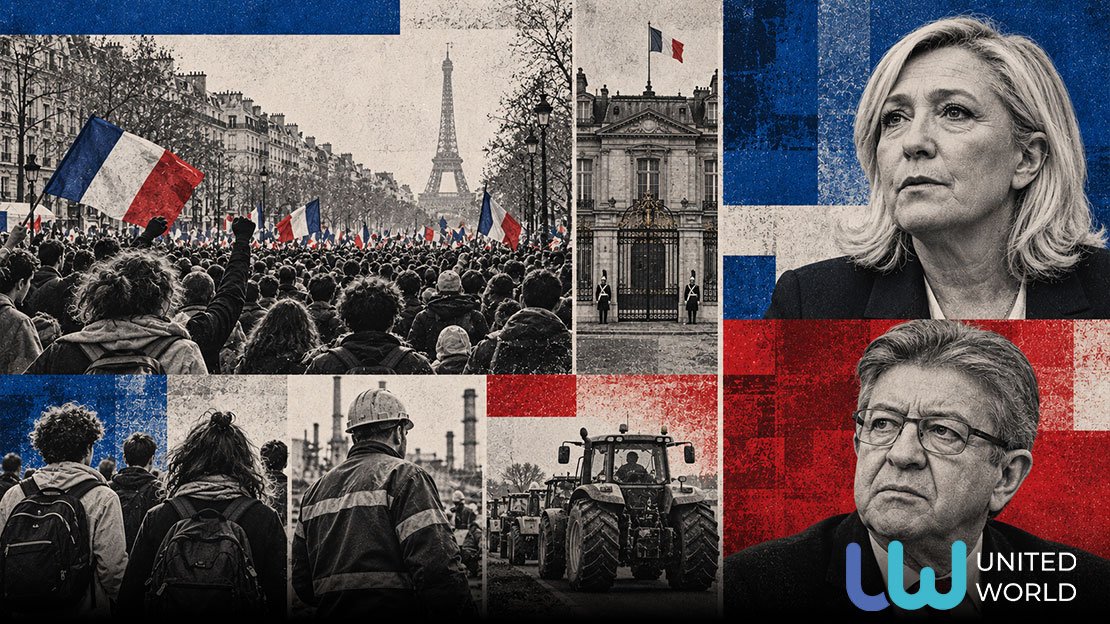
Television screens are filled with images of crowds clashing with police in the streets. Above all in Paris.
The government, and more broadly, the French political establishment as a whole, is in a state of panic.
There are calls for the police to intensify the force used against demonstrators; demands that the families of high-school students taking part in the protests be sanctioned; and even appeals to ban La France Insoumise (LFI), which has backed the demonstrations and is currently shown by opinion polls as the country’s second-largest political force.
What those in power fear most is that workers and farmers, whose livelihoods have been steadily squeezed by years of neoliberal policies, will join the protests led by high-school students and suburban youth.
There are already signs that this may be happening.
Public-sector employees have come out in support of the demonstrations. Teachers have taken to the streets to shield protesting students from police violence. Firefighters have been filmed turning their firefighting foam on the police.
Opponents of the European Union have also seized the moment and joined the protests. They carried banners condemning the government’s support for Ukraine.
Calls for a general strike are growing louder.
Marine Le Pen, currently regarded as a favorite in the presidential election scheduled for April 2027, sought to place responsibility for the unrest on Mélenchon, the leader of LFI and her principal rival in the presidential race. Le Pen has called for calm.
The political intention behind Le Pen’s statement is clear: she is seeking to win over capital, the bureaucracy, and sections of the petty bourgeoisie clustered around the center-right.
Mélenchon, by contrast, continues to back the protests despite threats from the government side to ban his party and despite Le Pen’s attacks.
His first-round support has now climbed above 20 percent. This figure is the highest level of electoral support for the French left in many years. And it is still rising.
Dominique de Villepin, Jacques Chirac’s former foreign minister, is meanwhile voicing support for the protesters’ demands without alarming centrist voters. He continues to keep his distance from Mélenchon.
If, as now appears highly likely, the second round becomes a Le Pen-Mélenchon contest, it is uncertain whom Villepin would ultimately support.
For years, capital and the bureaucracy in France urged voters to rally behind center-right or center-left candidates in order to stop Le Pen. Yet in a Le Pen-Mélenchon runoff, it wouldn’t be surprising to see the same circles eat their previous words and call for a vote for Le Pen against Mélenchon. In this context, it is worth recalling Le Pen’s meetings in recent months with MEDEF, the main organization representing the French capital class, and with the Israeli ambassador (which was the first such meeting of its kind.)
The Macron side, meanwhile, has already begun to disintegrate. They are searching for a candidate, but in the current climate it is difficult to imagine another figure in the mold of Macron, a former Rothschild banker, being elected.
Meanwhile, the liberal-“left” Raphael Glucksmann is being presented to the public as a false alternative. Glucksmann, whom I would describe as the left-wing branch of Bernard-Henri Lévy, is a murky figure. He enjoys the backing of the neoliberal left and the Soros-aligned milieu and maintains close ties with international networks.
If Mélenchon can bring students, workers and farmers together under a single political umbrella, his chance of winning will increase.
To prevent such an alliance, the system/the political center continually brings identity-based divisions to the fore: Christian and Muslim, native and immigrant, and so on. The objective is to fragment the masses of people crushed under the pressures of the neoliberal system. In other words, to prevent the struggle of the young person in the banlieue from converging with that of the French farmer on a common political ground. So far, they have succeeded.
Mélenchon therefore needs to pursue a careful strategy and maintain a class- and economy-centered discourse without falling into the “identity” trap. If he manages to do so, he could change not only the fate of France, but that of Europe as well. Whether he truly has a revolutionary solution to offer is something we will find out as this process unfolds.
As for Le Pen, it is necessary to note that on many issues she has already capitulated to the political center. This has gone beyond mere electoral tactics. Her inclination toward agreement with capital is growing stronger. Yes, she continues to advocate keeping a certain distance from the US on some issues and maintaining good relations with Russia. Yet domestically, apart from immigration, she has offered little indication that she intends to break with the policies of the center-right.
Increasingly, she resembles the politicians of restauration period.
Whatever happens, the neoliberal center is collapsing.
And we are rapidly heading toward an even more severe collapse.