


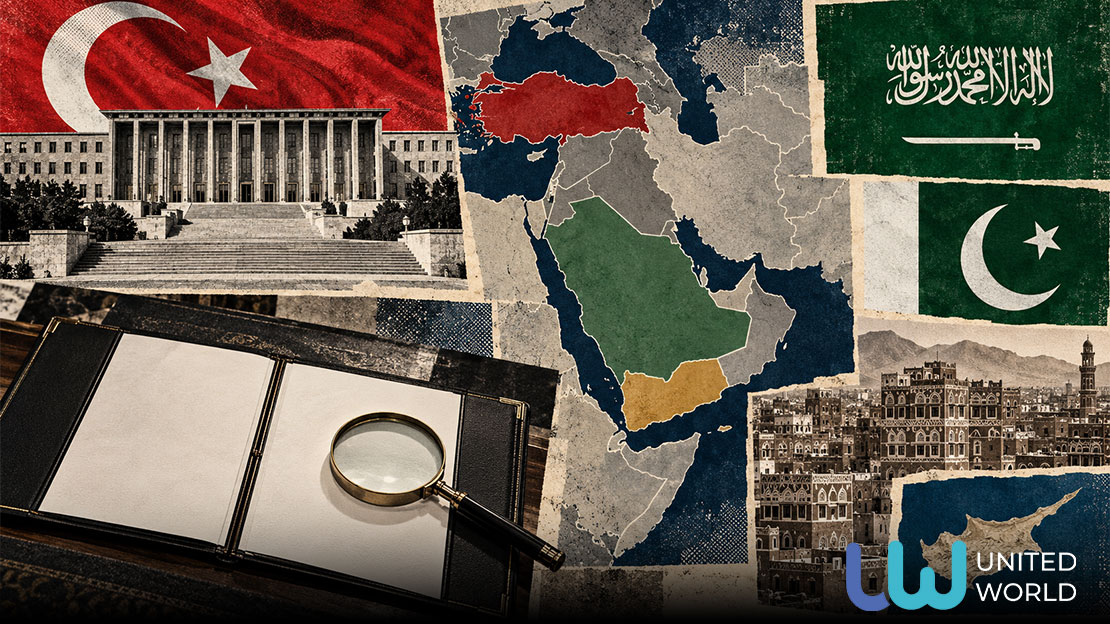
Türkiye, Pakistan and Saudi Arabia signed the “Mecca Agreement for Joint Defense” in Mecca on August 7, 2026.
The agreement has been the subject of extensive debate ever since. However, its text and provisions had not been made public.
On October 21, a bill seeking approval of the “Mecca Agreement for Joint Defense between Türkiye, Pakistan and Saudi Arabia” was submitted to the Presidency of the Grand National Assembly of Türkiye (TBMM). With its submission, the text and provisions of the agreement were made public for the first time.
It will be presented to the deputies’ vote once the relevant procedures within the Assembly have been completed. For the proposal to become law, an absolute majority is required in the 600-member parliament.
The agreement has become a major topic of analysis and discussion among politicians, retired military officers and experts in Türkiye.
Professor Hasan Ünal, an expert in international relations and Turkish foreign policy in Başkent University in Ankara, and retired Admiral Cem Gürdeniz, one of the coiners of the term “Blue Homeland,” shared their views on the agreement through their accounts on X.
We share Hasan Ünal’s and Cem Gürdeniz’s assessments with our readers.
Hasan Ünal offered the following assessment:
The text of the Mecca Agreement contains all the troubling provisions we had expressed concerns about in recent weeks.
Article 2, which stipulates that an attack on any one of the three signatory countries will be considered an attack on all three and requires an immediate response, is problematic. Although the agreement states that each country will provide military support in line with its capabilities, any escalation would inevitably lead to full-scale military involvement with all military capabilities.
Article 5, which contains ‘full cooperation on counterterrorism’, will create serious problems. For example, Saudi Arabia considers the Ansar Allah movement a terrorist organization. Riyadh might even place Hezbollah in the same category. What are we supposed to do in such a situation?
The provisions on intelligence cooperation are worded in very broad terms, giving the impression that each country will share with the others all the intelligence it gathers on any matter. This is highly likely to cause problems in practice.
Moreover, the fact that the agreement is of indefinite duration, that no signatory can withdraw from it for ten years, and that a country wishing to withdraw cannot even pull out of previously agreed activities and projects during this 10-year period is downright absurd.
For example, a different government coming to power in the next election would be unable to withdraw the country from this agreement for ten years and would also be obliged to continue the activities and projects approved by the current government. I hope that members of parliament from both the opposition and the governing party will carefully consider what these provisions mean, and what their practical consequences will be, before they vote.
The fundamental question is how and why we came to need such an agreement in the first place. It will make no contribution whatsoever to our security. On the contrary, it will put Türkiye under pressure to become actively involved in Saudi Arabia’s disputes and conflicts with Yemen and even Iran.
If helping the Saudis is so important, why are we not asking them to recognize the Turkish Republic of Northern Cyprus (TRNC)? After all, the agreement we have signed is a matter of life and death for the Saudis, and Cyprus is a national cause for Türkiye.
It hardly needs saying that the region has no need whatsoever for such an agreement. At a time when the power and influence of the US, which has lost considerable ground to Iran and is steadily losing influence around the world, and Israel, which has turned into a rogue state, are rapidly declining in the region and are set to decline further, what is needed instead is confidence-building measures and economic integration among the countries of the region. Alliances of this kind only give rise to counter-alliances, expanding the scope for manipulation by the US and especially Israel.
To constantly criticize Israel while rushing, alongside Israel and the US, to Saudi Arabia’s rescue in a conflict that the Saudis themselves started and have been unable to handle could rank among the strangest episodes in political and military history and diplomacy.
Cem Gürdeniz shared the following views on the Mecca Agreement:
The 16 articles of the Mecca Agreement have reinforced the concerns I expressed earlier. This military alliance, which Türkiye does not need, has the potential to deepen dangerous sectarian and geopolitical divisions in West Asia.
1. The possibility that the military alliance between Türkiye, Saudi Arabia and Pakistan will be perceived as a Sunni bloc against Iran poses a serious strategic danger. Why should Türkiye become part of such a polarization in West Asia, where sectarian divisions have turned into geopolitical rivalries? Türkiye’s security policy must be based on national interests, not sectarian affiliations.
2. Cui bono? Who benefits? In whose interest is it for the Muslim countries in the region to position themselves against one another along sectarian lines? In my view, Israel could emerge as the greatest strategic beneficiary of this polarization. A confrontation between Türkiye and Iran would serve the strategy of neoconservative circles in Washington to encircle Iran. Such a development would also fit to the interests of Western financial capital and colonial maritime hegemony in keeping the region divided.
3. Saudi Arabia’s enemies are not Türkiye’s enemies. Articles 1 and 2 of the agreement establish a framework for joint threat assessments and collective defense obligations.
Why should Riyadh’s security problems involving Iran or Yemen become Türkiye’s military responsibility?
Türkiye has a history of rivalry with Iran, but that does not mean the two countries must find themselves in opposing military camps divided along sectarian lines.
4. Ansar Allah’s conflict with Saudi Arabia is not Türkiye’s war. The counterterrorism cooperation stipulated in Article 5 must be carefully examined, considering differing definitions of threats could have operational consequences.
Türkiye’s priority in the Red Sea is the security of maritime trade. Making new enemies in the Bab el-Mandeb Strait would not serve the interests of the Blue Homeland.
5. Article 6 covers military deployments and joint activities, and Article 10 regulates the provision of weapons, ammunition, fuel and logistical support during wartime. Could Türkiye become a logistical supporter of a war involving Iran or Yemen even if Turkish troops are not directly involved? This is another potential danger to be examined.
6. Intelligence sharing, joint military decision-making mechanisms and the provision prohibiting withdrawal from the agreement during the first ten years could restrict Türkiye’s freedom of action in the future.
7. If Saudi Arabia expects extensive military solidarity from Türkiye, why does it not recognize the Turkish Republic of Northern Cyprus (TRNC)? Why should Türkiye assume heavy responsibilities for the regional security problems of a country that provides no concrete support for our national cause in Cyprus?
8. Türkiye’s duty is not to become the military force of either Shia or Sunni blocs. Türkiye should stand for regional peace and strategic balance, not sectarian conflicts.
The Grand National Assembly of Türkiye must assess not only the military provisions of this agreement but also its potential sectarian and geopolitical consequences.
9. Any development that deepens Shia-Sunni polarization in West Asia carries the risk of regional powers exhausting one another and becoming increasingly vulnerable to foreign intervention.
Atatürk’s principle of “Peace at home, peace in the world” requires Türkiye to avoid being dragged into other countries’ sectarian and geopolitical struggles.
Türkiye must become neither the vanguard of a Sunni military bloc nor a logistical base for an anti-Iranian front.
Defending the Blue Homeland is one thing; becoming a party to sectarian wars in West Asia is quite another.