


By Yasin Okyay
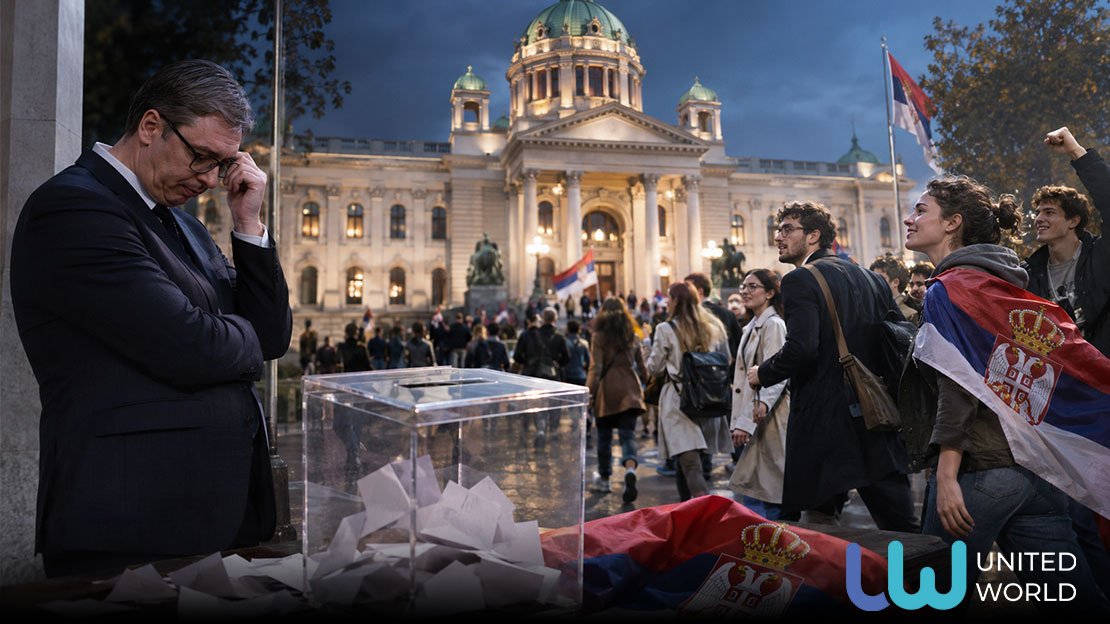
Aleksandar Vucic’s 12-year rule in Serbia has come to an end. In the national assembly elections held on October 25, the “Student List,” which emerged from the student protests that began following the Novi Sad tragedy in November 2024, won the election with 52.73 percent of the vote, while the alliance led by Vucic received 39.2 percent.
The election results leave just two electoral lists represented in Serbia’s parliament: the Student List and Vucic’s Serbian Progressive Party (SNS). Although Vucic’s party has lost power, it will remain the country’s strongest opposition force, backed by approximately 1.7 million voters.
We spoke with Dragana Trifković, Director of the Center for Geostrategic Studies and President of the Eurasian Media Forum, about how the unconventional Student List emerged, its structure, the reasons behind its electoral success, and why Vucic lost.
—
Why did Vucic lose? He was the one who called for the elections. What went wrong for him?
Regular parliamentary elections in Serbia would have had to be held no later than early 2028. However, Aleksandar Vucic opted for early elections, seeking to ensure political continuity and a transition from the position of President of the Republic to that of Prime Minister. His second presidential term was due to expire in May 2027, and the Serbian Constitution does not allow the same person to be elected President for a third term.
“Vucic misjudged the political situation”
In my opinion, Vucic misjudged the political situation. He believed that the prolonged protests had exhausted the energy of the citizens and that the mechanisms of political control, which had enabled him to remain in power for years, would secure him another electoral victory.
His rule relied on dominance in the media sphere, political engineering, party control over institutions, and clientelist mechanisms, while domestic and international observers had been pointing to electoral irregularities for years. However, the protests had far deeper consequences than the regime had anticipated. They raised questions of systemic corruption, connections between political and criminal structures, the abuse of institutions, and government accountability, while at the same time freeing citizens from the belief that political change was impossible.
Two decisive factors in the elections
Vucic’s actual support in society was considerably narrower than the election percentages suggested, because support among those who voted is not the same as support from a majority of the entire electorate.
I believe that two factors were decisive in these elections: the mass mobilization of citizens who wanted change and significantly more effective monitoring of voting and the electoral process, which narrowed the scope for manipulation.
Vucic lost because he underestimated the depth of the changes in Serbian society and overestimated the effectiveness of the mechanisms of political control on which his rule had relied for years.
How should we interpret the election results? What do you think about the Student List? How will the policies of the government formed by the Student List differ from those of the Vucic era? Or is it too early to talk about the future?
The election results confirm a high level of mobilization among citizens who wanted political change. Through the protests, the student movement gained the trust of a significant part of the public and succeeded in politically activating many citizens who had abstained from voting for years.
Fundamental reshaping of Serbia’s political landscape
At the same time, traditional opposition parties, both on the left and on the right, experienced a profound crisis of public trust. A significant part of the public no longer regarded them as an authentic alternative to the government, but rather as part of the existing political system. This created the conditions for a fundamental reshaping of Serbia’s political landscape.
Scientific and academic community’s weight in the Student List’s candidate list
I consider it particularly significant that a large proportion of the Student List’s candidates come from the scientific and academic community. According to the figures presented, as many as 160 of them hold doctoral degrees. This represents a potentially significant qualitative change compared with previous personnel policies, which were marked by scandals involving questionable diplomas, party-based employment, and the prioritization of political loyalty over professional expertise.
Corruption and accountability
Nevertheless, the fundamental difference lies not only in the educational background of the candidates, but in the very understanding of government. I expect the new government to seek to establish the principle that state institutions serve citizens rather than the interests of the ruling political structure. This implies the rule of law, the fight against corruption, the professionalization of public administration, and accountability for decision-making.
Of course, it is still too early to speak about all specific policy solutions, particularly in the fields of the economy and foreign policy. The new government will have to define clear priorities and demonstrate its ability to transform broad social support into a functional system of governance.
The most important change I expect is not merely a change of political figures, but a transition from personalized, party-controlled rule to an institutional system based on expertise, accountability, and the rule of law.
How was the Student List formed? Which social forces or political parties participated in its formation? If we are talking about a movement without a clearly defined leader, who will be the Prime Minister?
Candidates selected through student voting
The Student List was formed through a decision-making process at student plenums, which represents a form of direct democracy. As academician Radomir Saicic explained to the public, the candidates were selected through student voting, without a traditional party hierarchy or the decisive role of a single leader.
Naturally, a movement that gained such broad social support was exposed to attempts at influence by various political and institutional structures. There were interests on the part of political parties, attempts by the regime to exert influence through its own people, as well as interest from foreign political actors. However, it is important to distinguish attempts at influence from actual control over the decision-making process. There are insufficient grounds to conclude that such influences decisively determined the composition of the list.
As for the future Prime Minister, the final decision has not yet been announced. Several figures stand out in public discussions, including the head of the list, Professor Ilija Srdanović, academician Radomir Saicic, and Professor of Economics Dejan Soskic, former Governor of the National Bank of Serbia.
Challenges for the new government
I believe that the choice of Prime Minister should be considered primarily in light of the challenges facing Serbia. The new government will inherit a profound institutional crisis, problems in the functioning of public administration, and serious economic challenges. It will therefore be necessary to choose someone capable of managing a complex state system, assembling a professional team, and implementing institutional reforms.
In this context, Professor Soskic’s experience in managing the National Bank of Serbia is particularly relevant to economic stabilization and restoring confidence in institutions. Srdanović plays an important role as the head of the list, while Saičić comes from the academic community and emphasizes the need to establish the rule of law and protect state and national interests.
The decisive criteria for selecting the Prime Minister must be expertise, integrity, managerial ability, and readiness to assume responsibility for systemic changes. Serbia does not need to replace one unquestionable leader with another, but rather to build a system in which institutions function independently of the individuals who head them.
A heterogeneous social movement
It is said that the Student List has a “heterogeneous structure”. What are the most prominent political and ideological positions represented within it?
The Student List is ideologically heterogeneous, which is understandable because it emerged from a broad social movement rather than a political party with a predefined ideology. It brings together people of different political orientations, ranging from left-wing and socially oriented circles, through liberal and civic groups, to conservative, nationally oriented, and traditionalist representatives.
What unites them is not ideological unity, but agreement on the necessity of changing the existing political system, restoring institutions, establishing the rule of law, and fighting corruption. These very goals have made cooperation possible among people who, under ordinary political circumstances, would find themselves on different sides of the political spectrum.
However, differences will inevitably emerge on issues of foreign policy, relations with the European Union, Russia, and NATO, as well as Serbia’s economic development model. Among the candidates, there are supporters of European integration, but also those who attach greater importance to preserving sovereignty, military neutrality, and developing cooperation with Russia and other countries outside the Western political bloc.
Agreed on domestic reforms
For the time being, the Student List’s common platform is more clearly defined in the area of domestic reforms than in matters of international relations. However, Serbia occupies a complex geopolitical position, and the future government will have to formulate a comprehensive foreign policy strategy based on clearly defined national interests.
Kosovo and Metohija will be a particularly important issue. Preserving Serbia’s territorial integrity and respecting the Constitution constitute the starting point, but a concrete policy towards Pristina and international actors will require clear decisions and political consensus.
I do not believe that ideological diversity is in itself a weakness. It can facilitate reasoned debate and the search for more broadly acceptable solutions, but successful governance will require agreement on fundamental strategic priorities.
The essential question is not whether the Student List is ideologically heterogeneous, but whether it will succeed in transforming that diversity into a functional model of political decision-making and a long-term strategy for Serbia’s development.