


By Gökalp Erbaş
Poland’s long-running judicial dispute entered a new phase on October 30, when Constitutional Tribunal judge Anna Korwin-Piotrowska announced the one-month suspension of Tribunal President Bogdan Święczkowski and Vice President Bartłomiej Sochański, both appointed under the previous government.
The court leadership rejected the decision as unlawful and declared that it would remain in office. Meanwhile, police stormed the court building, and tensions flared between security forces and demonstrators.
President Karol Nawrocki, who was elected in 2025 with the backing of the opposition Law and Justice party (PiS), cut short his visit to Senegal and returned to Warsaw in response to the infighting between the state organs. Nawrocki denounced the events as an attempt to seize control of the Constitutional Tribunal by force. The Tusk government, however, maintains that it is seeking to reverse judicial practices introduced during PiS’s time in power from 2015 to 2023 and restore the rule of law.
Poland has been governed by a coalition led by Tusk since the 2023 parliamentary elections, while the presidency is held by Nawrocki, who enjoys the support of PiS. The competing claims to authority over key state institutions have turned disagreements within the judiciary into a much broader political confrontation.
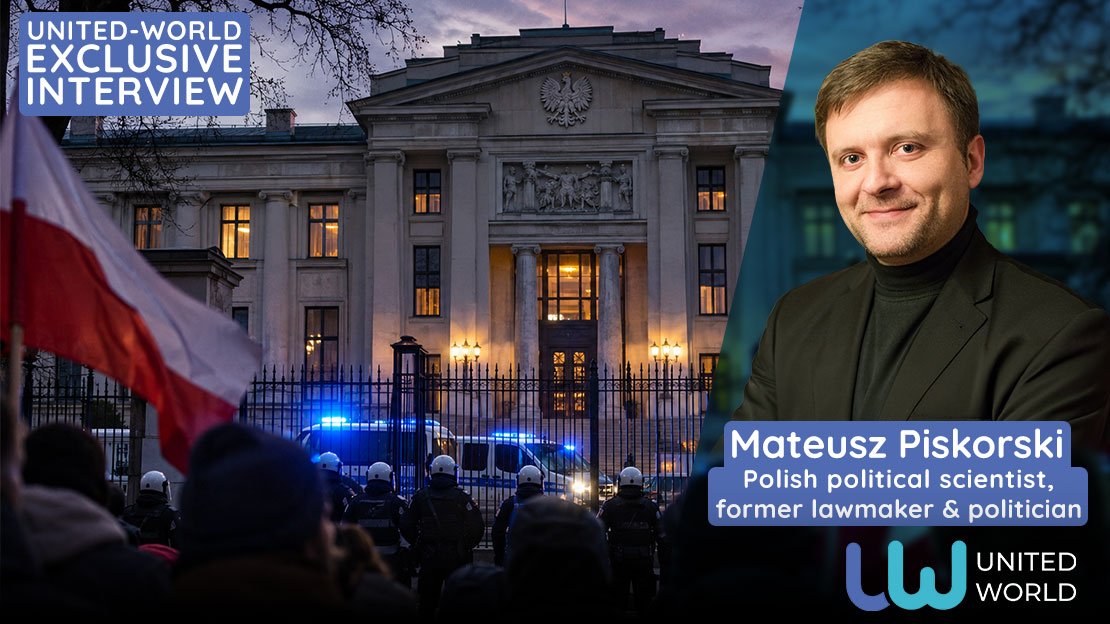
Polish political scientist, former lawmaker and politician Mateusz Piskorski shared his views on the development.
A classic power struggle
Asked whether the dispute was confined to the administration of judicial institutions or formed part of a wider struggle over Poland’s political direction, Piskorski linked the developments to the country’s ongoing electoral rivalry:
“This is a classic power struggle and part of an election campaign that is already underway in practice. Since at least 2015, the Constitutional Tribunal has been regarded by all sides of the political spectrum as an institutional instrument of power.”
According to Piskorski, the confrontation over the Constitutional Tribunal is about much more than removing its current president or appointing new judges. Poland’s main political forces have long viewed the court as a crucial institution for political power.
“Tusk represents Brussels, Nawrocki Washington”
The confrontation between Poland’s prime minister and president also has a foreign policy dimension. While Tusk’s government prioritizes close relations with the European Union, Nawrocki gives more importance to ties with Trump’s administration. How decisive foreign policy considerations in the ongoing confrontation? Piskorski replied:
“The main divide is this: Tusk represents Brussels, and Nawrocki Washington. So, this domestic power struggle may also have external connections. However, so far, only one external actor has openly taken a position: the European Union.”
Search for an external “patron”
Piskorski offered a notable assessment of President Nawrocki’s standing in Washington. He said:
“The US administration sees Nawrocki as a leader of provincial stature. His constant emphasis on his good relations with Donald Trump may be seen in Washington as overly ambitious, perhaps even irritating. This is also a clear indication of Polish politicians’ need for an external patron.”
Another question surrounding the Constitutional Tribunal dispute is whether it could affect Poland’s position within the European Union. The Tusk government’s close ties with Brussels and the approach taken by European institutions toward judicial reforms in Poland are important factors in the potential repercussions of the dispute.
Piskorski, however, does not expect the dispute to bring about any immediate change in Poland’s standing within the EU: “No, I do not expect such a change. The European Union itself is at a crossroads, and Donald Tusk is close to Ursula von der Leyen. There may be some criticism, but no direct or tangible consequences are expected.”
Rivalry between Tusk and Nawrocki
How Poland’s political dispute will ultimately play out remains uncertain. As the argument for authority over the Constitutional Tribunal continues, questions have arisen over whether the dispute between the government and the president could trigger snap elections, another government dispute or even attempts to remove the president from office.
Piskorski said he expected the political confrontation to persist but believed the parliamentary elections would go ahead as scheduled: “All options are on the table. However, I believe the elections will be held on time, in October 2027. Both main political actors will use the current confrontation in their election campaigns.
According to Piskorski, even if Poland’s Constitutional Tribunal dispute is resolved in the near future, the political rivalry between Tusk and Nawrocki will not come to an end. Both sides are expected to turn the ongoing dispute into a central element of their political campaigns in the run-up to the 2027 parliamentary elections.