


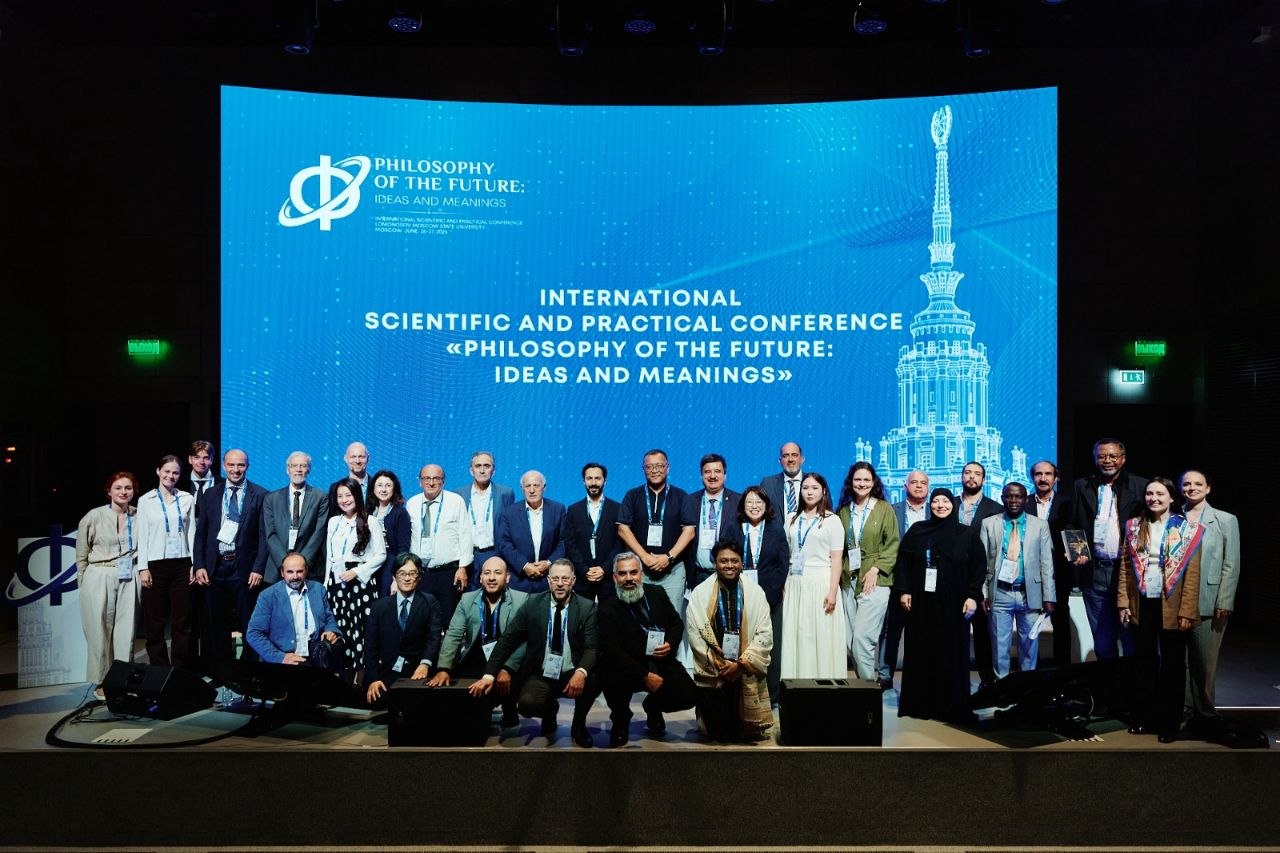
Speech presented at the international conference Philosophy of the Future: Ideas and Meanings”, hosted by Lomonosov Moscow State University in Moscow
Speech presented at the international conference Philosophy of the Future: Ideas and Meanings”, hosted by Lomonosov Moscow State University in Moscow
By Dr. Ali Alsaç
On June 26–27, 2026, I participated in the international conference “Philosophy of the Future: Ideas and Meanings”, hosted by Lomonosov Moscow State University in Moscow. The conference brought together scholars, philosophers, political scientists and researchers from many countries, including China, India, Iran, Serbia, Belarus, Türkiye, Romania, Slovenia, Cuba, Uganda and Argentina…
The opening of the conference began with a message from Russian President Vladimir Putin, who emphasized the growing importance of the humanities and philosophical reflection in an age of rapid technological, social and cultural transformation. The discussions focused on the future of humanity, the digital world, civilizational dialogue, sovereignty, technology and the foundations of a multipolar order.
Among the prominent participants were Zhang Weiwei from China, Richard Sakwa from the United Kingdom, Sanjay Kumar Pandey from India, Nick Land, Aleksandr Dugin, Aleksey Kozyrev, Andrey Shutov and Sergey Volodenkov. The conference demonstrated that the debate on the future is no longer shaped only by Western institutions, technology monopolies or Atlanticist strategic circles. Moscow, Beijing, New Delhi, Tehran, Ankara and other centers are now contributing to this debate through their own historical experiences, state traditions and civilizational perspectives.
I delivered my presentation in the session “Technologies of the Future” under the title “Artificial Intelligence, the State, and the Quest of a Virtuous Civilization.” In my speech, I examined artificial intelligence not merely as a technical innovation, but in relation to the state, production, planning, labor, property, data, technological sovereignty and the search for a virtuous civilization.
In the age of artificial intelligence, the main contradiction increasingly appears between the social rise of labor productivity through automation and the confinement of this productive power within private ownership and narrow profit mechanisms. Data, knowledge and AI infrastructures are products of collective labor, accumulated social knowledge and humanity’s common intelligence. Their use for the benefit of humanity requires national planning capacity, technological sovereignty and multipolar scientific cooperation.
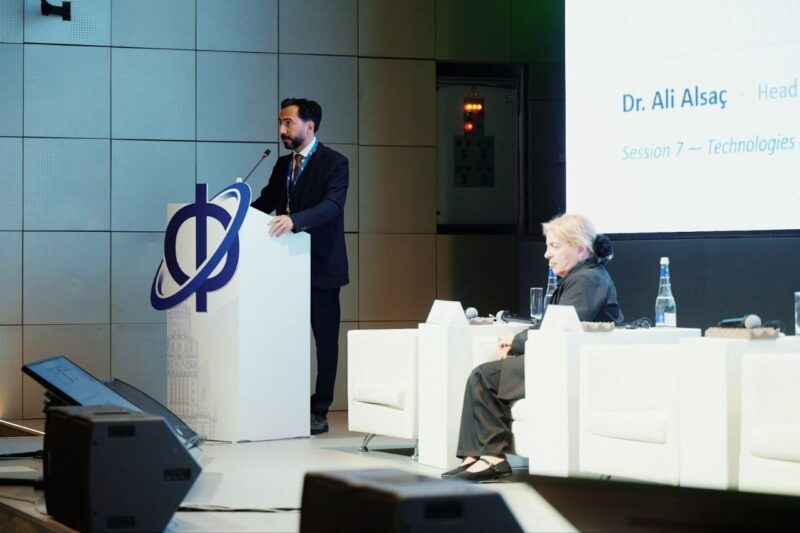
The memorandum prepared after the conference also emphasized that the future is not predetermined; that peoples have the right to build their future through their own histories and cultural traditions; that the human being cannot be reduced to technology; and that a just dialogue among civilizations is essential.
I have also written a broader analysis of the conference for Aydınlık newspaper, focusing on its atmosphere, key speakers, the role of Russia in the emerging multipolar world, and the political-philosophical significance of the final memorandum.
The following text is an expanded and revised version of the speech I delivered in Moscow.
Artificial Intelligence, the State and the Quest for a Virtuous Civilization
Moscow, June 26–27, 2026
To the optimists and the pessimists among us, welcome!
I wish I spoke Russian. Emotions resonate more powerfully in one’s native language.
I have prepared my speech within the framework of the interaction between technology and the state, and the search for a virtuous civilization.
I would like to begin by sharing my thoughts with a short passage from a poem that has been echoing in my mind:
We dig deep, always deeper.
Where is the golden heart of our age?
We are searching for the golden heart of our age.
A heavy earth lies above us.
Far from the sky… very far…
We dig deep, always deeper.
We are miners, we are revolutionaries.
We shall erupt like a volcano;
the age will not defeat us.
We are not tired.
This poem speaks to the deepest condition of our time. We are living under a heavy earth. We are far from the sky. Humanity possesses magnificent technologies, artificial intelligence, robotics, biotechnology, nuclear science, space systems and global communication networks. Yet at the same time, humanity is surrounded by war, inequality, loneliness, ecological pressure, cultural fragmentation and spiritual exhaustion.
This is why we must dig deeper. We must search for the golden heart of our age. We must ask not only what technology can do, but also what kind of human being, what kind of state, and what kind of civilization will guide it.
Human history can also be read as the history of transformative ideas and technologies. Fire changed humanity’s relationship with nature. Agriculture created settled societies. Writing gave memory to states and civilizations. The printing press accelerated the circulation of ideas. The steam engine changed production, labor and class relations. Electricity reorganized time, industry and cities. Computers transformed calculation, communication and administration.
Each of these breakthroughs did more than solve a technical problem. They reorganized society. They changed the balance between classes, states, regions and civilizations. Technology has always been more than machinery. It has always carried a social meaning. It has always been connected to power, production, culture and political organization.
Today, artificial intelligence stands in this historical line. But artificial intelligence has a distinctive character. It does not only transform physical production. It transforms knowledge, decision-making, prediction and social coordination. It enters the fields of education, health, security, public administration, finance, industry, science and even culture. Therefore, artificial intelligence is not merely a technical innovation. It is a civilizational question.
Technology has never developed in an empty space. It has always developed inside historical struggle. States have competed for resources, security, production capacity and strategic advantage. War has often accelerated technological change. Competition has forced societies to innovate. Crises have revealed the weaknesses of old institutions and opened the way for new forms of organization.
Different civilizations have produced different responses to the same technological pressures. The West followed one path through capitalism, colonial expansion and industrial power. The East preserved and developed other traditions of statecraft, social organization and civilizational continuity. Today, we are again at such a turning point. Old systems are losing their ability to answer the great problems of humanity. New ideas, new alliances and new institutions are appearing on the historical stage.
We are now entering a new revolutionary situation.
Artificial intelligence models can reason, generate, classify, predict, design and support complex decisions. Robotics and automation are replacing routine labor in factories, logistics, agriculture and services. Biotechnology and neurointerfaces are beginning to transform the human body and the boundaries of human capability. Digital systems increasingly shape administration, education, health, finance and security.
This means that automation is no longer limited to muscle power. It increasingly affects perception, memory, decision-making and the organization of knowledge itself. This opens a great possibility. Humanity may reduce compulsory labor and expand creativity. Production may become more efficient. Planning may become more intelligent. Science may become more accessible. Education may become more personalized. Health systems may become more preventive and humane.
But the same technologies also create a great danger. They may be used to deepen dependency, inequality and control. They may create societies in which human beings are reduced to data points, consumers, users and predictable behavioral patterns. They may serve a system where a small number of corporations and hegemonic centers control knowledge, infrastructure, platforms and standards.
This brings us to the central contradiction of our age.
Artificial intelligence is a tool. It is not destiny. It does not have an ethical direction by itself. Its direction will be determined by power, ownership, political purpose and civilizational vision.
Therefore, the real question is this: will artificial intelligence become an instrument of neoliberal algorithmic control, or will it serve a multipolar world of human-centered cooperation?
In one path, artificial intelligence becomes a mechanism of centralization, surveillance, dependency and social fragmentation. In another path, it can support cooperation, sovereignty, shared development and the circulation of humanity’s accumulated knowledge.
I believe humanity must defend the second path. Knowledge must not be monopolized by a narrow hegemonic center. It must flow through a multipolar world. New generations educated in such an environment can bring us closer to a new human-centered civilization.
At this point, the problem of the state becomes decisive.
The oldest problem of humanity is the problem of resource allocation. Every civilization must answer the same question: how will food, labor, energy, information, security and production be organized? A social system proves its historical capacity by the answer it gives to this problem.
In the twentieth century, this problem became even more complex. Industrial production, military planning, urbanization, logistics and national economies required enormous amounts of information. This is why the ideas of Russian and Soviet scientists such as Anatoly Kitov and Viktor Glushkov remain important. They imagined computer-based systems for economic management and planning. Their work showed that information technologies could be used not only for calculation, but also for social coordination and resource planning.
Today, artificial intelligence gives this old question a new scale. It allows us to think again about planning, coordination, public welfare and strategic development. But this cannot be left to private monopolies. The technological future cannot be governed by markets alone.
The market may produce innovation, but it does not automatically produce justice, sovereignty, long-term planning or human dignity. Markets calculate profit. States carry historical responsibility. Markets follow short-term signals. States can organize long-term development. Markets fragment society into consumers and competitors. States can unite society around common goals.
This is why national states remain central actors in the technological future. They can organize strategic planning, protect public welfare, build infrastructure, regulate technology and defend sovereignty.
Technological sovereignty is especially important. Without control over data, infrastructure, standards, platforms and scientific capacity, political sovereignty remains incomplete. A country that cannot control its technological infrastructure cannot fully control its future.
But sovereignty should not mean isolation. Sovereign states can cooperate. A multipolar order can allow different civilizations and nations to contribute to the common development of humanity. This is one of the most important lessons of our time. The future must not be built by a single center. It must be built by many centers, many civilizations and many peoples.
The question, then, is not simply how powerful artificial intelligence will become. The real question is: what kind of civilization will use this power?
Artificial intelligence and robotics should reduce compulsory labor. They should not create a new class of unnecessary or excluded human beings. Planning should expand abundance, peace, education and productive creativity. Science must serve human dignity. Technology must not dominate the human being. It must help the human being develop his or her full capacities.
A virtuous civilization is not a technical output. It is a political and ethical task. It requires institutions, education, planning, public responsibility and a struggle against systems that reduce humanity to profit, consumption and control.
Humanity today stands between two horizons. One horizon is technological domination without moral direction. The other horizon is technological development guided by human dignity, social justice, peace and cooperation.
We must choose the second horizon.
Technology must serve humanity. Scientific planning can help solve the resource allocation problem. Human-centered states can guide this transformation. But a virtuous world requires conscious struggle.
Artificial intelligence can combine humanity’s accumulated knowledge, scientific laws and the human capacity to transform nature. Used correctly, it can help build a world of abundance, productivity and peace.
But this future will not come spontaneously. It must be built by people, by national states, by scientific cooperation and by a human-centered political orientation.
A virtuous society is the duty of national states. A virtuous world is the duty of humanity.
Before closing, I would like to express my sincere gratitude to the Russian state, the Russian people and Lomonosov Moscow State University for hosting us and for supporting the sharing of our ideas.
I also extend my respect to all distinguished participants, to their countries and to their peoples.
I believe that conferences like this are valuable not only because they allow us to discuss the future, but also because they help us build intellectual bridges between nations and civilizations.
We are searching for the golden heart of our age. We are digging deep, always deeper. The age will not defeat us.
Thank you very much.