


By Adem Kılıç, Political Scientist
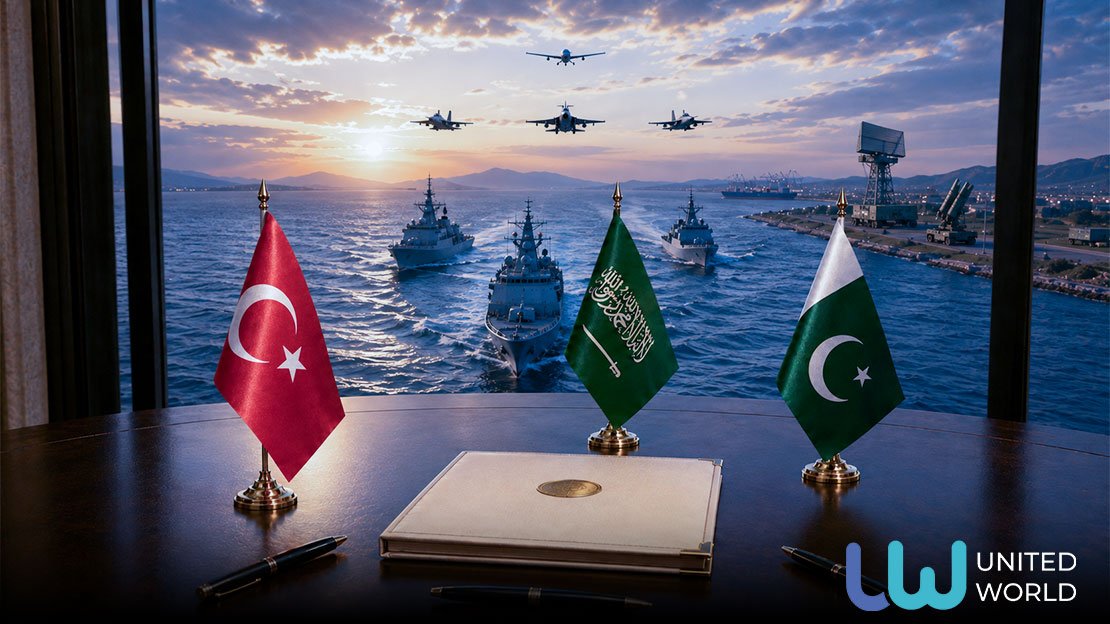
The joint defense agreement signed recently in Mecca by Türkiye, Saudi Arabia, and Pakistan should be regarded as an agreement that will have major implications not only for the region but also for the emerging new world order.
Although global media and various actors have focused particularly on the provision that “an armed attack against one of the parties will be considered an attack against all three countries,” I believe the agreement represents a much greater form of deterrence than this provision alone suggests.
The broader framework of the agreement points to the emergence of a new “power center” within the reshaping global order that is not under the patronage of the United States, China, or Russia.
Because what is coming together here is not merely the military capabilities of three countries, but also a set of strategic strengths that complement one another.
Türkiye’s strong military and defense industry, which is now approaching full strategic independence; Pakistan’s industrial capacity and nuclear deterrence; and Saudi Arabia’s economic power and strategic position in the Gulf are all being brought into the same equation.
When the spheres of influence and alliance relationships of these three countries are also taken into account, it becomes clear that it would be insufficient to view the Mecca Agreement simply as a defense cooperation pact between three countries.
Indeed, it is already known that there are a number of countries that could potentially join this emerging partnership.
Why is Türkiye’s role critical?
Türkiye’s role here deserves particular attention. Türkiye is not participating in this structure solely because of its military capabilities.
Türkiye is also a NATO member, part of the European security architecture, home to one of the region’s strongest militaries, and a power that has made remarkable progress in developing its own defense technologies in recent years.
There is no other regional actor that possesses all of these characteristics simultaneously.
In fact, the performance Türkiye has demonstrated in these areas is one of the factors behind the agreement signed in Mecca and its potential to serve as a model for others.
Regional countries realized they cannot rely on the United States!
The developments throughout the Iran war have created an important realization among regional countries: they can no longer entrust their security entirely to the United States.
Until recently, countries that believed they could guarantee their own security by signing major defense agreements with the United States and agreements such as the Abraham Accords, which expanded Israel’s room for maneuver, have now seen clearly that they cannot necessarily count on Washington for protection when Israel’s security is at stake.
According to OSINT data, during the approximately five months since the war began on February 28, more than 180 U.S. transport aircraft carrying munitions landed in Israel. Yet, according to a Reuters report, not a single U.S. transport aircraft landed in Saudi Arabia, despite the country reportedly using 86 percent of its Patriot air-defense missiles during this period.
During the same period, no additional defense transfers were made to countries that came under attack, including Qatar, or even to countries such as the United Arab Emirates and Jordan, both of which had signed the Abraham Accords.
At the same time, regional countries also witnessed that even the Sharm El-Sheikh agreement on Gaza, which Trump described as “the biggest agreement in 100 years,” was not implemented by Israel.
In other words, regional countries have realized that they can no longer rely on the United States not only militarily but also diplomatically.
The conflicts involving the United States, Israel, and Iran; attacks in the Red Sea; the inability to resolve tensions in the Strait of Hormuz; and threats against energy infrastructure in the Gulf have demonstrated one very clear reality to regional countries:
The priorities of the United States in the region are not the same as the security priorities of regional countries.
For this reason, Gulf countries, particularly Saudi Arabia, have been seeking to diversify their security relationships for some time. Türkiye’s example has encouraged other countries both to pursue additional forms of diversification and to deepen cooperation with Türkiye.
This is precisely why the Mecca Agreement, emerging after all these developments, carries far greater significance than it may initially appear to.
What happens if the power of the three countries is combined?
Even when Türkiye, Saudi Arabia, and Pakistan are assessed independently, we are talking about three significant powers. But the real issue is that their capabilities complement one another.
Türkiye’s greatest advantage lies in its defense industry ecosystem, which has become almost fully independent; its powerful military; and its increasingly autonomous foreign and strategic policy, which is based primarily on Türkiye’s own national interests and has enabled Ankara to establish its position with Russia, the United States, and China.
Türkiye is no longer simply a country that produces a handful of successful platforms. It has become a country capable of developing its own solutions across a very broad spectrum, ranging from unmanned aerial vehicles and electronic warfare systems to radar technologies, missiles, air-defense systems, and naval platforms.
Moreover, Türkiye’s advantage is not limited to producing defense products. It also possesses military experience that enables it to employ different systems within the same operational environment during wartime.
Pakistan’s most important strength emerges from a different dimension.
Pakistan has a powerful military and significant experience in high-intensity warfare. Decades of strategic competition with India have shaped Pakistan’s military planning and deterrence doctrine. When its nuclear capability is added to this equation, Pakistan brings a strategic dimension to this trilateral structure that few, if any, other countries could provide.
Saudi Arabia’s advantage, meanwhile, lies primarily in its economic capacity.
Saudi Arabia’s defense spending, investment power, and ability to finance large-scale technology projects create significant potential when combined with the military and technological capabilities of Türkiye and Pakistan.
When these three elements are genuinely brought together within the same strategic framework, they have the potential to create a new power center.
Why will Türkiye become the central country here?
In my view, this is precisely where the most important aspect of the agreement for Türkiye emerges.
Türkiye can naturally assume the role of a technology provider within this trilateral structure. But in my view, Türkiye’s objective should not simply be to sell more defense products.
Considering Türkiye’s projects in air defense, unmanned systems, electronic warfare, radar technologies, missiles and munitions, naval platforms, and next-generation fighter aircraft, Ankara has a very broad potential sphere of influence ahead of it.
When Saudi Arabia’s financial strength enters this equation, the establishment of joint production facilities and the creation of a new portfolio involving Pakistan and Saudi Arabia’s allies could unlock enormous potential.
At the same time, Pakistan’s engineering capabilities, production capacity proportional to its population, and military experience can also be incorporated into these projects.
This would create not merely a relationship in which Türkiye sells products to Saudi Arabia or Pakistan, but a much larger ecosystem and strategic power bloc.
Today, Türkiye already has a substantial defense industry relationship with Saudi Arabia. It has also maintained long-standing cooperation with Pakistan in naval platforms, aircraft, and various military projects.
Therefore, Türkiye already has a solid foundation in place, and this agreement opens the way for that foundation to evolve into a structure with much greater strategic impact.
The next stage should involve accelerating the establishment of joint R&D centers, the creation of joint production facilities, and the joint development of defense projects designed to meet the needs of all three countries.
For example, establishing a common air-defense architecture, developing joint projects in unmanned aerial and naval systems, creating joint centers for electronic warfare and cybersecurity, and increasing ammunition production capacity would significantly strengthen the military dimension of the agreement.
Türkiye’s experience, particularly in air defense and unmanned systems, is of enormous importance.
One of the most important lessons emerging from the wars in the Middle East is that expensive platforms alone are no longer sufficient in modern warfare.
Low-cost and mass-produced unmanned systems, electronic warfare, air defense, precision munitions, and network-centric warfare capabilities are becoming increasingly important.
Türkiye is building a strong ecosystem precisely in these areas.
Therefore, the Mecca Agreement does not merely represent new markets for Türkiye’s defense industry. It represents the emergence of a new geography for joint defense production.
Conclusion
The Mecca Agreement should certainly not be viewed as an alternative to NATO. All of the realities outlined above demonstrate that the issue is far more complex than that.
The real significance lies in the fact that Türkiye, Saudi Arabia, and Pakistan — three of the region’s most powerful actors — have, for the first time, taken a step toward creating a power center independent of the United States, Russia, and China and focused primarily on their own strategic interests.
In short, what is emerging is not merely a regional power center, but one with global implications.
Moreover, the most important characteristic of this emerging power center is that it is not based solely on military capabilities. Defense industry, energy security, maritime routes, intelligence, technology, finance, and diplomatic power are all being brought together within the same strategic equation.
For this reason, interpreting the signatures placed in Mecca merely as a “Türkiye-Saudi Arabia-Pakistan defense agreement” means missing the bigger picture.