

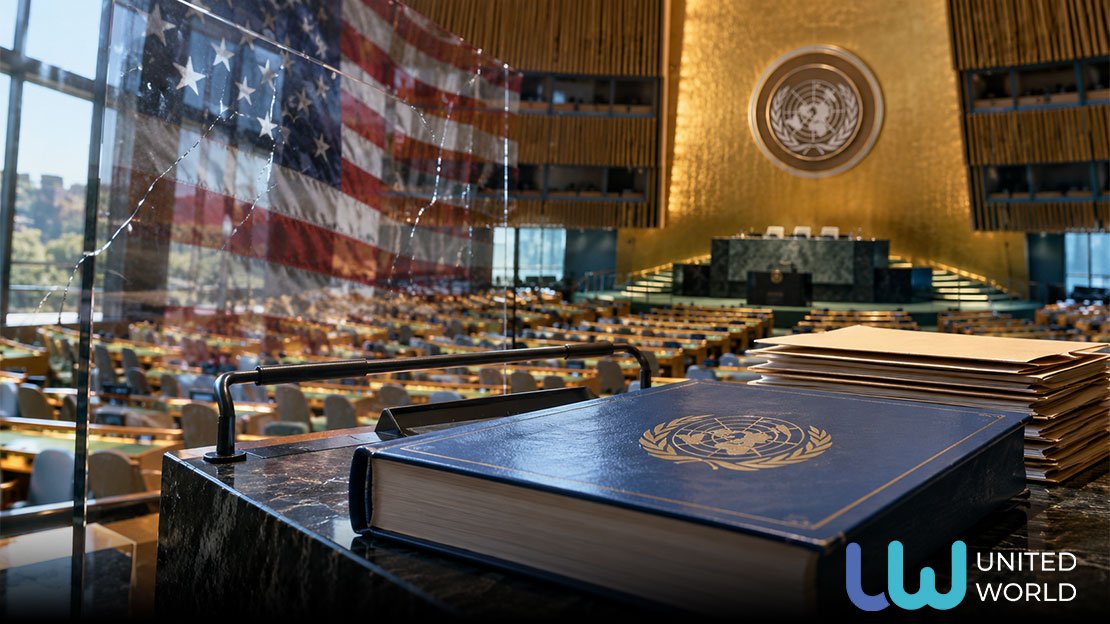
The 81st session of the UN General Assembly convened in New York on September 22.
The debates and the speeches delivered by world leaders were marked by a common theme: the United Nations is not functioning properly, has become increasingly ineffective, and is in need of reform.
These assessments now appear to have become something close to a consensus. Leaders from Latin America to East Asia, from Europe to West Asia, broadly agree on this point.
But what does it actually mean to say that the UN is not functioning properly, has become ineffective, and needs reform? What lies behind this problem? Did it simply emerge on its own over time?
When we look at the developments and actions of roughly the past two decades that have violated the principles and legal framework of the United Nations and gradually rendered them ineffective, much of the answer begins to emerge on its own.
US actions in this period include military attacks, threats, economic sanctions, and state decisions contrary to international law.
—————————————————————————————————————————————–
1- US military presence and operations in Syria – since 2014
The US began military operations in Syria without the Syrian government’s consent or a specific UN Security Council authorization. Syria has consistently rejected the US presence as a violation of its sovereignty.
2- US missile strike on Syria — 2017
In April 2017, the US fired 59 Tomahawk missiles at Syria’s Shayrat airbase. The operation had no Security Council authorization, and Washington did not base it on the conventional right of self-defense.
3- US, British and French strikes on Syria — 2018
The three countries attacked Syrian government facilities in April 2018 without Security Council authorization. The then UN Secretary-General responded by stressing that states were required to act consistently with the UN Charter and international law. No international court has ruled on the legality of the strikes.
4- Sanctions against Iran — from 2018
After withdrawing from the Iran nuclear agreement, the US reimposed extensive sanctions on Iran, including measures affecting third-country companies. In 2018, the International Court of Justice issued a binding order requiring Washington to remove sanctions-related impediments affecting medicines, food, agricultural products and civil-aviation safety.
5- Seizure of Iranian assets
In 2023, the International Court of Justice found that several US measures targeting Iranian companies and their property violated US obligations under the 1955 Treaty of Amity. The judgment is final and binding.
6- Killing of Qassem Soleimani in Iraq — 2022
A US drone strike killed Iranian General Qassem Soleimani in Baghdad in January 2020. The UN Special Rapporteur on extrajudicial killings concluded that the strike violated Article 2(4) of the UN Charter and constituted an arbitrary killing, finding insufficient evidence of an imminent attack that would justify self-defense.
7- US strikes in Iraq and Syria — 2024
The US carried out dozens of strikes against Iran-linked groups in Iraq and Syria, invoking Article 51 and self-defense. Iraq and Syria condemned the operations as violations of their sovereignty and territorial integrity.
8- US-British strikes on Yemen — from 2024
The US and Britain launched repeated strikes against Houthi-controlled Yemen following attacks on Red Sea shipping. Security Council Resolution 2722 demanded an end to Houthi attacks but did not expressly authorize US-British military strikes.
9- Sanctions on Venezuela
The US imposed extensive financial, oil and other sectoral sanctions on Venezuela, together with secondary sanctions affecting foreign companies. A UN Special Rapporteur concluded that applying extraterritorial sanctions to third-country companies dealing with Venezuela was not justified under international law and raised issues concerning sovereign equality and non-intervention.
10- Sanctions on Syria
US sanctions on Syria, particularly under the Caesar Act, also extend to foreign companies and individuals. A UN Special Rapporteur called for the removal of unilateral sanctions imposed without Security Council authorization where they could not be justified as lawful countermeasures, citing the principles of sovereignty, non-intervention and international law.
11- Embargo and sanctions on Cuba
The US has continued its decades-long economic, commercial and financial embargo against Cuba, including measures with extraterritorial effects. The UN General Assembly has repeatedly demanded its termination. In 2024, 187 countries voted in favor of ending the embargo, with only the United States and Israel voting against. General Assembly resolutions, however, are not equivalent to binding ICJ judgments.
12- Recognition of Jerusalem as Israel’s capital — 2017–2018
The US recognized Jerusalem as Israel’s capital and relocated its embassy there. The move conflicted with the established UN position on Jerusalem. In December 2017, the General Assembly voted 128–9 for a resolution calling on states not to establish diplomatic missions in Jerusalem and declaring unilateral changes to the city’s status null and void.
13- Recognition of Israeli sovereignty over the Golan Heights — 2019
Washington recognized Israeli sovereignty over the occupied Golan Heights in 2019. This contradicted Security Council Resolution 497, which had unanimously declared Israel’s imposition of its laws and administration over the territory “null and void and without international legal effect” and reaffirmed the inadmissibility of acquiring territory by force.
14- Sanctions on the International Criminal Court — 2025–2026
Washington imposed sanctions on ICC Prosecutor Karim Khan and subsequently on several ICC judges and prosecutors. UN experts stated that sanctioning judges and prosecutors merely for performing their lawful duties constituted a breach of fundamental rights and their privileges and immunities under international law and could interfere with the administration of international justice.
15- Continued US arms transfers to Israel – after October 2023
UN experts stated in February 2024 that arms transfers to Israel where there is a clear risk that the weapons will be used to violate international humanitarian law must cease, specifically identifying the US as one of Israel’s principal suppliers. In June they warned that continued transfers could create a risk of state complicity in serious international crimes. Separately, the ICJ’s July 2024 advisory opinion held that all states have an obligation not to render aid or assistance in maintaining Israel’s unlawful presence in the occupied Palestinian territory.
16- Threats concerning the Panama Canal — 2025
US President Donald Trump repeatedly stated that the US would “take back” the Panama Canal and refused to rule out the use of military force to obtain control of it. Panama formally protested at the United Nations, invoking the UN Charter’s prohibition on the threat or use of force against another state’s territorial integrity or political independence.
17- Threats concerning Greenland — 2025–2026
President Donald Trump repeatedly called for US control of Greenland and refused to rule out military or economic measures to acquire the autonomous Danish territory. In January 2026, he also threatened additional tariffs on several European countries until an agreement was reached allowing the United States to purchase Greenland.
Denmark and Greenland rejected the demands, while several European governments invoked the UN Charter principles of sovereignty, territorial integrity and the inviolability of borders. The possibility of using military force to acquire territory raised a serious issue under Article 2(4) of the UN Charter, which prohibits both the threat and the use of force against another state’s territorial integrity or political independence.
18- The abduction of Nicolas Maduro — 2026
On January 3, 2026, US forces carried out military strikes inside Venezuela and a special-forces operation that captured Nicolas Maduro and his wife, Cilia Flores, and transferred them to the US for prosecution. The operation was conducted without Venezuelan consent or UN Security Council authorization.
UN Secretary-General António Guterres said he was deeply concerned that international law had not been respected, pointing to the UN Charter’s prohibition on the use of force against another state’s territorial integrity or political independence.
In March 2026, the UN Independent International Fact-Finding Mission on Venezuela stated more explicitly that the US military operation violated international law, adding that allegations of crimes against humanity against Maduro did not justify an illegal military intervention.
19- Killing of Iran’s Supreme Leader Ali Khamenei — 2026
On February 28, 2026, Iranian Supreme Leader Ali Khamenei was killed in Tehran during the opening US-Israeli attack on Iran. US intelligence helped locate Khamenei and the US and Israel coordinated the timing of the operation.
UN Secretary-General António Guterres condemned the massive U.S. and Israeli strikes on Iran and recalled Article 2(4) of the UN Charter, which prohibits the threat or use of force against another state’s territorial integrity or political independence. The legality of specifically targeting Khamenei also raises separate questions under international humanitarian law. No international court has yet issued a ruling specifically determining the legality of his killing.