


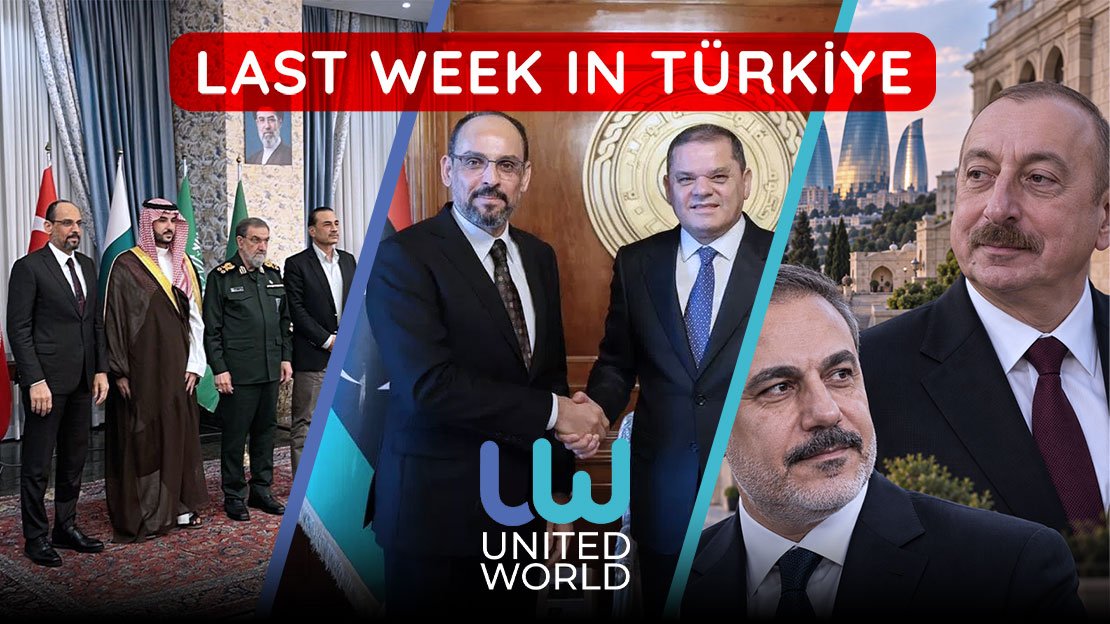
Last week, members of the Mecca Alliance, Türkiye, Pakistan and Saudi Arabia, paid a critical visit to Tehran.
Another important news of the week was the Libyan Parliament’s approval of the maritime boundaries agreement signed between Türkiye and Libya.
Steps toward resolving tensions between Ankara and Baku were another important development of the week.
Mecca Alliance talks in Tehran
Senior officials from Türkiye, Saudi Arabia and Pakistan paid a significant visit to Tehran.
İbrahim Kalın, head of Türkiye’s National Intelligence Organization (MİT), Saudi Defense Minister Khalid bin Salman and Pakistan’s Chief of Army Staff Asim Munir met with Mohsen Rezaei, Secretary of Iran’s Supreme National Security Council.
The delegations also held talks with Iranian President Masoud Pezeshkian and Foreign Minister Abbas Araghchi.
The visit marked the first joint official contact between Iran and the members of the Mecca Alliance following the signing of the “Mecca Mutual Defense Agreement” between Türkiye, Saudi Arabia and Pakistan.
The talks focused on regional tensions, particularly Israel’s ongoing occupation and genocide in Gaza.
The meeting took place at a time when the possibility of another US-Israeli attack on Iran was growing, fighting between Yemen and Saudi Arabia was intensifying, and Israel was holding elections.
The Saudi Foreign Ministry described the purpose of the talks as “reducing tensions between the parties involved in the region’s ongoing crises and promoting dialogue and diplomatic solutions.”
According to media reports, the discussions covered the situations in Palestine and Lebanon, Israeli aggression, and developments concerning the Strait of Hormuz and the Bab el-Mandeb Strait.
The principle of “regional ownership” featured prominently in the talks. Participants discussed opposing interference by powers outside the region and establishing a sustainable regional security framework based on cooperation and collective deterrence.
Statements issued after the meeting indicated that the parties had reached a common understanding that regional security should be maintained by the countries of the region themselves.
Commenting on the meeting, Iranian President Pezeshkian said: “I hope that the presence of representatives from important and influential Islamic countries at this meeting will contribute to further strengthening regional unity and solidarity.”
Following the talks, the four countries issued a joint statement. The statement read:
“The participants agreed to continue discussions aimed at strengthening cooperation among the four regional countries, including in the areas of regional peace and security.”
Libya approves maritime agreement with Türkiye
Libya’s eastern-based House of Representatives has approved the maritime boundaries agreement signed in 2019 between Türkiye and Libya’s Government of National Accord.
The agreement was approved unanimously.
The parliament also unanimously overturned its 2020 decisions rejecting the agreement and calling for the severing of political relations with Türkiye.
The approval brought an end to seven years of legal and political disputes, strengthening the legal and strategic basis of Türkiye’s western maritime boundary in the Eastern Mediterranean.
The memorandum of understanding was signed on November 27, 2019, by Turkish President Recep Tayyip Erdoğan and then-Libyan Prime Minister Fayez al-Sarraj. It entered into force on December 7, 2019. The Turkish Grand National Assembly approved the agreement on December 5, 2019. Türkiye subsequently notified the United Nations on March 18, 2020, and the agreement was registered with the UN on September 30, 2022.
However, political forces in eastern Libya had strongly opposed the agreement at the time. On January 8, 2020, the House of Representatives voted to reject the agreement and sever relations with Ankara.
The situation later changed as a national reconciliation process, supported in part by Türkiye’s diplomatic initiatives, brought the rival Libyan parties together. The House of Representatives, previously known for its opposition to Türkiye, ultimately reversed its position and approved the maritime agreement.
Türkiye’s Foreign Ministry welcomed the decision, stating that the agreement “safeguards the mutual rights and interests of both countries on the basis of international law and the principles of equity.”
Foreign Minister Hakan Fidan commented on the decision, saying “This is an entirely legitimate agreement, both legally and politically. There is no need for debate.” Fidan’s remark is a response to the statements of Greece and the European Union.
The agreement establishes a maritime boundary between the Turkish coastline stretching from Marmaris through Fethiye to Kaş and the Libyan coastline extending from Derna through Tobruk to Bardia.
Under the agreement, Türkiye and Libya will have jurisdiction over various activities in this maritime area, ranging from fishing to oil and natural gas exploration.
Türkiye will also be able to issue licenses for oil and gas exploration and drilling activities in the area.
The agreement’s approval drew criticism from the European Union and Greece.
The Greek Foreign Ministry announced that Athens rejected the decision, arguing that the agreement “contradicts international maritime law and violates the sovereign rights of countries in the region.”
Athens also called on Libya to “refrain from taking steps that could negatively affect stability in the Eastern Mediterranean.”
European Commission President Ursula von der Leyen expressed “regret” over the decision. She said that the EU’s position had remained unchanged since 2019 and claimed that the agreement is “invalid.”
Ankara–Baku tensions ease
Tensions between Türkiye and Azerbaijan, escalated after some officials of Ankara’s reaction to Baku’s ban on headscarves in public schools, are gradually easing.
The dispute began in September 2026, when Azerbaijan introduced regulations effectively banning the wearing of headscarves in primary and secondary schools. The move drew strong criticism from circles within Türkiye’s ruling Justice and Development Party (AK Party) and the affiliated media, which described Baku’s decision as “an infringement on religious freedom in a Muslim society.”
Azerbaijani President Ilham Aliyev responded indirectly to that during a speech at his party’s congress on October 2. Without naming Türkiye, Aliyev said: “Everyone should know their place, stay out of our affairs and stop interfering in our way of life.”
Aliyev had also emphasized that Azerbaijan had achieved its victory in Karabakh on its own and had paid for the weapons it purchased.
Tensions between Ankara and Baku escalated further when Azerbaijan imposed entry bans on dozens of Turkish citizens, including media professionals close to the AK Party government.
The dispute peaked following Foreign Minister Hakan Fidan’s visit to Baku on October 15. A news website known for its close ties to the Azerbaijani government published allegations that Fidan had held a “secret meeting” with a Turkish-funded foundation during his visit and had “given instructions” concerning political developments in Azerbaijan. The report also accused Türkiye of preparing a “coup and chaos plan” in Azerbaijan, conducting “intelligence operations” and training “agents of influence.”
The Turkish Embassy in Baku rejected the allegations in a written statement issued on October 17.
The embassy explained that Fidan had posed for courtesy photographs with numerous people during his visit, including members of an organization legally operating in Azerbaijan. It described the reports as “a disinformation attempt aimed at damaging Türkiye–Azerbaijan relations.”
Following the reaction from the Turkish side, the news website removed the article. It was later republished, but the sections targeting Fidan had been deleted.
Despite all this, Fidan met with President Aliyev in Baku on October 15. Speaking after the meeting, Fidan emphasized that the strategic bond between the two countries was stronger than any disagreement, saying “We are an ancient nation. We sit down and discuss our own problems in a civilized manner, befitting our long history and character.”
Fidan also stressed that there was no need to turn differences of opinion into propaganda material on social media.
The tensions now appear to have eased following a phone call between Erdoğan and Aliyev and the dismissal of Presidential Chief Adviser Oktay Saral, who had used harsh language toward Azerbaijan.