


By Fernando Esteche
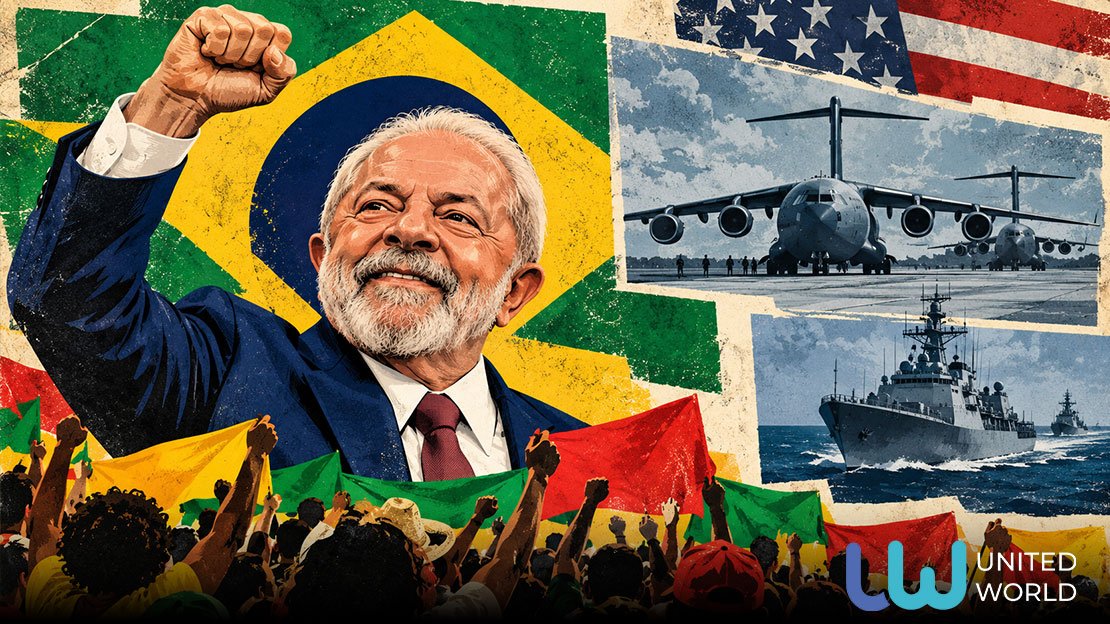
Lula won the runoff election, and the US redeployment in Brazil continues. For eighteen months, right-wing parties aligned with Donald Trump secured seven consecutive presidential victories in Latin America, and Brazil did not join the streak, which is far from enough to suggest a halt to the imperial redeployment in the region. Lula da Silva obtained 64,256,232 votes, 51.79 percent of the valid votes, compared to Flávio Bolsonaro’s 59,826,041, and is the first candidate in Brazilian history to win a second round after coming in second in the first. Three weeks earlier, the son of the imprisoned former president held a 2.2 million vote lead. He ended up 4.4 million votes behind, and two days later he landed in Fort Lauderdale with his wife and daughters, his passport canceled, and two investigations opened against him in the Supreme Court.
When we analyzed the first round of voting at UWI, we wrote that the right wing had won almost everything that mattered below the presidential ticket, and that the pieces of its redeployment were already in place, waiting for a Brazilian state willing to stop resisting them. The runoff election denied this operation the executive branch, which was the most visible piece. The others remained where they were. Tarcísio de Freitas continues to lead São Paulo, Sergio Moro will govern Paraná, Lieutenant Colonel Luciano Zucco will govern Rio Grande do Sul, and Deltan Dallagnol will have a seat in the Senate, so the lawfare cast returns to power, this time through the ballot box. From 2027, the right wing will hold 49 of the 81 senators, an absolute majority to block or impose appointments to the Supreme Court and the Central Bank, and a three-fifths majority to amend the Constitution, just five votes short of the two-thirds needed to impeach a president or a Supreme Court justice. Lula will take office on January 5 with the Senate against him, a situation that Brazil has not experienced since the institutional normalization.
Interpreting the result as the restoration of a progressive cycle is a diagnostic error. The country that re-elected Lula had voted three weeks earlier for the most right-leaning Congress in four decades, and the pressure from Washington, which was left without its own president in Brasília, is shifting toward Parliament, the courts, mining negotiations, dialogue with governors, and, as of this week, also toward Florida.
The votes that moved
Between October 4 and 25, Lula garnered 10,376,694 votes, while Flávio received only 3,721,538. The right-wing candidates eliminated in the first round—Ronaldo Caiado, Augusto Cury, and Romeu Zema—had amassed 6.4 million votes and urged voters to support Flávio, who retained 58 percent of that support. The anti-Lula strategic vote had dried up by October 4. What followed was largely a rejection of the candidate.
That rejection materialized into concrete evidence. On October 18, it was revealed that the Federal Police had submitted a new money laundering investigation to the Supreme Court against Flávio and his friend, lawyer Willer Tomaz, with whom he had taken five international trips in five months, in a scheme involving betting houses and payment companies. Alexandre de Moraes ordered the freezing of up to 6 billion reais linked to Tomaz. Simultaneously, the case concerning the financing of Dark Horse, the film about Jair Bolsonaro, was progressing. Flávio allegedly requested at least 134 million reais from banker Daniel Vorcaro of the bankrupt Banco Master, for the film, of which he received approximately half. Then came editorials in the major São Paulo newspapers and on Globo about his ties to Rio de Janeiro militias. The liberal faction of the bourgeoisie had taken Flávio’s victory for granted and ultimately concluded that a president facing prosecution was too costly. In a second round, two people are compared, and the candidate who promised order appeared to a large part of the electorate as an heir with criminal cases.
The other shift was in voter turnout. Abstention, which we thought would remain unchanged because it was seen as a sign of disengagement , fell from 21.08 to 19.22 percent, and almost 3 million Brazilians who hadn’t voted on October 4th cast their ballots on the 25th. Another 1.8 million who had submitted blank or invalid ballots chose a candidate. Lula gained ground in all 26 states and the Federal District. The Northeast, which had given him around 64 percent in the first round, gave him 69.4 percent, with Piauí exceeding 75 percent, and Minas Gerais was the only state that changed hands. São Paulo contributed 2.6 million new votes, a quarter of what he gained between the rounds. And the greatest relative growth occurred where it was least expected: in municipalities with a stronger evangelical presence, a whiter population, and higher incomes and levels of education, which form the heart of Flávio’s electorate.
There was also tangible policy, belated but concrete. The 15 percent increase in Bolsa Família (Family Welfare Fund), a debt renegotiation program, the temporary ban on online gambling in a country where betting had become a machine for popular indebtedness, and the promise of free public transportation on weekends all carried weight. Above all, the constitutional reform approved on October 14th, which ended the six-day workweek followed by one day of rest, carried weight. This reform became a rallying cry in the streets, ultimately forcing Flávio to change his position. Almost half of Lula’s voters cited social protection and the defense of their class as their reason for voting, far exceeding the 17 percent who said they voted primarily against Flávio. It was a class-based vote that the government had failed to cultivate in three years.
Lula won, strictly speaking, despite his economic policies. His first-round defeat can be explained by a real interest rate close to 10 percent, more than 80 percent of families in debt, and almost a third of household income allocated to loan payments and interest. Fiscal management was prudent, and the deficit stems from an interest burden that the government never altered. Financialization eroded the social base of Lula’s movement over three years, and the measures intended to compensate for this were implemented only when defeat was already inevitable.
“De-citizenization” in our analysis of the first round is resolved. Nearly three million people voted again, but 30.5 million remained absent, more than 19 percent of the electorate in a country with mandatory voting. The core of that group—young people with informal jobs and debt who had never been involved with a union or political organization—did not return. The closest segment did return: the Lula supporter who had stayed home convinced that the election was already won or lost, and this underlying gap will have a significant impact in 2030.
An army on WhatsApp
Since Sunday night, another, more convenient and marketable explanation has been circulating. The winner was Exército do Lula, the WhatsApp channel managed by Congressman André Janones of Rede per Minas Gerais, which went from 3.3 million followers on October 11 to more than 10 million on the 23rd. Lula thanked him in his victory speech and called him “our general,” and much of the progressive press in the region repeated that the left had finally learned how to use social media.
Gustavo Cangiano, from the Argentine national left, was precise on the subject: “Something about this exaltation of Lula’s ‘digital army’ doesn’t quite convince me. ‘Digital armies,’ with their bots, trolls , fake news , control of algorithms, etc., have been the right wing’s strategy for manipulating the masses and thus building electoral majorities (or pseudo-majorities ). This is a fundamentally anti-democratic methodology, since it doesn’t aim to build consensus through political enlightenment and popular participation, but rather through confusion, lies, and the passivity of the masses, who are reduced to mere spectators on screens. These are methods that have facilitated the ‘deconstruction’ of collectives and the atomization of the working class. Given the above, can we celebrate that a supposedly progressive force is mimicking the right wing by adopting its methods? Or shouldn’t we carefully examine whether these methods are appropriate for the objectives?” emancipatory (of national and social emancipation) that we pursue? If to win the elections Lula resorts to Bolsonaro’s methods, isn’t it that Lula is more like Bolsonaro than our understandable enthusiasm for Bolsonaro’s defeat allows us to see?”
The Army distributed daily missions to share videos, create memes, promote hashtags, and search Google for terms to manipulate trends. It worked on the algorithm, not on conscience, and spoke the language of the barracks, with a general and his soldiers, in a vertical chain of command that turns the militant into an executor of orders. Even some of those celebrating the victory objected to the name reinforcing a military ideology. Furthermore, its growth doesn’t explain the comeback. Ten million followers of a pro-Lula channel are, by definition, already convinced Lula voters, and what the channel did was amplify the message among its own supporters.
The votes that turned came from elsewhere. On October 5th, students at the Federal Fluminense University began mobilizing without any official call to action, and within a week, there were demonstrations at more than forty universities in fourteen states and marches of hundreds of thousands in Belo Horizonte, São Paulo, and Rio. The Landless Rural Workers Movement launched a Popular Mobilization Brigade that went door-to-door, to churches, factories, shops, and bus stops to discuss the issue. Labor unions, the Homeless Workers Movement, the Popular Youth Uprising, feminist and Black collectives joined in, and on election day, thousands of volunteers organized transportation for voters in the outskirts of cities when a lack of buses in several areas forced a two-hour extension of voting. Nearly three million people went to vote thanks to this grassroots organizing, something a WhatsApp group cannot achieve on its own. The second round of voting required translating political content into concise summaries for face-to-face discussion, and the WhatsApp group failed to do that.
The euphoria also obscures a geopolitical contradiction. The Exército (Brazilian Army) operates within WhatsApp, a platform owned by Meta, a US-based company subject to US legislation. This is the same company that, ten days before the first round of voting, inexplicably deactivated Lula’s ads, as we reported in PIA Global, and which, during the campaign, restricted the reach of its accounts, recommended content favorable to Flávio using its algorithm, and allowed its artificial intelligence to generate material about the Liberal Party candidate while rejecting equivalent requests about the president. Meta cited technical failures, and the Superior Electoral Court had to order equal treatment. On October 11, the channel itself was suspended for more than two days by order of the court’s president, Kassio Nunes Marques, appointed by Bolsonaro, even though a technical report from the agency had found no disinformation. A government that promises to regulate platforms and defend digital sovereignty celebrates as its main weapon a structure that exists by concession of a corporation aligned with Trump, and which the Brazilian state had no way to protect.
None of this equates Lula with Bolsonaro in terms of what’s at stake, which is the country’s subordination to an imperial project, but the technology is not neutral either. A digital apparatus of vertical command, personified by a congressman from a party outside the PT and its social movements, which has already announced it will continue operating to boost the government’s approval rating to 90 percent, could become a permanent propaganda machine that masks what hasn’t been built in three years: organization. If the Brazilian left concludes from October that it needs its own army of screens, it will have learned from this victory the same thing the right learned from 2018 and will have disregarded what the universities, the neighborhoods, and the brigades showed—what the popular mobilization demonstrated.
From likely victory to Fort Lauderdale
In thirty-six hours, Flávio Bolsonaro went from likely victory to flight. On Sunday night, with the results in, Moraes ordered his passports confiscated, prohibited him from leaving the country, and forbade him from contacting Tomaz. The measure was based on an October 23 statement by his brother Eduardo, who lives in the United States with an arrest warrant issued on October 8 and a Supreme Court sentence of four years and two months for coercion in the case against his father. Eduardo had said that Flávio should leave Brazil if he lost. On Monday, the Federal Police notified him on the street, outside the house where Jair is under house arrest. Flávio recorded a video assuring everyone that he had never considered leaving and that he would hand over his documents. He did not hand them over, and once the twenty-four-hour deadline had passed, the Federal Police canceled both his ordinary and diplomatic passports.
The route of his departure remains shrouded in conflicting accounts. Early Tuesday morning, the news site Infobae, with strong ties to the Florida-Miami ecosystem, reported that he had crossed into the Argentine province of Misiones with his identity document to board a Gulfstream G400 operated by Baires Fly in Puerto Iguazú, bound for Fort Lauderdale. The plane never took off, the Federal Police found no record of him passing through any border checkpoint, and the Argentine government denied his entry. Mexican lawyer Simón Levy, president of The Americas Council and linked to Trumpism, maintained that it was an extraction authorized by Secretary of State Marco Rubio, comparable to that of María Corina Machado, in which Puerto Iguazú would have been a decoy while the senator flew over Venezuelan airspace, and he thanked Milei for his cooperation. No official source has confirmed this. What is confirmed is that the State Department granted visas to him and his family, that he landed in Florida on Tuesday afternoon, and that it was Michelle Bolsonaro who finally admitted it to the leaders of the PL, whom no one had informed of the trip.
The reasons are far clearer than the route taken. Flávio escaped from prison. A victory would have protected him, because the Constitution prohibits prosecuting the president during his term for acts unrelated to his official duties. With the election lost, both cases are moving forward; PT deputies have already requested his preventive detention, and his term as senator ends on February 1, 2027, along with the protection afforded by his office. Lula contrasted this with his own history. When he was asked for his passport, he handed it over and stayed to fight the case that had been fabricated against him, while Flávio sought the protection of the power that financed him.
In our analysis of the first round, we located the center of gravity of the electoral operation in the Florida-Miami ecosystem, where Rubio’s foreign policy, the Trump family’s circle, the Cuban exile community, and the Venezuelan opposition based in Doral converge. Flávio ended up precisely there, in the rearguard from which Eduardo already operates, and his inner circle makes no secret of the model. He wants to replicate Juan Guaidó’s parallel government, portray Brazil as a closed regime, and get the White House to adopt that characterization. It would be a government in exile without territory or its own votes, useful for internationalizing the narrative of judicial persecution, fueling new sanctions against Moraes and other Brazilian officials, and giving Washington a permanent pretext to interfere in the country’s internal politics. Jair Bolsonaro attempted something similar in December 2022, when he traveled to Florida before handing over power and from there watched his supporters storm the headquarters of the three branches of government on January 8.
Trump, however, doesn’t seem willing to buy the whole package. On Monday, he said the Brazilian election appeared rigged, and the next day he distanced himself from the matter, arguing that he is the president of the United States, not Brazil, and even saying that he likes Lula. The midterm elections are on November 3rd, with his approval ratings declining and the Democrats poised to retain control of the House of Representatives. Granting a visa and asylum to a foreign politician who fled a court order could become a campaign issue against him. The usefulness of the Bolsonaro brothers to Washington also depends on this timeline.
The escape also has an internal effect that no one fully controls, because it decapitates Bolsonarism as a family business. Jair is in prison, Eduardo is a fugitive, and now Flávio is in exile. Even the Liberal Party’s allies are already pointing to Tarcísio de Freitas as Lula’s main opponent, and the governor of São Paulo is much more palatable to agribusiness and banking, with no criminal charges and a track record of governance to show for it. The decline of the Bolsonaros may well end up being the modernization of the Brazilian right rather than its setback.
What Washington is still looking for
Trump’s statement about fraud is unlikely to reverse anything. The Liberal Party itself had already acknowledged the result in a statement from its president, Valdemar Costa Neto, and Flávio, after announcing he would request annulment due to the two-hour extension, merely challenged the winning formula for abuse of power. What the statement does leave in place is a shadow of illegitimacy over the fourth term, which could be repaid later in the Senate or in the next round of tariffs—a form of low-intensity cognitive warfare designed to last.
The redeployment responds to a strategic need for Washington in the face of its relative decline and the rise of China, and therefore does not depend on who governs in Brasilia. The region already saw in 2026 what happens when a threat becomes action. On January 3, US forces kidnapped Nicolás Maduro, and Venezuela was placed under a tutelage that its interim government manages as best it can. With Brazil, the process was slower. There were 50 percent tariffs openly justified by the impeachment trial of Jair Bolsonaro, Treasury sanctions against Moraes, a diplomat, Darren Beattie, who tried to visit the imprisoned former president until Lula revoked his visa, the revocation of the Brazilian ambassador’s visa, and the suspension of consular services two days before the first round of voting. There was also the designation of the Primeiro Comando da Capital and the Comando Vermelho as terrorist organizations, two days after Flávio requested it from Trump. Lula warned that this label could serve as a pretext for intervention and resisted Brazil’s inclusion in the Shield of the Americas, the anti-narcotics military coalition being assembled by the White House. The use of drug trafficking as an imperial tool remains intact and could be reactivated with the next security crisis in Rio or on the Amazonian border, although the prolonged war against Iran and rising oil prices currently limit Washington’s options for opening another front on the continent.
Beneath it all lies a tangible asset. Brazil possesses the second largest known reserves of rare earth elements on the planet and roughly 90 percent of the niobium used in jet turbines and rocket engines. Flávio offered this wealth in March, at the Conservative Political Action Conference held by the Trump administration in Dallas, as the solution for the United States to break its dependence on China. Nine days earlier, his ally André Marinho had drafted a 22-page memorandum in English, the Prosperity Partnership, proposing to transform Brazil into the leading Western-aligned supplier of critical minerals in the hemisphere, with a supply system parallel to China’s. Behind it all was the Rockbridge Network, a network of American businessmen who finance conservative politicians and, through the 1789 Capital fund, in which Donald Trump Jr. invests, are connected to the magnet manufacturer Vulcan Elements, a partner of Energy Fuels. That mining company bought a project in southern Bahia with 19 active operations in areas rich in monazite, the sand from which rare earth elements are extracted. Supreme Court Justice Flávio Dino ordered the Federal Police to investigate whether the campaign received foreign funding. The defeated candidate ended up seeking refuge in the very country to which he had offered the minerals.
The victory doesn’t end this dispute, because pressure regarding rare earth elements was going to come regardless of who won. In his speech before the United Nations on September 22, Lula tied access to Brazilian minerals to technology transfer and value-added processing within the country, and that condition will be tested in 2027. At the Council on Foreign Relations, the leading think tank on US foreign policy, they already assume that Lula will be pragmatic enough to agree with Trump on lower tariffs in exchange for mining access. The risk is that this agreement will simply replicate, under a different name, the return to primary commodity exports that Bolsonaro’s administration shamelessly promoted.
Beijing, Moscow, Tehran and New Delhi
Outside the hemisphere, the election was interpreted through geopolitical lenses. China buys approximately 28 percent of all Brazilian exports, almost three times as much as the United States, and in the first nine months of 2026, bilateral trade reached a record $143.3 billion. Beijing congratulated Lula before Flávio conceded defeat. The result effectively ended the possibility of a Brazilian withdrawal from the BRICS, a scenario Flávio had promoted during his campaign by presenting the bloc as an ideological tool to provoke the United States. As we warned after the first round, a government under his leadership would not have been able to break with China because the agribusiness sector that voted for him depends on that market, but it could have blocked trade in local currencies and the bloc’s central bank from within, leaving Brazil as a depleted partner. This risk is postponed, though not eliminated, since many of these decisions are made by a Congress controlled by the right wing.
Vladimir Putin called Lula a dear friend and highlighted his defense of sovereignty, while the Kremlin emphasized his contribution to the BRICS. At the Valdai Club, Russia’s leading forum for international analysis, Fyodor Lukyanov had written in early October that a Lula defeat would subject the bloc to its greatest political test, warning that the Latin American electoral pendulum shows that no side has provided lasting solutions to the region’s economic and social problems, a point that also holds true for the aftermath. Masoud Pezeshkian, the president of Iran, delivered a message focused on multilateralism, and the Iranian press interpreted the result as the defeat of a pro-Israel Bolsonaro, backed by Benjamin Netanyahu and Javier Milei, against a president who denounced the genocide in Gaza at the United Nations. Narendra Modi spoke of deepening a strategic partnership that this year included an agreement on critical minerals, after the BRICS summit in New Delhi in September questioned tariffs and unilateral sanctions.
Multipolarity retains in Brazil a partner with its own distinct grammar, different from that of Moscow and Beijing. Lula preserves the BRICS and trade with China, but also maintains the Mercosur-European Union agreement and seeks an understanding with Washington. This ambivalence irritates those who expect clear alignments, yet it is the form that Brazilian autonomy has historically taken. Its sustainability depends less on the Brazilian Foreign Ministry (Itamaraty) than on the State’s capacity to retain the revenue from its strategic resources and to break the financial hegemony that drains popular income.
The neighborhood
The regional map left by Sunday is more fragmented than the celebrations suggest. Claudia Sheinbaum celebrated from Mexico, and Yamandú Orsi called from Montevideo, and the axis between Mexico and Brazil, the two largest Latin American economies, remains in the hands of governments that do not submit to Washington. The rest of the continent is governed by right-wing administrations that are already part of the hemispheric system, and their reaction was revealing. José Antonio Kast called Lula from Chile, Colombian President Abelardo de la Espriella acknowledged profound differences and proposed cooperation against drug trafficking, Daniel Noboa greeted him from Ecuador, as did Keiko Fujimori, president of Peru, and Rodrigo Paz, president of Bolivia. None of them can afford to break with the neighbor that accounts for half of South America’s GDP.
Milei was the exception. The Argentine president had traveled to Brazil for Flávio’s campaign launch and insulted Lula so hurled that the ambassador withdrew. He didn’t offer congratulations, reposted messages comparing Lula to Maduro, and, if Levy’s version has any basis, allegedly provided territory and logistical support for the escape of a senator barred from leaving the country by court order. His advisor, Santiago Caputo, merely posted an illustration from the film The Prestige. Delcy Rodríguez’s silence, leaving the congratulations to her foreign ministry, is of a different nature and reflects the marginalization of a Venezuela under government control.
For Argentina, the consequence is paradoxical. Milei retains his status as Trump’s preferred ally in the Southern Cone without the competition that a Bolsonaro-led Brazil would have represented, but he faces a neighbor that, at least from the executive branch, does not automatically align itself with him. The 2027 Argentine election is part of this equation, as is the South Atlantic. An aligned Brazil would have emptied the Zone of Peace and Cooperation that it promoted for decades. With Argentina already conducting joint naval patrols with the United States and with the Falkland Islands serving as a British base, Brazil’s continued autonomy transforms that sea into another frontier in the dispute.
The Senate and the rest of the term
The immediate front is the Senate. With its majority, the opposition can veto the next Supreme Court justice, influence the management of the Central Bank, push for amnesty for Jair Bolsonaro and those convicted in the coup plot, and move against Moraes, the judge whom Eduardo promised from Mar-a-Lago to remove from the Court. Within Bolsonaro’s camp, it’s already being said that the impeachment campaign began the day after the election. The numbers are there, because the counts show between 48 and 54 senators in favor of impeaching Supreme Court justices, but the key lies with whoever presides over the upper house. Davi Alcolumbre, its current president, estimates he needs 48 votes to be re-elected on February 1st and reiterates that he will not put these requests on the agenda. Furthermore, if a justice were to be removed, Lula would nominate a replacement and would need 41 votes, which opens the door to ongoing negotiations regarding the Court’s composition. It is the lawfare of 2016 turned on its head, no longer to imprison Lula but to govern him from Parliament, and one of its arms now operates from Florida.
Much of the government’s mandate will depend on what it does with the second-round mobilization. If it transforms it into a social organization, it will have leverage in negotiations with the Senate and can defend the reduction of the workday and the regulation of platforms, which Congress has the tools to block. If it dismantles it to appease the markets, which punished the reelection with a stock market crash and a 15 percent drop in the Brazilian exchange-traded fund in Tokyo, it will be at the mercy of the centrão (the center-left bloc) in every vote. Even within the Brazilian left, there are warnings that a faction of the PT (Workers’ Party) leadership is seeking to demobilize the grassroots and revert to neoliberal policies. The most likely outcome is an unstable combination, with street protests as a threat, the centrão as a partner in every law, and a digital apparatus that offers the illusion of mobilization without the need to organize anyone.
With Washington, the battle will be fought over minerals and tariffs, and a partial agreement in 2027 or 2028 is likely. Cooperation with India and the relationship with China give Brazil leeway to not accept the full package, although there’s no guarantee the government will take advantage of it. Meanwhile, coercion will continue outside the electoral arena, with the Bolsonaro family lobbying from Florida, new individual sanctions, the narco-terrorist threat as a pretext for military intervention, and the offensive by the Silicon Valley techno-oligarchy —whose ties to the Bolsonaro camp include Elon Musk, Peter Thiel, and Vice President JD Vance—against the regulation of platforms that Lula promised in his victory speech, along with the development of domestic artificial intelligence and national data control.
The most uncertain horizon is 2030. The Constitution prevents Lula from seeking another consecutive term, and at 81 years old, which he turned on October 27, this is his last government. Lulaism has no clear successor. Anti-Lula sentiment proved to be a structural identity capable of garnering 48 percent of the vote with a weak candidate, facing charges and tied to Trump, and now it has in Tarcísio a more presentable heir than the family that founded it. If a fourth term does not alter the debt structure that pushed the middle class to the right, nor win back the thirty million who stopped voting, the 2030 election could accomplish what the 2026 election could not.
On October 25, the Brazilian people bought their country time. They denied a president willing to implement the redeployment of power from within and forced Washington to continue down the slower path it had already been using, now with Bolsonaro’s influence firmly established in Florida, without resolving any of the contradictions that led to Lula’s defeat in the first round. The first test has a date. On February 1, while Flávio loses his parliamentary immunity thousands of miles away, the Senate will elect its president, revealing how much of the conservative majority is prepared to launch an offensive against the Supreme Court, and how much prefers to negotiate the price of each vote with the government.