
By Odile Mojon, from Paris / France
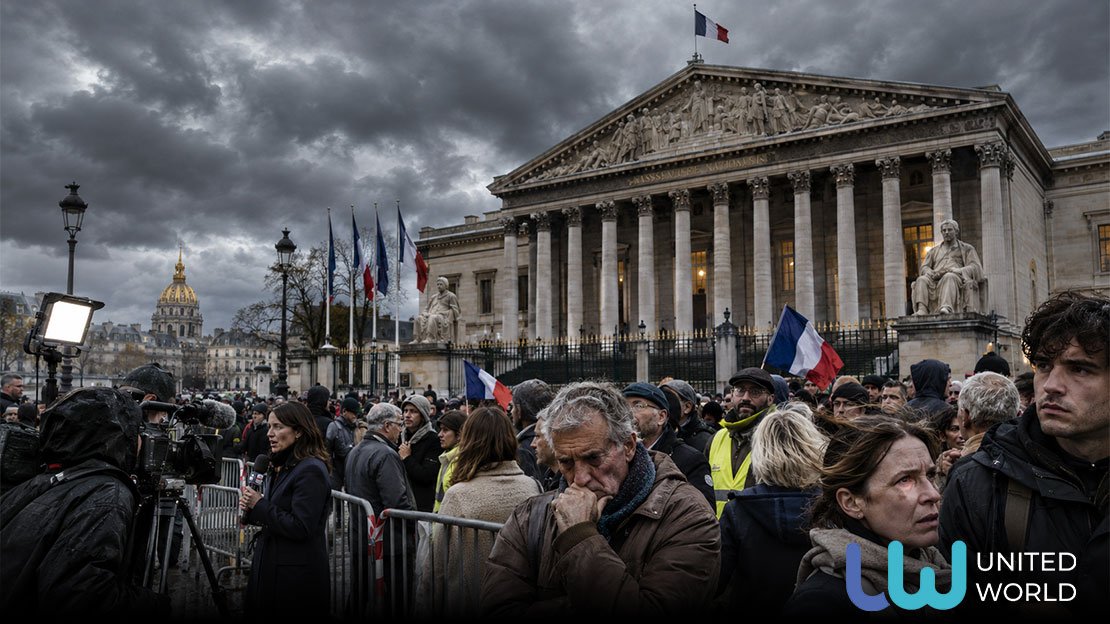
Everyone has been able to see in the press or on television the high school demonstrations that have shaken France since October 17. Not only will these demonstrations continue, but they will also amplify as other segments of the population, strangled by the government’s austerity policies, join the groundswell.
The Economic Reasons Underlying the Protests
In order to understand the dynamic that has been set in motion, let us begin with the figures illustrating an economic situation that is now focused on the state debt. The debt-to-GDP ratio stands at 3,652 billion euros, or more than 120% in real terms. Debt interest, which until now was around 64 to 70 billion, will rise to 90 billion euros next year, and the annual deficit will reach nearly 5 to 6% of gross domestic product.
It is in this context that the National Assembly must vote on the budgets of the State and of Social Security (the healthcare system), knowing that two proposals—one for the Social Security budget and the other for the State budget—have already been rejected (on October 23 and November 4 respectively), while the dates set for the adoption of these two budgets are November 26 for Social Security and December 17 for the State.
This sword of Damocles that has long hung over France is now taking on an urgent character for two reasons. The first is that the next presidential election will take place in seven months, with the first round scheduled for April 18, 2027; the second is that the straitjacket now suffocating France is the result of decades of disastrous political choices culminating in two calamitous terms of Emmanuel Macron. Add to this, finally, a highly unstable international situation.
The debt question has therefore taken center stage in all debates, as if nothing else mattered anymore, even though it is perfectly impossible to solve a problem in the terms in which it is posed and without calling into question the predatory nature of the economic system that engendered it. This incapacity is also reflected in the work of the National Assembly, which has become a place of incessant debate on points that certainly have their own importance but are secondary compared to the general crisis.
As for the structure of the debt, one will better understand how it is a time bomb if one knows that its holders are unknown. In other words, the French population, on whom this debt has been imposed and who is its guarantor, is not allowed to know to whom it owes it. At most, it is known that it is held 50% by non-residents, who may be foreigners or French people residing outside France.
Among those who play with this debt are hedge funds, hyper-speculative funds that are said to have placed 50% of their new investments in it. In short, French debt is not only in the hands of speculators but its interest rates are rising dangerously. Thus, France must now pay more in interest rates than Greece or Portugal, and between 1.8% and 1.5% more than Germany—that is, a situation in which, under the leadership of leaders subservient to the feudal powers of money, it has become the sick man of Europe in financial terms.
Austerity as the Horizon
These same leaders lecture the French, telling them now that the only way out is through a policy of austerity, notably by reducing “costs” in the public sector, and even certain analysts who possess the tools to understand the broader stakes behind this debt crisis hammer home that austerity is necessary and that there is no other way.
The reality is that public money has been squandered by those who exercise power or who have exercised it for more than 50 years, by selling off France’s sovereignty in all domains: national sovereignty, border sovereignty, territorial sovereignty, digital sovereignty, energy sovereignty, and even, with the new defense doctrine established by Macron, by taking a first step toward losing the sovereignty of our nuclear deterrent force. Thus, faced with such a situation that threatens to escape all control, faced with the complete disavowal by the populations of the leaders currently in place, those who exercise power, whether internationally or within the country—and who form this oligarchy holding real power—have decided that Macron no longer fits the bill, that he must go, and that the “rupture in continuity” must be prepared.
What Will Come After Macron
The question is therefore no longer Macron but what will come after. And what comes after is the division between the extremes.
First, there is the extreme center, guilty of the current situation and which everyone associates with Macron. No one wants it anymore, but everything that matters in France has more or less done business with it at one time or another. Then there is the extreme right, with Marine Le Pen, credited with 38% of voting intentions in the first round of the presidential election, but who, no longer even bothering to defend an appearance of sovereignty, accepts remaining and operating within the EU, within the euro, and very probably within NATO. Admittedly, she proclaims that Ukraine should no longer be financed, since there is no more money, and that it should not be given weapons—but she excludes weapons produced in France!
This is therefore a vision turned inward and disregarding France’s role in the world, a France that projects itself onto the international stage.
On the extreme left, Jean-Luc Mélenchon proposes interesting and necessary social measures. Above all, he raises the question of the debt by showing that the roughly 18% held by the Bank of France could be eliminated or frozen, which would provide the means to ensure the country’s development. This proposal, however, runs up against the functioning of the EU, which forbids any such possibility and, worse still, Mélenchon having promised to end nuclear power, he would have no sufficiently powerful lever in the real world to ensure the basis of any development.
This is one of the biggest flaws in Mélenchon’s program because, in seeking to attract the vote of environmentalists without providing education on nuclear energy, he not only risks losing the votes of those who will never accept—and they are numerous—that France renounce it, but he also casts doubt on the coherence of his program. French nuclear power is not only a precious legacy of de Gaulle’s visionary policy; it is, par excellence, the form of energy indispensable to any modern economy. The great challenge that any statesman with a vision of the future should seize is that of “citizen nuclear power” as opposed to “the nuclear power of technocrats,” so that the population is involved in the imperative of building fourth-generation nuclear plants and nuclear fusion.
Changing One’s Way of Thinking
Today’s French ruling classes are distinguished by their inclination to see the world in categories, without an overarching vision and therefore without coherence, or even without logic.
This vision certainly makes it possible to identify the undeniable assets France possesses: nuclear power, a seat on the UN Security Council, a transportation system that works, functioning infrastructure, a healthcare system that, for better or worse, still treats everyone—but one must acknowledge that the mediocrity of today’s leaders makes them incapable of conceiving, from these assets, a coherent strategy that would make it possible to define a perspective for emerging from the crisis.
Worse, while a whole discussion is emerging about what France is, it is being instrumentalized for partisan purposes. Provoked by the feeling of having been betrayed, by incomprehension, anger, or even despair, which torment a large part of the population, this discussion, however indispensable it may be—since the French are wondering where their country stands—exposes the fractures that have opened up in recent decades.
Some, extensively relayed by the conservative media, speak of “eternal France,” distorting what belongs to its history—that is, to the historical journey dictated by invariants, from belonging to the city and the importance of politics to the will to define oneself as a power of balance and reason; from the centrality of power to the temptation of anarchy—in order to see in it values and an identity frozen “for all eternity” and repeating themselves identically.
The “opposing camp” speaks of the new France, as if one could change the old France by a new France that would spring from nowhere like a rabbit from a magician’s hat, or as one sells one’s old car to choose the latest model, with arbitrariness then becoming the reference.
Neither seeks to place themselves “above the fray” nor envisages opening up the debate by recalling that the nation is subject to the same laws as “everything that lives under the sky.” Thus, if it is true that nothing is permanent but change, the history of France is that of continuity in transformation, with this ever-renewed response to the circumstances of its “twenty-times-secular pact with the freedom of the world.” It is a pact that can hold only if every French person shares it and brings to it in good faith an optimistic and positive contribution.
Such an approach presupposes becoming aware of and breaking out of the rules of the game imposed by a cannibal order whose objective is to “change everything so that nothing changes” by confining political and electoral debate to subjects that make it possible to play on citizens’ fears or by leading citizens to fixate on “the other” as responsible for all ills: “Yes, the problem is Jean-Luc Mélenchon, that pack leader” or “Yes, it’s Marine Le Pen, it’s the threat of fascism in France,” etc.
If this way of proceeding is neither new nor specific to France, it is causing damage there whose consequences are already perceptible. Thus, 69% of French people believe that what divides them matters more than what unites them—an unprecedented deterioration of national cohesion in a republic whose motto is “Liberty, Equality, Fraternity” and whose constitution’s first lines proclaim its “indivisibility.” Thus have resurfaced those “ferments of division” against which de Gaulle had warned and which become, in hands greedy for power, instruments of destruction and domination.
The Oligarchic Order Against the Specter of Chaos
In this period of agitation, the presidential election concentrates all hopes for change and for finally managing to “clear out” the worn-out political caste that clings to power by all means, even at the cost of violating the Constitution. In an unprecedented development, faced with the feeling of emptiness and impotence of power, some forty self-declared candidates have already been counted, most of them with no hope of qualifying.
However, a new candidacy in the presidential election has appeared—that of Teddy Riner, judo champion and five-time Olympic gold medalist. Unofficially pushed by Emmanuel Macron—who today ranks 33rd among the French people’s favorite personalities—it shows a sitting president intervening in an election (in which he himself can no longer stand) in order to attract toward it the potential voters of Jean-Luc Mélenchon and makes Marine Le Pen appear as the preferred candidate of the financial oligarchy.
While both the right and the extreme right erect “order” as a prerequisite for France’s “recovery,” it is nevertheless chaos that this strategy calls forth. Worse, with the bet on polarization between the (extreme) right and the (extreme) left that emerges from the way the media “play” the presidential campaign, the result, whatever it may be, can only lead to chaos, or even to a situation close to civil war.
The Coincidence of Opposites
It will be very difficult for France to escape the trap in which it has locked itself as long as it proves incapable of taking things from a higher perspective and persists in a blindness dictated both by its submission to the European Union and by its ignorance and an ideological approach where it should instead draw inspiration from fruitful examples.
Consider China. It has an economic development policy that all those who have been able to go there find extraordinary. Yes, one might say, but “it is a regime that is not democratic”! Yet in this “non-democratic” regime, there is more discussion at the grassroots level, directly with the people, than in Western countries.
And at the top, they observe very closely what this same people thinks. In France, do the political leaders, those in place at all levels—do these people who form the oligarchy, who cannibalize the economy—do they think about the people? Do they love the people? It is obvious that they do not. It is obvious that the only interest they see in the people is trying to flatter them or to develop relations with them that will allow them to attain or remain in power.
So yes, China, like many other countries in the world, thinks in a different way from Westerners and which, on many points, may seem to be opposed. This is precisely where the capacity to think outside pre-established categories is essential, the good news being that this capacity, which existed in France’s finest hours, can be rediscovered, if not learned and developed.
The APEC Summit (Asia-Pacific Economic Cooperation), which opened today and which will be remembered as having provided the historic occasion for a tripartite meeting of Xi, Putin, and Trump, could be an opportunity for France—the last?—in particular, to abandon the geopolitical conception it has adopted by sacrificing its own tradition of foreign policy.
At the national level, it could restore the sense that the people must be heard, that they are ready to cooperate if leaders show wisdom and initiatives moving in the direction of the general interest, of a better life for all, and of a worthy future prospect for their children.
This comes all the more opportunely since it is what the French constitution stipulates.