


By Orçun Göktürk / President of Sino-Turkish Studies Center, Nanjing, China
At the end of last April, I was in Crimea. I visited the Livadia Palace in Yalta, on the Black Sea coast. This historic palace hosted one of the most consequential conferences in world political history.
In February 1945, U.S. President Franklin D. Roosevelt, Soviet leader Joseph Stalin, and British Prime Minister Winston Churchill gathered at the palace before World War II had even come to an end. The three leaders negotiated the future of postwar Europe and the fundamental principles of the new international order that would emerge.
As I walked through the historic halls of Livadia Palace, I reflected on how the decisions made there approximately eighty years earlier had shaped global politics. Several months have passed since that visit.
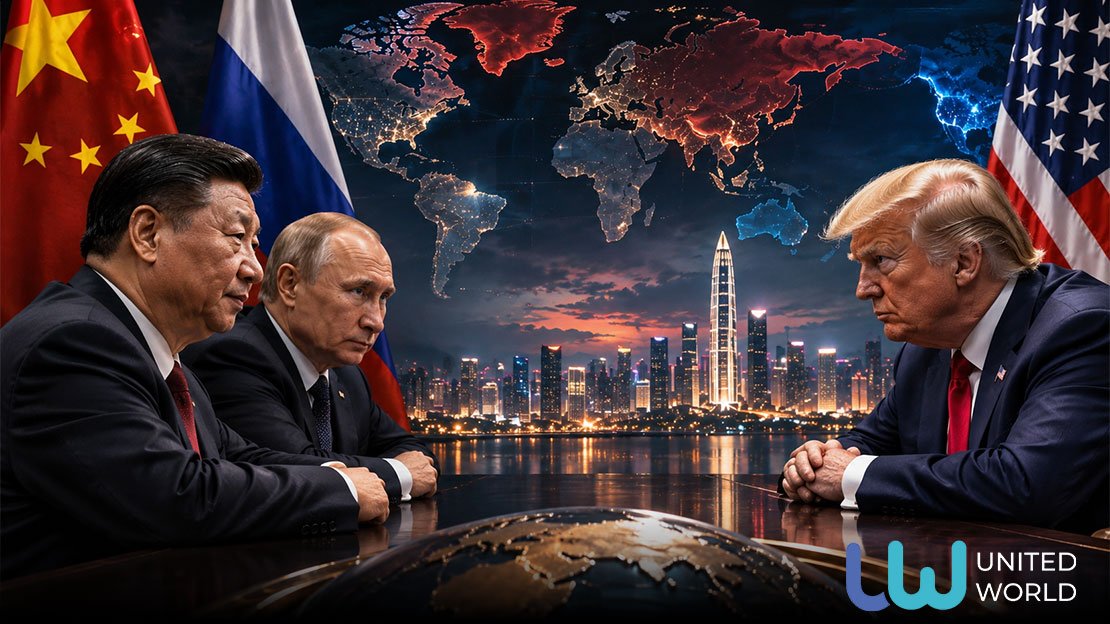
Now, Chinese President Xi Jinping, U.S. President Donald Trump, and Russian President Vladimir Putin are expected to meet in Shenzhen, China, on the sidelines of the APEC summit scheduled for November 18–19.
The prospect of this meeting brought back memories of Livadia Palace, which I visited in April.
Will Shenzhen become a new Yalta?
What raises this question is not simply the prospect of three leaders sitting at the same table, but rather the historic transformation currently unfolding within the international system.
In 1945, the old-world order had collapsed following a devastating global war. Today, the unipolar system shaped by American hegemony is unraveling, while the emergence of a multipolar international order is accompanied by profound tensions and growing pains.
Yet there is a striking contradiction between these two historical moments. The three leaders who gathered at Yalta were allies fighting on the same side against Nazi Germany. The leaders expected to meet in Shenzhen, by contrast, represent powers engaged in increasingly intense economic, political, and military competition.
The three great powers are already at war!
Of course, there is currently no formally declared direct war among the United States, China, and Russia. However, the struggle among these three countries has moved far beyond conventional diplomatic rivalry.
Indeed, the United States constitutes one pole, while China and Russia constitute another. These two poles are already engaged in an indirect confrontation extending from Ukraine to Tehran!
On the economic front, a trade war is underway between Washington and Beijing, involving tariffs, technology embargoes, semiconductors, and strategic supply chains. While Washington seeks to constrain China’s technological rise, Beijing is strengthening its domestic manufacturing capabilities and developing alternative economic relationships to counter American pressure. Russia, meanwhile, is fighting in Ukraine against an army supported by the West in virtually every respect, from military equipment to financial resources.
The weapons, intelligence assistance, and financial support provided to Ukraine by the United States and its European allies have transformed the conflict into a broader security confrontation between Russia and the West.
A similar polarization is unfolding in West Asia.
The deepening crisis surrounding Iran and the Strait of Hormuz has raised questions about the American military presence in the region and Washington’s control over vital energy routes.
The relationships that Russia and China have developed with Tehran have further complicated Washington’s efforts to exert pressure on Iran.
Naturally, Beijing’s and Moscow’s support for Iran should not be equated with direct participation in military hostilities. Nevertheless, while avoiding direct military confrontation with one another, the three great powers are increasingly clashing through economic sanctions, trade restrictions, regional conflicts, and military deterrence. These are precisely the circumstances that make the Shenzhen meeting historically significant.
Moscow wants to end the war. Washington is searching for an exit strategy and seeking to reduce its burdens. Beijing wants stability.
It is clear that the three leaders will arrive in Shenzhen with different strategic calculations. For Russia, the immediate priority is to bring the war in Ukraine, now in its fifth year, to an end under conditions that satisfy Moscow’s security interests. The Russian economy has demonstrated considerable resilience against Western sanctions. Moscow has redirected its energy exports toward Asia, established alternative financial mechanisms, and expanded its defense industry.
Throughout this process, Russia has also received substantial support from Beijing, based on what the two countries describe as their “unshakable relationship.” Nevertheless, the costs of maintaining a wartime economy are steadily increasing. The West’s embargo against Moscow, unprecedented in its scale in modern history, had backfired.
Yet more than four years of war, combined with high defense expenditures, inflation, labor shortages, and technological restrictions resulting from sanctions, are inevitably placing pressure on Russia’s long-term economic development.
The Kremlin is being forced to pursue measures it would strongly prefer to avoid, including distributing at least part of the economic burden of the war across different segments of Russian society.
For Putin, the objective is to secure Russia’s gains in Ukraine and, over the longer term, achieve the removal of the major sanctions constraining the Russian economy. Moscow will also seek to use any new negotiating mechanism established with Washington as an opportunity to reopen discussions about Europe’s security architecture.
Trump’s situation, however, is different. The American president emerged from the November midterm elections having suffered a significant political defeat. The Republicans’ loss of strength in Congress has narrowed Trump’s room for maneuver in domestic politics.
In foreign policy, meanwhile, the confrontation with Iran has once again exposed the limitations of Washington’s military power. The Strait of Hormuz crisis, in particular, poses a serious strategic challenge for the United States. American naval superiority existed in the minds of many, but developments on the ground revealed a different reality.
Furthermore, the U.S. Navy cannot automatically guarantee the uninterrupted flow of global energy trade. Iran’s geographical position and asymmetric military capabilities have constrained Washington’s freedom of action in the region.
Trump wants to halt China’s rise, restructure relations with Russia, and reduce American military commitments in West Asia. Yet this is precisely where the fundamental contradiction of American foreign policy becomes apparent: the gap between Washington’s global ambitions and the resources available to achieve them continues to widen.
Beijing, by contrast, possesses certain advantages over the other two capitals. China is not directly engaged in the war in Ukraine. Nor does it carry military commitments in West Asia on a scale comparable to those of the United States.
As one of the world’s largest manufacturing centers, China occupies a decisive position in global production networks.
It continues to expand its capabilities across numerous sectors, from electric vehicles and renewable energy technologies to infrastructure investment and industrial manufacturing. However, China’s strength also brings with it a significant vulnerability. For a country that serves as the world’s manufacturing hub, the uninterrupted functioning of international trade is critically important. The closure of maritime routes, rising energy prices, declining global demand, and escalating trade wars directly undermine China’s economic interests.
For Beijing, therefore, international stability is one of the essential conditions for continued economic development. While resisting American economic and technological pressure, China does not want to see the global trading system fragment completely. This is where the different priorities of the three countries intersect.
Russia wants to reduce the costs of war. The United States wants to reorganize its global commitments. China wants to establish a stable international environment in which it can sustain its economic rise.
From Yalta to Shenzhen: negotiating a new world order
There are, of course, important historical differences between the 1945 Yalta Conference and the anticipated meeting in Shenzhen.
At Yalta, the victorious powers were negotiating the postwar order. Today, there is no shared victory among the parties. On the contrary, the three great powers are attempting to constrain one another’s strategic objectives across different areas. In 1945, Britain, the United States, and the Soviet Union occupied the center of world politics.
Today, China has taken Britain’s place. Moreover, the international system is far more complex than it was eighty years ago. India, Türkiye, Brazil, Africa, the European Union, and absolutely emerging actors across the Global South possess economic and political capabilities that allow them to influence the decisions of the major powers.
It is also worth emphasizing that the European Union may be the actor most apprehensive about the APEC summit and the trilateral meeting.
After all, the EU does not even have a seat at the table. Another major difference is economic interdependence. In 1945, the international community was attempting to rebuild economic relationships devastated by war.
Today, competition between the United States and China is taking place between two economies that have developed deeply interconnected trade relationships.
Consequently, the costs of economic decoupling would be substantial for both sides. Despite these differences, the comparison with Yalta remains relevant. The reason is that both historical moments share one defining characteristic: the international system is undergoing a period of transition.
In 1945, the central question at Yalta concerned the principles upon which the postwar order would be established. Today, the future of great-power relations, security balances, nuclear arms control, and the functioning of the international economic order are all on the agenda in Shenzhen. Nuclear arms reductions are expected to feature prominently in discussions among the three leaders.
However, it remains uncertain whether the conflicts in Ukraine and Iran, along with the ongoing trade wars, will be addressed through any comprehensive agreement. Nevertheless, these crises define the international environment in which the meeting will take place. The fundamental question is how the great powers will contain their existing conflicts and manage the transformation of the international system.
Yalta became one of the diplomatic symbols of the international order that emerged after World War II. Shenzhen could eventually acquire a similar historical significance.
Whether that happens will depend less on the images of the three leaders standing together than on their ability to reach concrete agreements capable of changing the rules of their competition. When I visited Livadia Palace in April, I thought about how the decisions made around that negotiating table had shaped the decades that followed.
Now, more than eighty years later, the leaders of the world’s three great powers are preparing to meet in China.
I, too, will be following the summit from Nanjing, China’s former capital before Beijing. In 1945, the leaders gathered around the table were allies who had defeated a common enemy.
In 2026, the powers preparing to meet are engaged in economic warfare against one another and hold opposing interests in Ukraine and West Asia. Perhaps this contradiction is precisely what makes Shenzhen so historically intriguing. At Yalta, allies discussed how to establish a new international order.
In Shenzhen, rivals are preparing to negotiate how the emerging order will take shape. Only time will tell whether a new Yalta will emerge. What is certain, however, is that the transformation of the international system is no longer merely a theoretical debate.
That transformation is now unfolding in concrete terms through trade wars, on the Ukrainian battlefield, in the Strait of Hormuz, and at the diplomatic negotiating tables of the great powers.