


By Yunus Emre Özgün
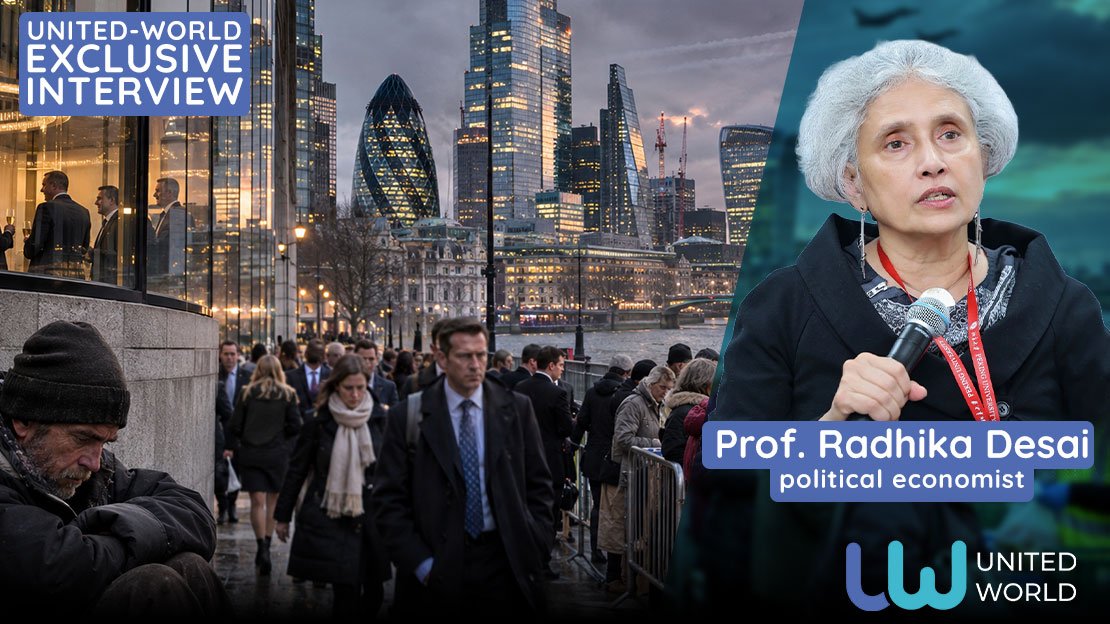
A durable social and international order depends on peace, adherence to international law, and universal ethical principles that prioritize human dignity and social well-being over geopolitical domination. However, across Europe and the United Kingdom today, those principles are being systematically subordinated to the demands of war economies and financial rent extraction. As mass strikes and street demonstrations across Europe, and mounting social pressures inside the UK make clear, there is an irreconcilable conflict of interest between working people and a ruling oligarchy committed to militarism and austerity. While ordinary households, public sector workers, and pensioners confront falling real wages, soaring energy and housing costs, and the steady dismantling of healthcare, education, and disability support, defense contractors and financial monopolies enjoy state-guaranteed profits. By manufacturing external threats to justify billions in military spending, war profiteers and rentier elites shift the full weight of both foreign military escalation and domestic economic stagnation onto the backs of the working class. To unpack the historical roots and global consequences of this depression in the UK, we spoke with a renowned political economist and Director of the Geopolitical Economy Research Group at the University of Manitoba, Canada, Prof. Radhika Desai.
Thatcherism to Military Neoliberalism: Public Money to Arms Corporations While Cutting Welfare
UWI Data: While public services at home face deep cuts and ordinary households struggle with living costs, the UK government continues to prioritize billions in military spending and defense partnerships. How does the UK’s financial and economic model connect this domestic social depression to its military posture abroad?
Prof. Radhika Desai: You refer to the UK’s economic model, and I would say that the combination you are pointing to, an increased emphasis on military spending alongside deep social cuts at home, essentially constitutes a new phase of that model. Ever since the Thatcher years, the economic model of the UK has been neoliberalism, which fundamentally involves shifting the social balance of power away from working people and toward the propertied class, the rich, and the capitalists.
Today, this new emphasis on military spending, which is created and maintained by keeping up a very high-decibel rhetoric about the “Russian threat,” hyping up news about Russia, and totally misunderstanding and misinterpreting the conflict, marks a shift toward a modified model because neoliberalism essentially never succeeded. It never succeeded in injecting productive dynamism into Western economies, no matter how much freedom was given to capital and no matter how severely labor was restricted. Even though the model is not working, the ruling class wants to stick to it. All they can do is tweak it a little bit, claiming each time that the latest adjustment will finally work.
Now, the result is a new form of neoliberalism in which defense spending serves as the primary mechanism of capital accumulation. The essence of the neoliberal model has always been not only to deregulate capital, but to hand corporations ever more lucrative opportunities for profit and assured markets. And what is a more assured market than government defense spending? Military corporations receive vast sums of public funds; essentially, this is a new way of shoveling money in the direction of the companies supplying increased military expenditure without giving working people a single cent and, indeed, while actively cutting the rights and living standards of working people.
This has been going on for several years. Two or three years ago, people were already talking about how poor older citizens were being forced to choose between “heating and eating.” Now the government is finding new ways to cut social support; for example, Personal Independence Payments (PIP) for disabled people are being slashed. Essentially, this new military neoliberal model is designed to continue benefiting capital directly at the expense of labor.
Imperialist Instability Comes Home: Deindustrialization, Choke Points, and the End of Impunity
That brings us to what is happening on the international front, because the two spheres are intertwined. Disruption around the Strait of Hormuz and Bab el-Mandeb, driven by the US-Israeli barbarity on Iran and Yemen, is pushing up global commodity prices, while the US is using tariffs to pressure its European allies. Is London now experiencing at home the instability it has long caused elsewhere, or is this a secondary quarrel inside the imperialist camp? As the global balance of power shifts, how do you see the UK’s dependence on the US developing?
I find the way you frame your question very interesting: That the kind of instability countries like the UK have long imposed on other nations through colonialism and imperialism is now coming home. Certainly, there is a huge element of this, because the era we are living through is one of the accelerated decline of the imperialist powers’ ability to get their way in the world. They can no longer simply declare war on a poorer country and win while suffering few or no consequences themselves.
On the contrary, they are now highly vulnerable, and over decades of neoliberalism, they have made themselves vulnerable. Neoliberalism has essentially involved a withdrawal from domestic production, which means Western economies have become increasingly reliant on the rest of the world for manufactured goods and productive output. Of course, their reliance on the rest of the world for raw materials and energy has never disappeared; securing those resources was a large part of what colonialism was about, and that dependency remains. What no longer remains, however, is their ability to control that world.
They cannot control Iran, and they cannot win against Iran. Iran, Ansarallah in Yemen, and other regional forces can actually close off these vital maritime choke points and stop commercial traffic from moving through them. That means countries like the UK cannot do whatever they like and get away with it, let alone win. That is definitely the reality we are living in today, and both the UK and the US are suffering the consequences.
Moreover, remember that this oil and shipping shock comes on top of a broader structural decline in the West’s ability to extract cheap inputs from the rest of the world. As the rest of the world develops, developing countries also demand these same inputs whether oil, fertilizer, or other primary commodities. Given that the supply of these inputs is not elastic and does not automatically expand in response to rising demand or prices, global commodity prices rise structurally, and Western economies are suffering from that shift as well.
The City’s “Get Out of Jail Free Card”: Invisible Earnings and the K-Shaped Economy
Looking at the UK internal class dynamics; official statistics put finance at roughly 8% of GDP, yet the economy is visibly driven by rentier extraction, asset inflation, and what Marx called fictitious capital. What is the real state of this rentier model today, and what does it actually do to the working class, particularly public sector workers, as well as the squeezed lower-middle class? Given that rents, energy bills, and failing public services are impoverishing people in the UK just as severely as in France, Spain or Germany, why aren’t we seeing mass street movements on that scale? How does London still manage to manufacture public consent?
That is a very big question, so let me try to do justice to it. Let me first answer your question about political protest against this model very simply: It may just be a matter of time. We may not be seeing mass street protests on that scale right now, but I cannot imagine that ordinary people in the UK can put up with this for much longer, because they are already suffering deeply. When you look at the statistics for average and median incomes in the UK, I am appalled; how can people live on so little money? Somehow people are managing for now, but the pressure is immense.
Let me turn to the financial sector in the UK, which is often called the “City of London,” although that term has become a misnomer partly. It applied when the financial sector was concentrated in that Square Mile around the Bank of England, which is nominally an independent municipal entity, the City of London, with its own autonomy separate from Greater London. Today, of course, the financial sector has stretched out to Canary Wharf, Mayfair, and beyond, so the UK’s financial sector is much bigger than just that Square Mile.
This financial sector has been at the root of Britain’s economic decline for the last 100 to 150 years. Britain’s industrial decline can be roughly dated back to around 1870, when the country began to lose competitiveness to the rising industrial powers of that era, first the United States and Germany, and later Japan and others. As those industrial powers rose, Britain could not defend its share of world markets, which was increasingly eaten into by these new competitors. By the 1960s and 1970s, there was widespread anxiety about Britain’s decline, with numerous books and articles written on the subject.
After Margaret Thatcher came to power, however, it was generally assumed that even if the UK’s productive decline had not been resolved, the country had somehow overcome the problem because the City of London became so prominent. The City had been largely eclipsed during the period between Britain abandoning the gold standard in the First World War and the 1970s. But Thatcher led a wave of deregulation, granting the City sweeping freedoms to engage in all sorts of speculative and financial activities. Throughout the 1980s, 1990s, and 2000s, the financial sector became far more dominant and was credited with generating so called “invisible earnings,” which allegedly compensated for the loss of “visible earnings” from manufacturing exports. Because this was portrayed as a national success, whenever anyone complained about the financialized nature of the British economy, defenders of the system would reply, “Look, it is keeping the British economy afloat.” In this way, the City of London—the financial sector, was handed a kind of “get out of jail free card”.
In reality, this financialized model is now costing the UK dearly. First, it perpetuates Britain’s industrial decline. Second, it produces a highly unequal form of growth, the famous “K-shaped” economy, where a wealthy minority does very well while the vast majority does badly. Third, it expands privately owned monopolies; when private monopolies grow, ordinary people pay more and more for essential goods and services, further squeezing household budgets. Furthermore, financial activity does not generate significant employment, certainly not good employment. The jobs primarily created are those that service the consumption needs of people who already have a great deal of money, such as restaurant work and delivery jobs, while jobs offering long-term stability, good wages, and solid benefits are simply not being created.
A “Vassal State,” the Self-Harm of Brexit, and the Growth Trap
Let me add another crucial point; the UK financial sector, still its most prized sector to this day, is no longer even owned by British financial institutions. It is primarily owned by foreign financial institutions, many of which are from the United States. Both within the financial sector and across the broader economy, British assets have been owned by foreign powers. Commentators have been writing about this for years, noting that Britain has become a vassal state and has essentially sold itself off to the rest of the world. This buyout happens largely through financial activity itself, such as foreign private equity firms coming in and buying up British companies.
Partly as a result of this fragmentation and foreign ownership, the British capitalist class was not sufficiently organized to oppose Brexit. Calling Brexit a major “own goal” makes it sound like a small affair; in truth, Brexit was a major act of self-harm on the part of the British state. I am not saying that the European Union is great; it has many deep problems, but simply leaving the way Britain did was like cutting off a limb, and no economy survives that easily. Today in the UK, figures like Andy Burnham (Prime Minister and the Labor Party’s leader) have started talking about rebuilding a closer relationship with the European Union, perhaps even reapplying for membership. Who knows whether that will happen, but that discourse is now underway.
Brexit also dealt another heavy blow to the financial sector itself. For a long time, the City of London benefited from serving as a bridge between the American and European financial sectors. Britain was part of the European Union and therefore enjoyed access to the European economy and financial market, yet it remained outside the euro, a “one foot in, one foot out” position that allowed it to mediate business between Europe and the United States. Now, ten years after the Brexit vote and roughly six years after Britain’s formal exit, that mediating role is increasingly disappearing. This is directly reducing the volume of business conducted in the City: more and more companies are no longer listing in London, and the size of the London Stock Exchange has been shrinking. In all of these ways, the ability of the City of London to generate the international compensatory income that once offset the loss of exports is vanishing.
Britain is therefore in very deep trouble. Finally, the entire economic model has become reliant on growth. Without growth, a government must choose between taxing the rich or cutting social services for the poor. Because taxing the wealthy is unpalatable to the current government, and to every mainstream government we can think of, their only rhetorical way out is growth. Yet growth is not materializing, and it is not about to materialize, because people are not investing in the UK. All in all, it is a very dismal situation.
Austerity and the Four Nations: The Economic Roots of Self-Determination
Building on your last point about Brexit, one final question on the future of the UK itself. In the wake of Brexit, opposition to London has grown sharply across Scotland, Wales, and Northern Ireland, with self-determinist and sovereignist parties gaining real ground. How do you view this rise in local nationalism, and what does it mean for the sustainability of the British state?
Britain has historically been a four-nation state, and once upon a time, it included all of Ireland. Of course, Ireland was much more obviously a colony than the other parts of the Union, which led to the partition of Ireland. Today, the possibility that the north of Ireland will be reintegrated into the Republic of Ireland is greater than ever. That is because Brexit had to be negotiated in such a way as not to undo the gains of the 1998 Good Friday Agreement, which essentially removed any physical border between the north of Ireland and the rest of Ireland. To avoid recreating a hard border there, London had to make further concessions in that direction, which has brought the question of the reintegration of the north of Ireland into a united Ireland much closer.
Furthermore, the fact that Scotland, the north of Ireland, and Wales, just like Greater London, all voted against Brexit separates them politically from the bulk of rural and small-town England that voted for Brexit. This divergence has increased internal tensions and contributed, particularly in Scotland, to renewed talk of independence.
Above all, the social cuts do not help. Ultimately, all of these self-determinist movements have gained ground in large part because the government in London is imposing austerity, and nobody likes it. All of these nations are trying to find ways of moving forward; if not completely without austerity, then at least with a moderated austerity that they know they will not get from London. Thus, a large part of this self-determinism has direct economic causes.
*Editor’s Note: The transcript of this interview has been lightly edited for grammar, syntax, and stylistic flow to ensure readability, while strictly preserving the interviewee’s original talk, meaning, and tone for full intellectual freedom.