


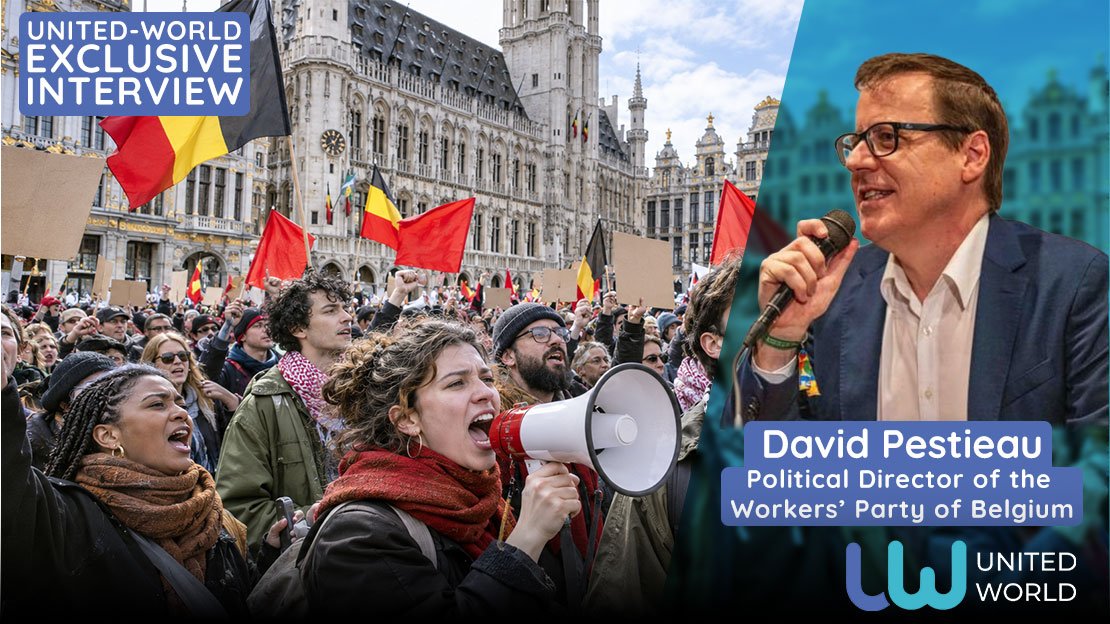
Europe stays on the streets. Protests and strikes are continuing in various countries. One of them is Belgium, and an important political actor in organizing the protests against militarization is the Workers’ Party of Belgium, a force that has continued to increase both its street presence and votes during the past years.
We spoke to the party’s political director, David Pestieau on militarization, protests and the public opinion regarding
The conflicts around militarization in Europe. How is it continuing? I know from Germany that they spend a lot of money. How is it, for instance, in Belgium?
I think it’s quite similar because, as you know, Trump asked that every European country has to reach 5% of the GDP for the army. And so, in every country in Europe and also in Belgium, you see the increase of the military expenditures, and at the same time, of course, austerity for social measures and pensions and wages. Everything is going down. And so, the contradiction between militarization and austerity for the people is growing.
And in Belgium, we have a social movement since about two years now. Nearly every month, there is a big demonstration or a general strike. And this Friday, there was a demonstration in the center of Brussels with 50,000 people. So, with people coming from the trade union, but also student movements, people from schools, because since two weeks, there is a big, big movement in the schools against austerity in education.
So it’s a very big movement like what we see in France. It’s connected. And at the same time, there is quite a movement growing about militarization. And as you know, there will be a youth strike on the 20th of November, a European strike where the Belgian one will be also there, not only the Germans, but also the Belgians, the Italians. From all over Europe, there will be actions. And the 22nd in Brussels, there will be a big demonstration against militarization.
So, you see, do you observe that the population is increasingly rejecting these austerity policies and connects them to militarization?
Yes, we see that, and we have seen also that two years ago there was the idea we have to defend, it is very important, we have to increase. But of course, the people didn’t see the contradiction from one hand the social expenditures, so now they see that much more.
And secondly, they didn’t see that it’s in fact not to defend the territory but to go on war against Africa, against the Middle East, and that’s, I think, a very big move. So, before, there was a sort of 50-50, now 80% of the population is against the increasing of military expenditures.
So, it’s a change in the mindset of many people, and that makes that our Minister of Defense is very angry against the left, against the Workers’ Party of Belgium, and against all the people who stand against these measures.
Well, usually, when governments prepare. For war or militarization, that also goes hand in hand with increasing repressive measures at home. Do you observe such measures in Belgium?
Indeed. Indeed, we observe that against the social movement, against the youth. So, two days ago, there was, for the first time since long, the demonstrations were forbidden in the center of Liège. So they said that nobody could meet more than three people. So, it was a very strong measure, repression.
And the young people answered with an organization of a demonstration. And the beginning of the demonstration was with a big banner when we, what was right, was we are more than three. And there were 5,000 people. So we see that there is a sort of increasing of resistance also against the repression. But you’re right that we’ve seen that they try to insinuate and also take to say that the left organization are linked with terrorism, with violence. And so they try to push us in this direction.
So there was the Attempt of our Minister of Defense against our own festival, Manifiesta, in the beginning of September. They want to forbid it because there were several speakers from the United States they don’t like, like us and Piker. And so they tried to do it, but the answer was very good because we had more people than ever in our festival.