


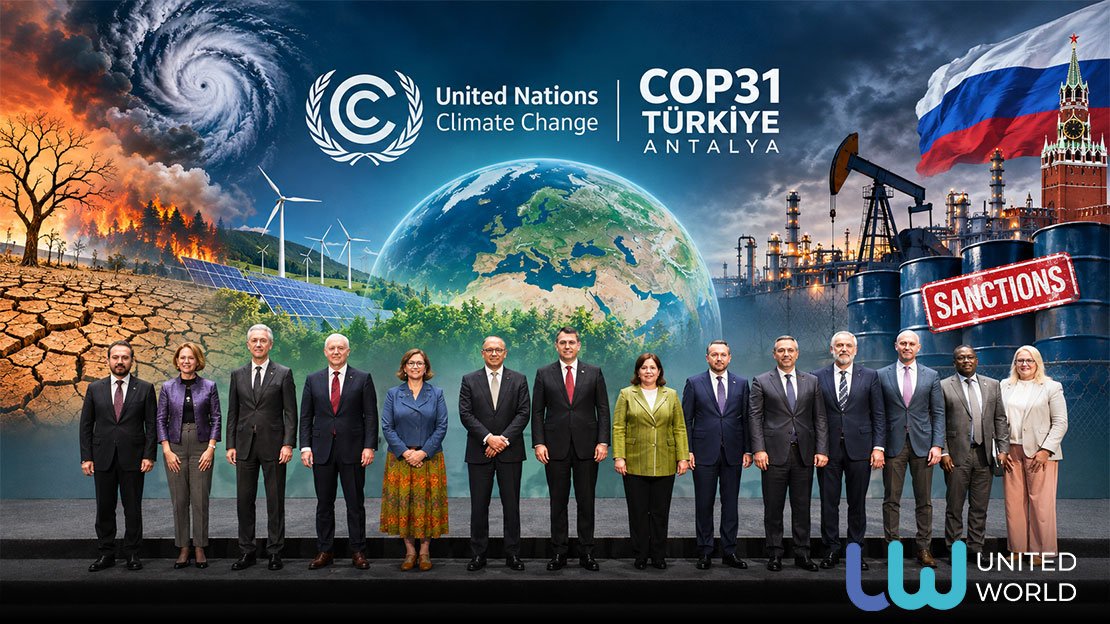
The United Nations is supposed to represent the unity of humanity in confronting common challenges. Yet, at COP31 in Antalya, the international effort to combat climate change has also become a platform for geopolitical disagreements, with Russian representatives accusing Western countries of applying discriminatory policies to international climate cooperation.
Speaking at a forum organised at the Russian pavilion during the UN climate conference, Russian officials and business representatives argued that political and economic restrictions imposed by Western governments were preventing countries from making full use of their resources, technologies and industrial capabilities to address the climate crisis.
Sergei Kononuchenko, Special Representative of the Russian Foreign Minister for Climate Affairs, accused some Western countries of using climate policy to advance political objectives unrelated to environmental protection.
“Some Western countries, not only this year but over a long period of time, have tried to use this field to promote policies that are in no way connected with the problem of climate change,” Kononuchenko told UWI.
According to the Russian diplomat, such policies contradict the fundamental principle of the UN climate process: bringing all participating countries together to confront a shared global threat.
He argued that unilateral restrictions prevent countries from mobilising their full potential and capabilities in the fight against global warming. In his view, international climate cooperation cannot be effective if political differences determine which countries are allowed to participate fully in it.
Dispute over a just energy transition
The Russian representative also questioned whether the international community could achieve what is commonly described as a “just energy transition” under the current geopolitical circumstances.
The concept, which has become central to international climate negotiations, emphasises that the transition towards low-carbon economies should take into account the different economic capacities and development needs of individual countries.
However, Kononuchenko argued that Western policies were making this objective increasingly difficult to achieve.
“We speak about a just energy transition, while at the same time we see that this so-called just transition is not possible precisely because of the policies pursued by Western nations,” he said.
His remarks reflect a broader disagreement over how the costs and responsibilities of climate action should be distributed. Developing economies and countries with significant natural resources have repeatedly stressed that they should not be expected to abandon existing energy structures without access to alternative technologies, financing and sufficient time to adapt.
For Moscow, the principle of equal participation should extend beyond political declarations. Kononuchenko maintained that all countries, regardless of their political systems or international alignments, should be able to contribute their technological and financial resources.
“When we speak about universal threats, this clearly means that we have to pool our efforts and use all possibilities and opportunities, including technologies and financial resources, without making distinctions between countries or political regimes,” he said.
Technological neutrality and national choices
The debate at the Russian pavilion also addressed the question of whether climate targets should require countries to follow the same technological and industrial model.
Sergei Tverdokhleb, Vice-President of the Committee on Ecology and Climate Policy of the Russian Union of Industrialists and Entrepreneurs, argued that governments should retain the freedom to determine their own routes towards reducing emissions.
He described this approach as “technological neutrality”, meaning that each country should be able to select the methods best suited to its geographical, economic and industrial circumstances.
“It means that every country should choose its own way of achieving climate objectives and reaching carbon neutrality,” Tverdokhleb said.
He cited Russia’s forests as an example, arguing that their capacity to absorb carbon dioxide could play a significant role in reducing the country’s net emissions.
According to Tverdokhleb, northern forests represent one of Russia’s most important and effective instruments for achieving this objective. His argument was that climate policies should recognise not only technological solutions such as renewable energy, but also the natural characteristics and resources of individual countries.
The Russian business representative also warned against imposing identical energy policies on countries with very different development priorities.
He specifically referred to Latin American countries, where access to oil, gas and other mineral resources remains important for economic and social development.
“I fully understand that, for many Latin American countries, the possibility of using oil, gas and other mineral resources is crucial for economic and social development,” he said.
“Making everyone act in the same way is not productive and creates enormous risks for achieving climate objectives in general.”
Tverdokhleb argued that countries cannot be expected to implement identical policies when they lack the necessary financial resources, domestic industries and technological expertise. A uniform approach, he suggested, could ultimately undermine rather than accelerate the global transition.
Climate cooperation amid geopolitical divisions
The Russian representatives’ interventions in Antalya highlight the difficulties of separating climate diplomacy from the wider geopolitical tensions affecting international relations.
Their central argument is that climate change is a global challenge requiring cooperation between countries that have different political systems, economic structures and energy resources. Political restrictions, they contend, risk weakening the collective response.
Their proposals focus on removing political and economic barriers to climate cooperation, recognising national circumstances and allowing governments greater flexibility in selecting technologies and energy strategies.
However, the debate also raises a fundamental question for COP31: how can the international community reconcile the need for common climate objectives with the different priorities and capabilities of individual states?
For the Russian participants, the answer lies in technological neutrality and equal access to international cooperation. Whether such principles can overcome the geopolitical divisions surrounding climate policy remains one of the broader challenges facing the negotiations in Antalya.