


By Ali Rıza Taşdelen
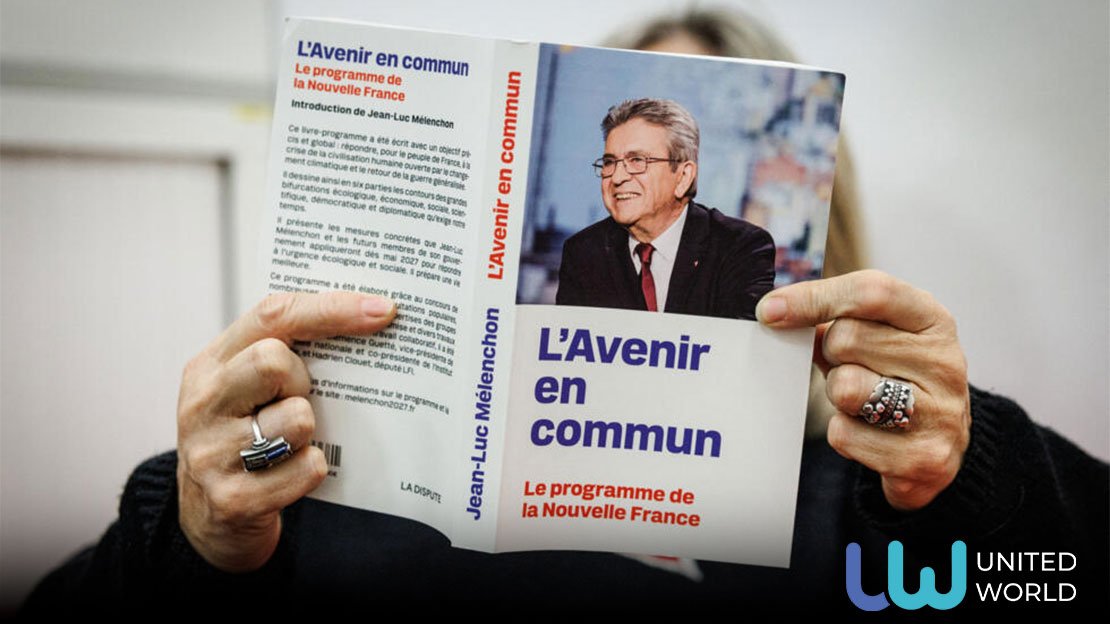
Jean-Luc Mélenchon has unveiled his program for the 2027 presidential election. He presented it at an indoor rally attended by 20,000 people in Le Bourget, near Paris, on November 7, 2026.
Mélenchon described the gathering as an unprecedented event in nearly four decades: “An indoor rally of this size, drawing such a large crowd, has not been seen in 38 years, since François Mitterrand held a similar event.”
Mélenchon’s reference was to the indoor rally, that I followed on-site as the France correspondent for 2000’e Doğru magazine from Türkiye, of Mitterrand in Lyon during the 1988 presidential election campaign with 15,000 participants.
The political program, titled L’Avenir en Commun (A Shared Future), covers a broad range of issues, from constitutional reform and economic policy to social rights, energy and foreign affairs.
Speaking at the launch of the program, Mélenchon said:
Global crisis of human civilization
“We are facing a global crisis of human civilization. Everywhere in the world, people have the same difficulties. You… all of you, are being called upon to take the lead in raising awareness and taking action. Otherwise, all life itself will plunge into the abyss. Because right now, crises are piling up on top of one another: a geopolitical crisis, a financial crisis and a crisis threatening all living beings – humans, animals and plants. Everything is under threat from this system.
“Our program is, above all, a comprehensive vision for fundamentally restructuring our country based on this diagnosis.
Ten million people in poverty in France
“With more than ten million people living in poverty, global economic turmoil that may seem distant can quickly become a matter of day-to-day survival for millions. A change in fuel prices, electricity bills or the cost of resources can instantly push millions of people into hardship, suffering and poverty.”
During his lengthy speech, Mélenchon declared, “We believe capitalism is dangerous to life on this planet.” He also announced that he would declare a “social state of emergency” as soon as he took office.
Constitution, democracy and citizenship
Mélenchon’s program calls for replacing France’s Fifth Republic with a Sixth Republic and drafting a new constitution through a constituent assembly.
The proposed program includes redefining presidential powers, introducing citizen-initiated referendums and giving voters the right to recall elected officials.
The program also seeks to lower the voting age to 16, uphold laicism, combat discrimination and expand citizenship rights.
Economic planning and public investment
Mélenchon wants to give the state a stronger position in economic planning and public investment.
His proposals aim to boost domestic production in strategic sectors such as energy, transportation and industry, while reducing dependence on foreign suppliers.
The program also calls for higher taxes on large fortunes and capital income, the elimination of tax privileges and the expansion of public banking. These measures are intended to generate funding for social spending and public investment.
Wages, pensions and social rights
The program proposes raising the net minimum wage to €1,700, linking wage increases to inflation and freezing the prices of essential goods.
It also calls for lowering the retirement age to 60 for workers who have contributed to the pension system for 40 years.
Other priorities include protecting pension payments, strengthening job security and trade union rights, and expanding social protections for workers.
Healthcare, education and public services
The program foresees strengthening public hospitals, recruiting more healthcare workers and ensuring that essential medical expenses are covered by the social security system.
In education, it aims to promote equal opportunities, improve teachers’ working conditions and allocate €10 billion to renovating school buildings.
Mélenchon also proposes abolishing university admissions systems, Parcoursup and Mon Master.
The EU and foreign policy
Mélenchon advocates changing the European Union’s economic rules and strengthening France’s national sovereignty.
His foreign policy proposals include withdrawing from NATO, refusing to participate in US-led military operations and pursuing a non-aligned foreign policy.
The program also calls for recognizing the State of Palestine, advancing nuclear disarmament, strengthening the United Nations and upholding international law, promoting cooperation between sovereign states on the basis of equality.
On the Russia-Ukraine war, Mélenchon calls for a ceasefire, the withdrawal of Russian troops and the opening of peace negotiations. He also proposes convening a “European security conference” that would include Russia, establishing mutual security guarantees and allowing the populations concerned to decide on any changes to national borders through referendums.
Regarding the rivalry between the US and China, Mélenchon advocates a neutral stance rather than siding with either power. The program wants to expand economic, technological and diplomatic cooperation with Beijing and BRICS.
Importantly, reducing the dominance of the US dollar in the international monetary system basis of mutual benefit are also among the program’s objectives.