


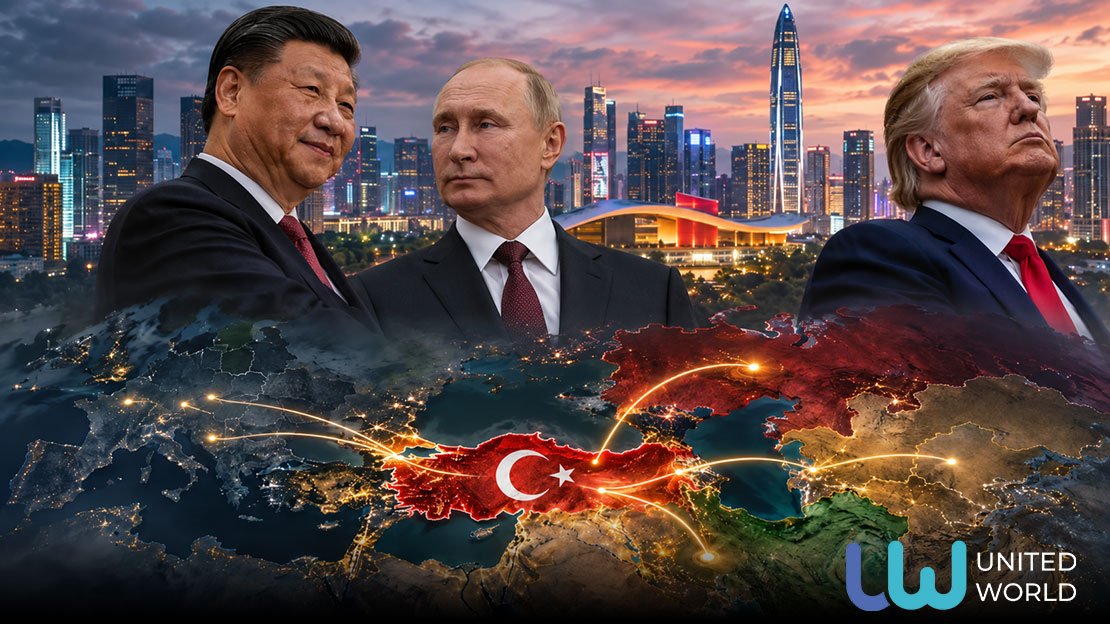
US President Trump, Russian President Putin, and President of China Xi Jinping met in Shenzhen on November 19, 2026.
From the approximately 90-minute “Trilateral Summit” resulted in a four-point declaration encompassing the following issues:
1- Reforming the UN
2- Increasing the production and supply of refined petroleum products and reaffirming the importance of stable energy flow
3- Recognizing immunities of State officials and that International Criminal Court and other similar bodies must not abuse their jurisdiction
4- A nuclear war cannot be won and must never be fought, and the three countries will conduct a dialogue on reducing nuclear risks and preventing the proliferation of nuclear weapons.
Even prior to the declaration, the fact that the presidents of the US, Russia and China came together in a trilateral format was enough to capture the attention of the entire world.
What does the Trilateral Summit tell us? Below is UWI author, Associate Professor Onur Sinan Güzaltan’s evaluation.
—
No longer the world’s policeman
With this summit, the Trump administration has effectively acknowledged that the US is no longer the world’s policeman. By signing the four-point declaration, Washington has also, at least partially, recognized the multipolar world. To understand the significance of this shift, we should remember the situation in the 1990s where the US considered itself the world’s sole superpower and global policeman, seeking to impose its own rules everywhere in the world.
Russia’s resistance in Ukraine, Iran’s resistance in the Strait of Hormuz, the Palestinian people’s years of resistance in Gaza and the West Bank, and other resistance movements against imperialism all over the world have brought the US down from its policeman position. This summit marks the first document, the beginning of a formal recognition, of this new reality. That is why it is a historic meeting.
Will the declaration be translated into practice?
Of course, we still need to see how far these commitments in this four-point declaration will be translated into practice. For example, will the US be able to impose its terms on the Kiev government, convince its European allies to accept this, restore relations with Russia and change their policies toward China? Then there is the question of Iran, which remains unresolved. But what I am emphasizing is that the summit and the agreement themselves represent a major turning point.
“Middle Easternization” of Europe
Another major point to draw from this summit is that Europe is becoming the “new Middle East”. Since the late 19th and early 20th century, Europe treated the “Middle East” almost like a dish on a menu, something waiting to be carved up. Today, what is called the “Middle East” is becoming “West Asia”, while Europe is turning into the Middle East”. Europe’s absence from this summit is a direct consequence of this.
Europe’s policies toward Eurasia, particularly regarding Ukraine, have been disastrous. Europe has shot itself in the foot. Through its own decisions, it has undermined its economic system, political structure, demographic balance and broader social order. Yet geographically and economically, Europe and Russia should be natural complementary partners as history shows. However, European political leaders decided to place their future on the other side of the Atlantic, and today, Europe has virtually disappeared from the center of world politics. This is another reason why the composition of this summit is so significant.
I believe a major political rupture is approaching across Europe. In fact, it has already begun. There are street protests, mass movements, political unrest, demographic problems, economic crises and even attempts at civilian coups like in Poland. I do not believe Europe’s current governments will be able to stay in power for much longer. I think all this points to the fact that Europe is approaching a decisive choice: either losing its place in history within the Atlantic system or returning to what geography, economics and historical relations naturally require: cooperation with Türkiye, Russia, and Eurasia in general.
Türkiye’s “policy of balance”
Lastly, looking at the summit as it relates to Türkiye, the first point to take into consideration is the current Turkish government “policy of balance” between the US and Eurasia. At times, it tried to counterbalance Eurasia, Russia in particular, with the US, at other times, vice versa. Sometimes the government moved closer to Iran, but had periods of tension with it at other times.
However, at a point where the major powers are together establishing a new international framework, Türkiye needs to adopt much clearer policies on fundamental strategic issues. Take Ukraine, for example. The Turkish government’s position has been inconsistent. On the one hand, Türkiye does not participate in Western sanctions on Russia, and the two countries maintain cooperation in various fields. But on the other hand, Ankara repeatedly expresses support for the Kiev government and supports the Coalition of the Willing led by Europe. Or take Iran as another example. At the beginning of the latest war, the Turkish government adopted an ambiguous position, and didn’t stand behind Iran. Although its position changed as during the war, the ambiguity prevailed.
Türkiye’s “remarkable room for maneuver”
Still, Türkiye has an enormous range of opportunities before it. As I mentioned, Europe is searching for a new direction. Russia has resisted the Atlantic and achieved a certain degree of success. Iran has also resisted and continues to resist, dealing heavy blows to the petrodollar system which lies at the heart of American economic power in the Strait of Hormuz. In this landscape, Türkiye has remarkable room for maneuver across an enormous geographical area stretching from Europe to Russia, from Iran to Central Asia.
Türkiye can use its geographical position and diplomatic relationships to assume a central position in regional cooperation. With that, Türkiye could contribute to the process of ending American influence in West Asia. To capture this opportunity, Türkiye needs to free itself completely from American and Atlantic influence and abandon the outdated foreign policy approaches inherited from the Cold War. And it does not necessarily have to adopt an openly confrontational position toward any particular country. After all, we see that the US is weakening.
We have already seen in Europe where the old Cold War paradigm leads. Europe’s political decline is largely the result of its inability to read the course of events in the world. Türkiye must avoid making the same mistake. We have far more room for maneuver than Europe.