


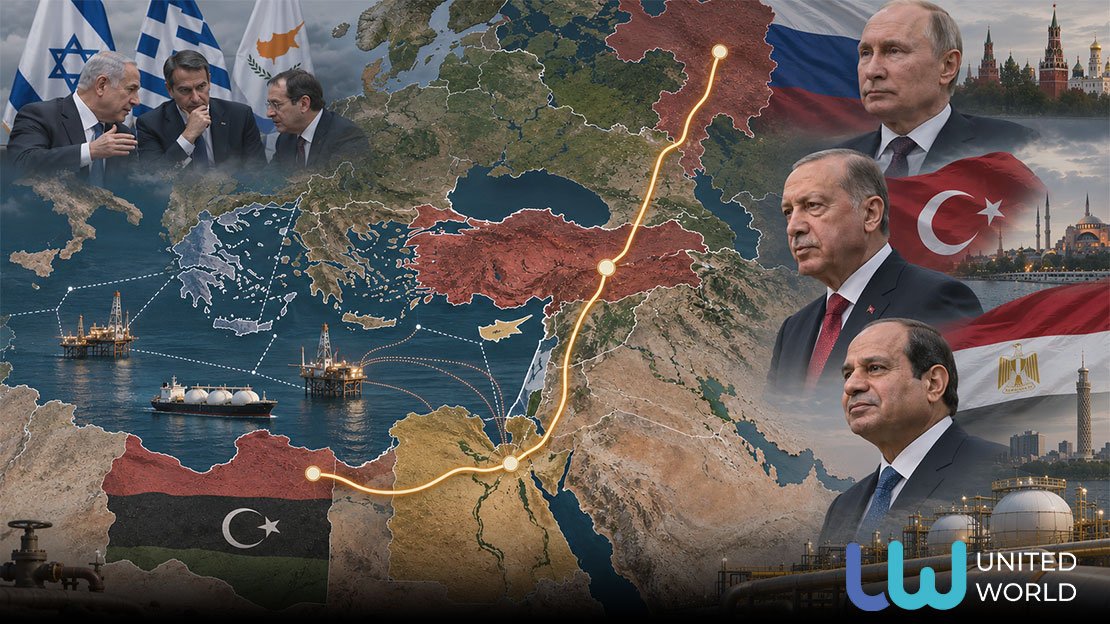
On 25 November, Libya’s eastern-based parliament approved the agreement signed between Türkiye and Libya’s then-internationally recognized Government of National Accord on 27 November, 2019.
As reported in the Anadolu Agency, with the approval of the agreement, all official procedures for the memorandum of understanding on the delimitation of maritime jurisdiction areas in the Mediterranean have been completed.
The agreement consists of six articles and two annexes, establishing the boundaries of the continental shelf and exclusive economic zones between Türkiye and Libya based on 36 geographical coordinate points.
The day after the agreement, Turkish President Recep Tayyip Erdogan hosted Khalifa Haftar, General Commander of the Libyan National Army controlling eastern Libya, in Ankara on Wednesday.
UWI author, political scientist Associate Professor Onur Sinan Güzaltan was guest to a live program of Türkiye’s Ulusal Kanal.
—————————————————————————————————————————————–
Mr. Güzaltan, we would like to hear your initial reaction to Libya’s eastern-based parliament’s approval of the agreement signed between Türkiye and Libya’s internationally recognized Government of National Accord in 2019.
The fact that Türkiye’s maritime delimitation agreement with Libya has now been endorsed by all sides in Libya gives the agreement a greater weight.
Secondly, Haftar’s visit shows that he and the forces behind him have come to realise that they cannot reshape Libya’s political landscape on their own. They have therefore opted to reach an understanding with Ankara.
Question over Haftar’s visit
One point deserves particular attention here. Haftar visited Ankara, but he is also in contact with Qatar and Egypt. This raises two important questions that have yet to receive much attention in publicly available sources: How does Russia view Haftar’s visit to Türkiye? And how does Egypt see it? Is there a joint initiative at work here? The possibility of Türkiye, Egypt and Russia working together to establish political stability in Libya has been on the agenda for some time. We know that certain steps have already been taken in that direction. Was Haftar’s visit part of this broader framework, or was it an initiative undertaken independently by Ankara? The answers should become clearer in the coming days. For now, we know that Moscow has recently shown a willingness to work with Ankara on Libya.
Egypt’s reservations about the agreement
We also know that Egypt has certain reservations about the agreement. But as experts have pointed out, Egypt stands to lose maritime areas under agreements with Greece or the Greek Cypriot Administration of Southern Cyprus compared with what it could secure through an agreement with Türkiye. This could provide a basis for negotiations. This point was first raised by the late Admiral Soner Polat during meetings in Egypt around ten years ago.
How do you think these developments will affect the positions of Egypt, Russia and the United Arab Emirates in Libya?
There have been joint initiatives in the past. As you know, Türkiye and Egypt have gone through a process of normalization. The presidents of the two countries have met, reciprocal visits have taken place, and one of the key issues on their agenda has been Libya or, more precisely, the Eastern Mediterranean and Libya in connection with it.
There had already been talk of Ankara and Cairo taking joint initiatives. There were even reports in the press suggesting that this cooperation was beginning to take concrete shape in certain respects. Should we interpret Haftar’s visit within this framework or is it something different?
The Eastern Mediterranean is a structural issue in Turkish-Egyptian relations, as is Libya by extension. Egypt shares a long land border with Libya, and developments there are therefore a matter of national security for Cairo. This makes cooperation between Türkiye and Egypt particularly important.
As for the United Arab Emirates, it is not an actor shaping the regional order but rather a spoiler. It has close relations with Israel. The key geopolitical triangle here is the one between Ankara, Cairo and Moscow.
The central question for a possible Türkiye-Egypt cooperation
Suppose Ankara and Cairo were also to sign a maritime delimitation agreement. How would such a scenario reshape the Eastern Mediterranean?
This has essentially been the central question for years. Much of the discussion surrounding Türkiye’s relations with Egypt has revolved around it. The issue is how to put Turkish-Egyptian relations on a lasting structural footing. Trade continues, reciprocal visits are taking place, diplomatic relations have been normalized, and numerous projects are underway, ranging from a joint university project to cooperation in various other fields. All these are good for regional peace and cooperation. However, the way to give cooperation between Ankara and Cairo a permanent foundation is a maritime delimitation agreement in the Eastern Mediterranean. If such an agreement were signed, relations would no longer be so easily disrupted, regardless of who held power in either country.
Is this a realistic possibility? Yes, it is. I hope it happens. It would transform the entire geopolitical equation in the Eastern Mediterranean.
“North-south axis”
As for Russia’s position, the Eastern Mediterranean is home to natural gas deposits and other energy resources. Russia possesses extensive technological expertise in the extraction and processing of such resources. Ankara, Cairo and Moscow could reach an agreement on these energy resources drawing on Russian know-how.
What I envisage here is a north-south axis. Picture a map stretching from Moscow through Ankara down to Cairo. It is an almost straight line. A strategically significant axis could be established along this line, bringing about lasting changes in the Eastern Mediterranean, Eurasia and West Asia alike.
Other countries bordering the Eastern Mediterranean could also be incorporated into such a framework like Syria and Lebanon.
There is no reason why such an alignment should not be established as a counterweight to the Western-backed forces involving Israel, Greece and the Greek Cypriot Administration of Southern Cyprus.
“Türkiye is up against an extensive bloc”
The US, the EU, Israel and Greece were quick to express their opposition to the Türkiye-Libya agreement. What kind of moves might we expect from these countries?
They may resort to all sorts of provocations to undermine Türkiye’s relations with Libya and Egypt or destabilize the Eastern Mediterranean.
Türkiye is up against an extensive bloc in the Eastern Mediterranean: Israel, Greece and the Greek Cypriot administration at the forefront, Brussels, Berlin, Paris and London and Washington behind them. It is a broad front.
Türkiye’s response should therefore go beyond the agreement with Libya, consolidating it through regional cooperation. That would enable Türkiye to defend its rights more effectively.
What troubles Israel most in the region
The defense minister of Israel, Israel Katz, expressed concern over Türkiye’s “dangerous adventures in Syria. Do you think Syria and Libya are connected in some way?
What troubles Israel most in the region, as the experience of recent decades has shown, is regional cooperation. Ankara and Cairo, Ankara and Tehran, Tehran and Cairo, etc: cooperation between these countries is what concerns Tel Aviv above all else. The most effective response to Tel Aviv is therefore to broaden and deepen regional cooperation.
As for Syria, Israel is not happy with Türkiye’s influence in Syria. Judging by Tom Barrack’s remarks, the US is seeking to reconcile Ankara and Tel Aviv on certain issues.
Haftar’s policy change is positive
One final question concerning both the maritime agreement and Haftar’s visit to Türkiye. Until recently, Haftar had kept its distance from Türkiye’s Libya policy. How do you interpret his policy change?
They failed to take control of Libya. He opted to reach an understanding with Türkiye and the forces Türkiye supports in Libya. I believe the rapprochement between Türkiye and Egypt also played a part in this shift. Remember Egypt had been providing political support to Haftar’s forces through the shared border between Egypt and Libya.
Haftar’s policy change is a positive change. To consolidate these gains, we need the kind of regional cooperation I have been describing.