


By Meral Akkaya
The planned visit to Bulgaria by Bartholomew, the Fener Greek Patriarch, has sparked controversy. Invited by the Holy Synod of the Bulgarian Orthodox Church, Bartholomew is expected to preside over a religious service at Rila Monastery, one of Bulgaria’s most important religious centers, on October 19.
The visit has met with strong opposition from within the Bulgarian Orthodox Church. An “Open Letter of Sorrow,” signed by clergy, monks, and laypeople, voices opposition to Bartholomew’s visit.
The letter criticizes the Patriarch for his claims to ecumenical authority and his actions leading to the division of the Church in Ukraine.
The signatories describe the prospect of Bartholomew presiding over a service at Rila Monastery as “spiritually and canonically unacceptable.” Bulgarian clergy and members of the Orthodox community have called for the visit to be canceled. A petition supporting the letter has gathered more than 2,000 signatures and has been submitted to the Holy Synod of the Bulgarian Orthodox Church.
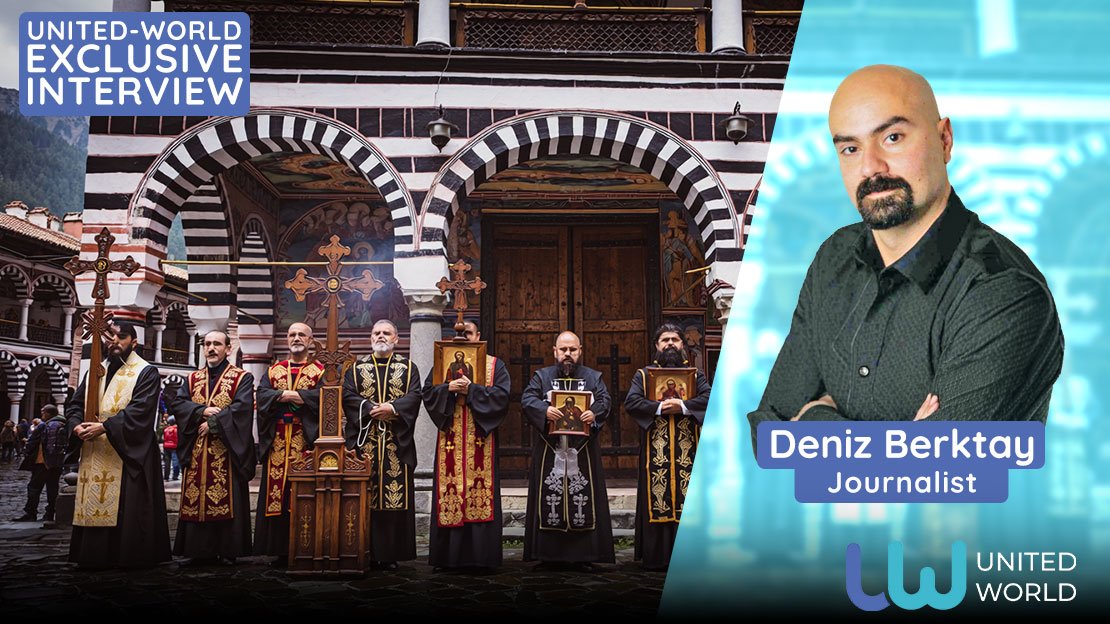
Journalist Deniz Berktay, who lives in Kyiv, spoke to Meral Akkaya from “Aydınlık Europe”. Berktay, author of The Fener Greek Patriarchate in the Russia-West Conflict, gave an account of the political and historical factors behind the petition in Bulgaria.
—
Not just about religion
Patriarch Bartholomew, who has made headlines over the past year for complaining about Türkiye to the US administration and whose position Washington has sought to strengthen, has now become the center of controversy in Bulgaria. A statement that has already attracted thousands of signatures warns that the Patriarch will seek to impose “foreign geopolitical and religious agendas” on Bulgaria.
Let me make one thing clear from the outset: Neither this visit nor the reactions to it are simply about religion. They are closely connected to geopolitical disputes that also directly concern Türkiye.
The Patriarch is the only invitee
The Patriarch’s visit to Bulgaria is connected to commemorations marking the 1,050th anniversary of the birth and the 1,080th anniversary of the death of Saint Ivan of Rila, who is regarded as Bulgaria’s patron saint. In July, the Holy Synod of the Bulgarian Orthodox Church, its governing body, sent Bartholomew an invitation to attend these commemorations.
However, as the petition points out, although there are sixteen independent Orthodox churches worldwide, including churches such as those of Alexandria and Antioch, which are older than the Patriarchate of the Fener, none of their leaders were invited. The invitation was extended exclusively to the Patriarch of the Fener.
The US and Western influence
The opposition to the Patriarch’s visit in Bulgaria has two dimensions.
The first concerns the role of the Patriarchate of the Fener in international politics. Since the second half of the 1940s, the US and the Western world more broadly have used the Patriarchate as an instrument for bringing Orthodox populations in Eastern Europe and the Middle East under Western influence.
Of all those who have occupied the patriarchal throne of the Fener, Bartholomew is one of the two most closely aligned with US policies. (The other was Athenagoras, who became Patriarch in 1948 following direct US intervention. He was the leader of the Greek Orthodox community in the US. He was flown to Türkiye aboard a special aircraft provided by then-US President Harry Truman, granted Turkish citizenship at extraordinary speed, and elected Patriarch.)
Without doubt, one of the motives behind Bartholomew’s interest in Bulgaria is to strengthen US influence in the country as part of the broader power struggle between Washington and Moscow. However Bulgaria, being a country where Slavic culture and Orthodoxy are predominant, and due to its critical location on the Black Sea and in the Balkans, is a country that Russia absolutely does not want to leave to the West’s sphere of influence. So Moscow is also seeking to strengthen its influence in Bulgaria. One important element of this effort is the dialogue between the Russian Orthodox Church and the Bulgarian Orthodox Church.
Between Russia and the West
It is also important to recognize that Bulgaria’s attitude toward Russia is not straightforward.
There is widespread sympathy for Russia among Bulgarians, rooted not only in religious and cultural ties but also in the role Russia played in securing Bulgaria’s independence. But Bulgarian society often sides with the West when immediate practical interests are at stake. For example, although Russia is commonly referred to as Bulgaria’s “liberator,” Bulgaria sided with Germany in both the First and Second World Wars. Nevertheless, Bulgarian leaders at the time were mindful of the strong pro-Russian sentiments among their population, and Bulgarians and Russians did not directly confront each other on the battlefield, with the exception of the Dobruja Front during the First World War.
These historical dynamics are important to understanding contemporary Bulgarian politics. Just as Bulgaria has long wavered between Russia and the West, its attitude toward the Patriarchate of the Fener has also been marked by similar fluctuations.
History of the Fener with Bulgarians
The second dimension concerns the historical relationship between the Patriarchate of the Fener and the Bulgarian people.
During the Ottoman period, particularly after the conquest of Constantinople, the Patriarchate of the Fener, historically known as the Church of Constantinople, was granted powers far exceeding those it had possessed even under the Byzantine Empire. The Greek Patriarch was placed in authority not only over ethnic Greeks but also over other Orthodox peoples, including Serbs, Bulgarians, and Romanians. Moreover, this authority extended beyond religious affairs to secular matters, including judicial proceedings.
The Patriarchate used these powers to pursue an extensive campaign to Hellenize the Bulgarian population. In the eighteenth century, it even succeeded in securing a complete ban on Bulgarian-language education and publications. This is why the Bulgarian nationalist movement, which gained strength during the nineteenth century, sought religious independence from the Greeks before achieving political independence from the Ottoman Empire.
In 1870, the Ottoman government authorized the establishment of the Bulgarian Orthodox Church, having come to recognize that the Patriarchate of the Fener was increasingly supporting Greek nationalism. The Patriarchate, however, refused to recognize the Bulgarian Orthodox Church.
Only in 1945, after the Soviet government had provided substantial financial assistance to the Fener through the Russian Orthodox Church, the Patriarchate finally agreed to recognize the independence of the Bulgarian Orthodox Church. However, even today the Patriarchate of the Fener appears intent on interfering in the internal affairs of the Bulgarian Orthodox Church.
The framework of Lausanne
For the Patriarch of the Fener to step outside the framework established for him by the Treaty of Lausanne implies the emergence of a structure that interferes in the political affairs of neighboring countries, which Türkiye cannot oversee but the USA can.