


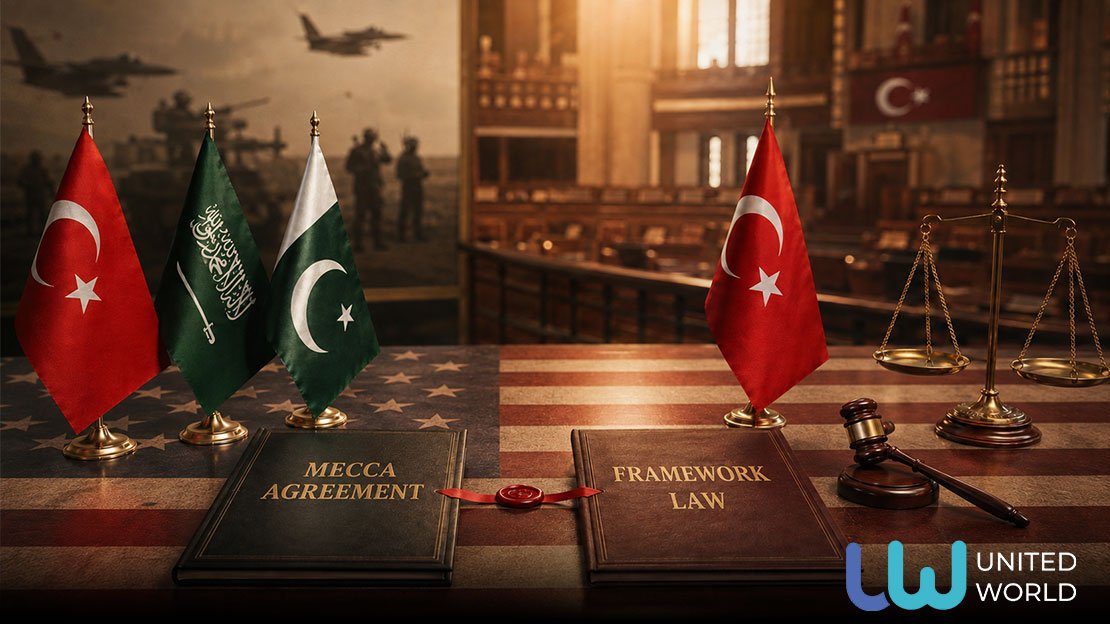
In recent days, two mutually reinforcing developments have taken place in Türkiye regarding the government’s new political orientation: the Mecca Agreement signed between Türkiye, Pakistan, and Saudi Arabia, and the Framework Law passed by Parliament.
The Mecca Agreement: a step in line with the US’ new strategy
There are several indications that the government has abandoned the carefully calibrated “policy of balance” between West and East that gained momentum starting from 2015 and continued until recent years, and has instead embarked on a course that places greater emphasis on relations with the US/NATO:
1. The “neutral” and “mediatory” approach during the war launched by the US and Israel against our neighbor Iran,
2. The deepening of relations with Ukraine and the distance from Russia on certain issues,
3. Commitments in bilateral relations with the US (the comprehensive and long-term LNG agreement, preparations for a return to the F-35 program, ongoing US-Türkiye cooperation in Syria, and the issue, raised by journalists close to the government, of transferring the S-400 systems to another country, etc.)
4. The government’s statements in support of the US-led NATO alliance at the summit held in Ankara, together with concrete steps taken in the same direction (the deployment of Patriot systems in Türkiye, the expansion of NATO engagements at various strategic points, above all the Turkish Straits, etc.)
We could extend the list.
The Mecca Agreement signed on August 7 takes on its full meaning when viewed within the framework of the government’s new orientation.
At the same time, any proper assessment of the agreement must also take into account the changes in Washington’s strategy toward West Asia.
As US Ambassador to Ankara Tom Barrack has repeatedly stated, the US has moved toward a strategy aimed less at directly controlling West Asia and more by giving greater room to “friendly states” in the region.
Within this framework, and to strengthen its relations with governments with which it maintains close ties, particularly Ankara, the US has curtailed, at least for now, its support for the PKK/YPG and similar ethnic and religious-based terrorist organizations.
In parallel with this, Washington has adopted what may be described as a more flexible approach toward countries it defines as “allies.” It no longer automatically opposes their room for maneuver in the region so long as their actions don’t directly conflict with US interests; it even supports them to the extent that they are consistent with its interests.
From the US perspective, the red line is that their room for maneuver must not threaten US-Israeli interests in the region and strengthen Iran, which Washington regards as its principal enemy there.
This shift in US strategy toward West Asia is a consequence of the weakening of American hegemony and the growing trend toward multipolarity among West Asian countries, as elsewhere in the world.
The Mecca Agreement signed by Türkiye, Pakistan, and Saudi Arabia does not contradict this new US regional orientation.
Nor does the agreement pose a threat to Israel.
Saudi Arabia is at war with the Houthis, who threaten US-Israeli interests through the Bab al-Mandab Strait, and has good relations with Iran.
Pakistan may seek a certain balance on particular issues, but it nevertheless continues to feel the weight of US influence.
Viewed from this perspective, it wouldn’t be inaccurate to identify certain parallels between the Mecca Agreement and the 1955 Baghdad Pact of the Cold War era which included the US and the UK.
The periods are, of course, different. Today, unlike during the Cold War, it is no longer possible to speak of full US control over its regional “allies.” Precisely for this reason, Washington has adopted a more flexible policy toward them. So long as their actions are not directed against the US and Israel and don’t align with the regional interests of Iran, Russia, or China, Washington is open to a broader range of initiatives by its “allies,” including the formation of new alliances.
Regional developments, the Framework Law, and the American trap
Since the overthrow of Bashar al-Assad’s government, the US scaled back its support for the PKK/YPG terrorist organizations it had used as a ground force in the region and moved toward supporting the al-Sharaa government. During this period, the idea of the PKK/YPG being integrated into the central government in Damascus through a “political solution” came to the fore.
This was compatible with the Turkish government’s Syria policy and gave fresh momentum to relations with the US.
Against the backdrop, a new process with the PKK, officially named as “Terror-Free Türkiye”, started in Türkiye’s political agenda. The timing matters.
The connection between this process and developments in Syria and the region is evident.
The US first brought down the government in Syria. It then targeted Iran-linked groups in Syria, Lebanon, Iraq, Yemen, and across the region, before ultimately attacking Tehran itself.
While attacking Iran, Washington has simultaneously dangled before other regional countries the prospect of filling the “vacuum” that would supposedly emerge if the government in Tehran were to fall.
Washington has taken steps aimed particularly at strengthening relations with Türkiye and has pursued policies, including concessions, designed to keep Ankara “neutral” at the very least on Iran.
This is the reality behind Trump’s statements and moves praising the Turkish government.
Washington’s decision to limit its support for the PKK/SDF and to back the new process in Türkiye is also part of the US strategy I’ve sketched above.
The US is promising the Turkish government greater room for maneuver in the areas that would supposedly be left open if the Iranian government were to collapse. As part of this, the US is proposing to Türkiye a project of patronage over the Kurdish population in the region.
This project is nothing new.
In different forms, it was previously presented to the Turgut Özal government in connection with Iraq and later to the AKP during its first “process” with the PKK.
And it is precisely at this point that a link can be detected between the Mecca Agreement and the Framework Law.
While attacking Iraq and Syria and, in essence, clearing greater room for Israel, the US sought to win over regional countries, Türkiye foremost among them, with the false promise that “you will fill the vacuum.” What we are witnessing this time in the context of the attack on Iran is the same thing.
The US is attempting to impose on Türkiye an “expansion” in the short term but a “contraction” in the long term, packaged as the “acquisition of new areas of influence”.
The political, economic, and demographic costs of the mistakes made in Iraq and Syria are already plain to see. It is clear that the price of submitting to the US’s plans will be a heavy one, once again.
Moreover, the world is changing.
The US has failed to bring Iran to heel.
Israel, Washington’s regional outpost, is increasingly isolated and beset by crises.
Globally, the trend toward multipolarity is gaining strength.
Under these conditions, attempting to tie Türkiye’s future to the US amounts to nothing but perpetuating the deadlock.