


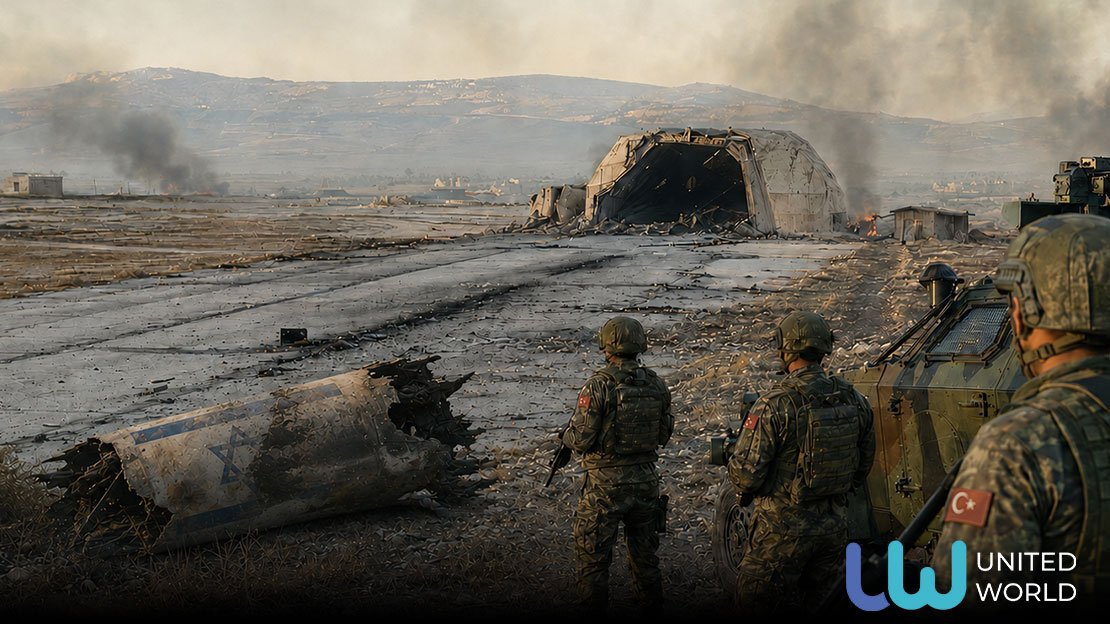
Israel bombed the Abu al-Duhur airbase in the Idlib countryside of northwestern Syria on August 18, just 70 kilometers from Türkiye, citing the presence of Turkish troops as justification.
On August 19, telling an army radio podcast, Netanyahu said that Israel had initially sent a message “in general terms” against a Turkish military presence at an airfield near Aleppo. “Apparently they didn’t hear it, so we made sure they understood it more clearly,” he said, and added, “We will not tolerate a Turkish military entrenchment moving southward, because it threatens us”.
On August 20, Israeli Defense Minister Israel Katz said that Turkish President Recep Tayyip Erdoğan is “dragging Türkiye into dangerous adventures in Syria” and “Israel will not allow any entity to threaten its security”.
The Israeli press, meanwhile, described the strike as a move made in full awareness of the risk of a direct confrontation with Türkiye.
UWI author, Associate Professor historian and political scientist Mehmet Perinçek, joined Türkiye’s Ulusal Kanal live to comment on the Israeli bombardment.
We share Perinçek’s assessment with our readers.
—————————————————————————————————————————————
Israel capitalizes on Türkiye’s vulnerabilities
Netanyahu has openly said that Türkiye was the direct target of this Israeli strike. Are they trying to test Türkiye? There are also analyses suggesting that Netanyahu is doing this with the upcoming elections in Israel in mind. How do you see it?
They are trying to test Türkiye, that much is true. And they are also trying to capitalize on Türkiye’s vulnerabilities. The Turkish government’s policy today is entirely tied to US foreign policy and strategy. That gives Israel a very serious advantage.
As has been pointed out many times by many, if Türkiye were to enter into a conflict with Israel, or even if tensions were to escalate, it is quite clear that the US wouldn’t side with Türkiye. Yet the Turkish government’s approach is to try to restrain Israeli aggression through cooperation with the US, or more precisely, by operating within the framework of US strategy. But as long as Türkiye does so, it becomes cut off from its real allies. Who are those allies? Iran, RRussia,and China.
Türkiye moving away from Russia, IIran,and China
Just look at the developments of the recent period: Türkiye signing the Mecca Agreement; its position on Ukraine, including increased arms sales to Ukraine; its failure to speak out against Ukrainian attacks on Turkish ships in the Black Sea because it finds itself on the same side as Ukraine within the broader US strategy; and its participation in the “Trump Route” project in the South Caucasus. All of this is pulling Türkiye away from Russia, Iran and China, and, in fact, away from what one of the government’s own partners has called the “TRÇİ” (The initials of Türkiye, Russia, China and Iran iin theTurkish alphabet). Breaking away from the TRÇİ alliance means leaving Türkiye isolated in the face of threats from the West and Israeli aggression.
Israel’s “messages”
Israel’s “messages” are not confined to Syria. We are seeing similar developments in the Eastern Mediterranean and in Cyprus. In fact, the Cyprus-Eastern Mediterranean question and the Syrian question have become closely intertwined, turning into a single front. The Greek Cypriot administration of Southern Cyprus is signing major agreements with the Damascus administration while sidelining the Turkish Republic of Northern Cyprus (TRNC). At the same time, policies aimed at cornering the TRNC are being pursued both by Israel and by Atlanticist forces in Europe.
Faced with all this, Türkiye needs allies to counterbalance these threats. And those allies can only be countries facing the same problems and the same threats: Iran, RRussia,and China. By acting together with these countries, Türkiye can draw on their economic and military strength, as well as their energy resources, to stand up to these threats. But once you place yourself inside the US strategy, you become estranged from those countries, as we are seeing today, and you turn yourself into an easy target.
Easier to target
In fact, the US and Israel are pushing Türkiye into a very dangerous trap. They are both using Türkiye within their own plans against Eurasia and rendering Türkiye much easier to target by isolating it and driving a wedge between Ankara and its real friendly countries. Actually, Türkiye itself too contributed to open the door to becoming such an easy target when it helped overthrow Assad and became part of US plans. And unfortunately, the Turkish government has continued down that road with determination. In the South Caucasus, in Syria, and in Palestine, it has effectively hitched Türkiye to US plans.
There is another factor that has emboldened Israel enough to carry out an attack like this: Türkiye’s growing orientation toward the West and the Atlantic system in the field of defense and the defense industry. Türkiye had perhaps broken with that trajectory when it purchased the S-400s; in fact, it was almost revolutionary for Türkiye. But the more Türkiye became embedded in US plans, the more it began backing away from the S-400s and turning again toward the F-35s and European and American systems. Israel knows very well that, in the event of a confrontation with Israel, Türkiye would not be allowed to use those systems against it.
“”How far”could Israel go?
You spoke of a “single front” comprising the Eastern Mediterranean, Cyprus and Syria together. Analyses appearing in the Israeli media portray Türkiye’s moves in Cyprus, Libya, Somalia and the Eastern Mediterranean as a threat. With that in mind, what might we see in the period ahead? How far could Israel actually go against Türkiye?
How far Israel could go ultimately depends on the policies of the Turkish government. And it is not just about Israel. How far the US could go with its arrogant, bullying posture also depends on the stance of the Turkish government.
We can go even further than that: whether we are dragged into a world war, whether a major regional or global war breaks out, is closely connected to Türkiye’s position. If Türkiye takes the necessary precautions, builds the right alliances, and creates enough deterrence to prevent hostile powers from embarking on such adventures, then neither Israel nor the US can go “too far.”
The gap between the needs of the government and those of the country
How can Türkiye achieve that? The first condition is for Türkiye to establish a national government and carry out a production revolution. A government capable of doing that could strengthen the home front economically and militarily, while also building the right alliances in foreign policy and achieving concrete successes. It has now become qobviousthat the AKP government is no longer capable of meeting these needs.
Second, as I said, if the TRÇİ alliance can be established, it can put an end to brazen acts of aggression of this kind by Israel. It could even help bring about the removal of the genocidal faction within Israel and put an end to Israel’s aggressive policies not only toward Türkiye, but also toward Palestine and the other countries of the region.
If Türkiye, Russia, Iran and China come together, they would form a very serious economic and military force and, at the international level, a major center of political gravity. Such an alliance would attract many other countries as well. That could include European countries. Europe is not made up only of those currently governing the continent. Main opposition parties that advocate European independence, a break with Atlanticist policies, and cooperation with Eurasian countries are on the rise.
A Turkish government of this kind, together with such an alliance, is precisely what could stop Israeli aggression and bring the wars in Ukraine and Iran to an end, preventing the escalation into a possible larger war.
The integration process in Syria
One final question on Syria. The integration process between the Damascus administration and the Syrian Democratic Forces (SDF) has now been completed. Do you think this marks the beginning of a new era in the country?
The answer depends on the broader strategy in which both Syria and Türkiye are operating.
In one respect, yes, serious blows are being dealt to the project of creating a “Second Israel,” a puppet “Kurdish state”. But still, we must be careful of the possibility of Syria itself as a whole turning into a puppet state .
Yes, it is undoubtedly a positive thing that the SDF, the PKK, the autonomous administrations controlled by terrorist organizations in Syria are being integrated into the central government. But if you hand over all of Syria’s resources to US companies such as ExxonMobil, and if you lock the country into strategic agreements, economic agreements and trade-route arrangements with the US and the West, then you are risking effectively turning the entire country into a puppet state.
Damascus is now entering into cooperation with the Greek Cypriot administration. If we look at the implications for the Eastern Mediterranean, this would mean an area along one of the Mediterranean’s most important coastlines effectively being handed over to Atlanticist powers, in cooperation with the Greek Cypriot administration.
The gains achieved against the PKK and the SDF need to be crowned with the right strategy. If you remain inside US plans, if you get into in efforts to “create alternatives to the Strait of Hormuz” against Iran, or if your approach is, “There is a vacuum in the region, so let’s fill it and profit from the opportunities that cooperation with the US and Europe can offer,” then you cannot achieve any real success.
I don’t think the US would be particularly unhappy to see the whole of Syria turned into a puppet instead of merely establishing a so-called “Kurdistan” in a specific part of the country. In fact, that would fit Trump’s policy of plunder and seizing control of energy resources even better. That is what they did in Venezuela and what they have tried to do in Iran.
The matter in Syria is not only about getting rid of the PKK and the SDF, but also about freeing Damascus from US influence and preventing Syria’s coastline from falling under US control.