


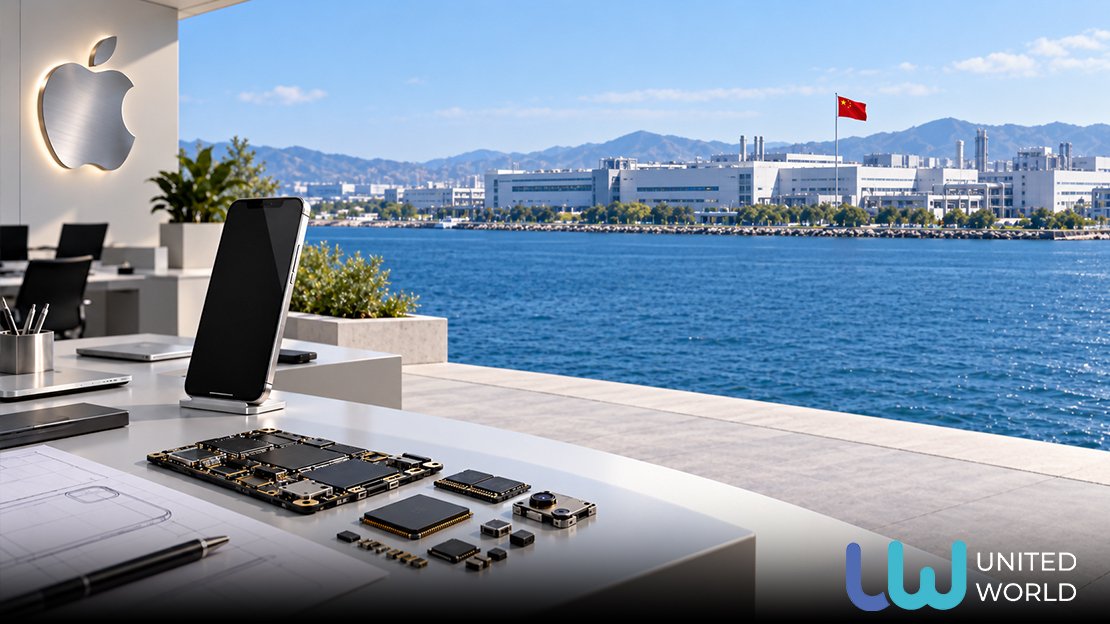
The supremacy of Apple in the international market is sustained by a paradox it cannot sustain any longer. On one hand, its branding and positioning are centered on seductive design, excellent user experience, and Silicon Valley innovation principles. Underneath, however, lurks a maze of supply chains, their core located in China’s manufacturing regions. The “Designed in California, Made in China” slogan does not merely denote a branding tag. This is geopolitics. An increasing geopolitical challenge as the rivalry between the US and China grows and both sides demand independence in technologies and supply chain management and weaknesses become evident amid recent shocks. Apple represents an example of a longtime poster child of globalization.
While the ability to orchestrate a supply chain across dozens of countries, with final assembly in China, had been an economic miracle of Apple, China’s role in its production has become a strategic burden for the company. As Washington steers its foreign policy toward decoupling from China and the latter is becoming increasingly focused on indigenous innovations and independent supply chains, Apple risks falling apart under pressure from both sides. The champion of smooth integration faces the pressure of disintegration at this stage.
Relocation is certainly possible as Apple already begins to shift some assembly operations to such countries as Vietnam, India, and others.
However, none of these actions is completed, gradual, and marred by difficulties. The Chinese ecosystem includes not only the final assembly process but also levels of suppliers, logistics, skilled personnel who can adapt to specific requirements for production. No other country provides such extensive opportunities for this particular kind of production, despite the attempts by other countries, such as India, to lure production away from China. Even when iPhones start being manufactured in India, it still relies heavily on components provided by China, China-based intellect, and even engineers brought in from China in order to fill up the skill gap. China benefits from this relationship too.
Indeed, by using its partnership with the global corporation, Beijing managed not only to take its economic benefits but also learned the lessons in how to develop its own champions, companies that compete on equal terms with their counterparts abroad. Chinese firms climbed up the value chain, reproducing Apple’s supply chains, designs, and other innovations before challenging it in international markets in sectors ranging from wearables to mobile phones to display technology. The presence of Apple in China always meant more than economic benefits because the latter served as a tool for technology transfer, a practice China seeks to continue. On the diplomatic level, Apple is prone to both threats and risks.
Politicians in the US have grown increasingly concerned with Apple’s heavy reliance on Chinese manufacturing capabilities and have raised questions regarding the working conditions in faraway factories. In China, the problem is not one of rejecting the company but entrapping it because of the strategic importance of Apple to its economy while maintaining distrust towards it. Apple has to abide by Chinese regulations on data, censorship, and other aspects of politics of technology that become increasingly pronounced as Beijing asserts its control over data flow. Apple’s position remains risky to shocks of various kinds because of the highly centralized nature of its supply chain. The coronavirus pandemic made it evident how central the Chinese factories were for the production of iPhones. When they closed in Zhengzhou, the shock wave reached the whole world. Geopolitical trouble spots or labor strikes can pose similar challenges. In an age of resilience, Apple finds itself lacking resilience.
There is also the issue of consumers and the reputation. The premium brand of Apple is built partly on its values, including ethics, privacy, and innovation. However, as awareness of geopolitics underlying the hardware increases, and as consumers learn about labor rights violations in Chinese factories, the gap between rhetoric and reality may prove to be unsustainable. Building its brand reputation on the principle of ethicality while maintaining its manufacturing supremacy in China may result in a reputational blow to the company. Thus, the logic of Apple’s production is incompatible with the world order in which the company operates.
This production logic emerged in the days of free markets, clear policy regimes, and inexpensive global capital. The contemporary world, in contrast, is characterized by techno-nationalism, trade fragmentations, and reassertions of sovereignty over silicon and data. In other words, the very dependence on China becomes a strategic constraint for the company rather than a base from which it achieved success. Apple is no longer a simple corporation but a geopolitical player regardless of its wishes.
It is involved in geopolitics as its decisions on where to produce and cooperate imply broader consequences for the economy and politics alike. Leaving China, or decoupling, theoretically seems easy but may involve a total revamp of Apple and its approach to supply chains, value propositions, etc. The question here is not whether or not it is capable of doing it but whether the world in which this was possible any longer exists.