

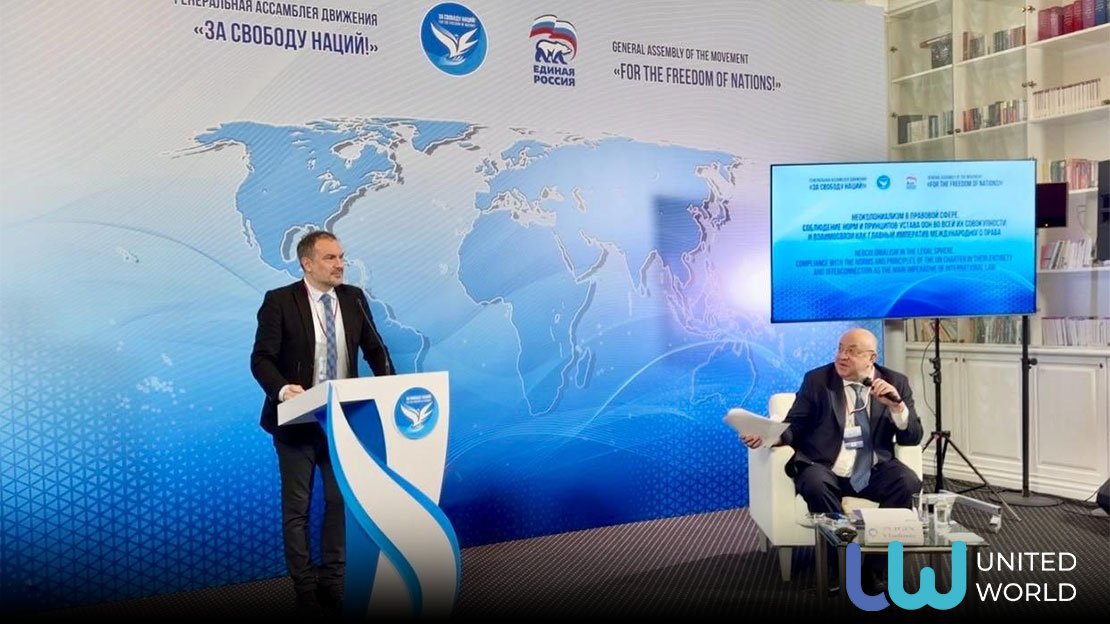
On November 14 to 17, the United Russia party, the country’s ruling party, hosted the General Assembly of the Movement for the Freedom of Nations in Moscow, where the common struggle against neocolonialism was discussed. The meeting, attended by 200 delegates from 72 countries, was largely dominated by representatives from ruling parties. From Türkiye, the AKP and the Vatan Party participated. The opening speech was given by Dmitry Medvedev, Deputy Chairman of the Russian Security Council, and President Vladimir Putin also sent a message. During the session on international law, Assoc. Prof. Dr. Mehmet Perinçek, the Vatan Party’s representative in Russia and a member of the Movement’s Experts Board, also delivered a speech. We are sharing the text of his speech with our readers:
When I entered Türkiye’s oldest law school, one of the first things our professors emphasized was that law and legislation are a set of rules established by those who wield the power to enforce them—that is, those who control the army, police, and gendarmerie. Consequently, it is impossible to speak of law without the power to enforce compliance and punish those who do not.
This is perfectly obvious when considering the situation at the level of individual states. However, if we look at this from the perspective of international law, which we are discussing today, we face a rather problematic situation.
Because in international law, there is no army, gendarmerie, or police. So, what will force countries to comply with international law, and who will punish those who do not? This question is even more pressing today. Because the attacks on Venezuela and Iran, in particular, have once again exposed one crucial fact: the Western world, the Atlantic world, has completely abandoned its founding principles. This attack effectively proclaims the death of liberalism, which has long been in its death throes. Western civilization was built on principles such as the protection of life and property, the security of trade, and the inviolability of the home—principles born out of the British, American, and French revolutions. Yet today we see the kidnapping of heads of state, open assassination on the leaders of other countries, threats to territorial integrity, and interference in the internal affairs of other countries in flagrant violation of UN rules, such as pirates hijacking merchant ships or attempting to confiscate legitimate assets held in Western banks.
The Atlantic system no longer even seeks a pretext for its aggression. It no longer attempts to legitimize itself through lies and deceit. It continues its attacks, openly admitting its crimes. We are experiencing postmodern banditry. We have reached a point where even the liberal principles of the capitalist-imperialist system are openly ignored.
Furthermore, the world also faces the threat of a major war. There is even talk of a possible global nuclear war. US and Israeli plans for Iran and the militarization of Europe justify these fears.
Now all data, even from within the Western world itself, show that US hegemony is coming to an end. The Atlantic bloc is losing its economic, military, political, and social dominance, and a multipolar world is emerging. Europe, on the other hand, faces the prospect of losing its pole in this multipolar world. The aggression we mentioned earlier, the flagrant violation of the most fundamental norms of international law, and the threat of a major war stem from this situation. Will the West accept these realities and resign itself to its fate, or will it rebel against its destiny by unleashing a major war?
Of course, the countries that have fallen victim to this aggression and threat of war will demonstrate determination to defend their rights under international law and will adopt an approach based on cooperation, dialogue, and coordination within this framework.
However, in the current circumstances, international law is insufficient to resolve the problem. For example, what international court ruling has been able to stop the genocide Israel is committing in Palestine? Clearly, international courts do not have the authority to resort to force against Israel.
The sovereignty and rights of our countries do not derive from international law. The source of our sovereignty and rights is the will of our nations, the strength of our economies, and, most importantly, the might of our armies. International law and so-called “international forces” understand only the ability of these combined forces to enforce the law. However, even this force, created by individual states, is insufficient. Although the force threatening us will be weakened, it is impossible to confront this threat alone and force them to respect our sovereignty.
Therefore, it is imperative for countries that have suffered from this flagrant violation of UN law to unite. In this context, a Türkiye-Russia-China-Iran alliance could play a vital role. Such an alliance would not only protect the sovereignty of these countries but also contribute to the construction of a new world order and the establishment of international law in a multipolar world. It would guarantee peace, stability, tranquility, international justice, and economic development in the world.
Only then will those who thirst for a world war, even a nuclear one, planned through Iran and Ukraine, be deterred; only then will the Zelensky regime, supported by Western warmongers, be prevented from attacking Turkish merchant ships in the Black Sea; only then will the resources of the Eastern Mediterranean be fairly distributed; only then will Latin American countries not be at risk of having their leaders kidnapped during night raids; only then will the plunder of Africa’s resources cease.
An alliance between Türkiye, Russia, China, and Iran is not an option, but a necessity, a task facing us.