


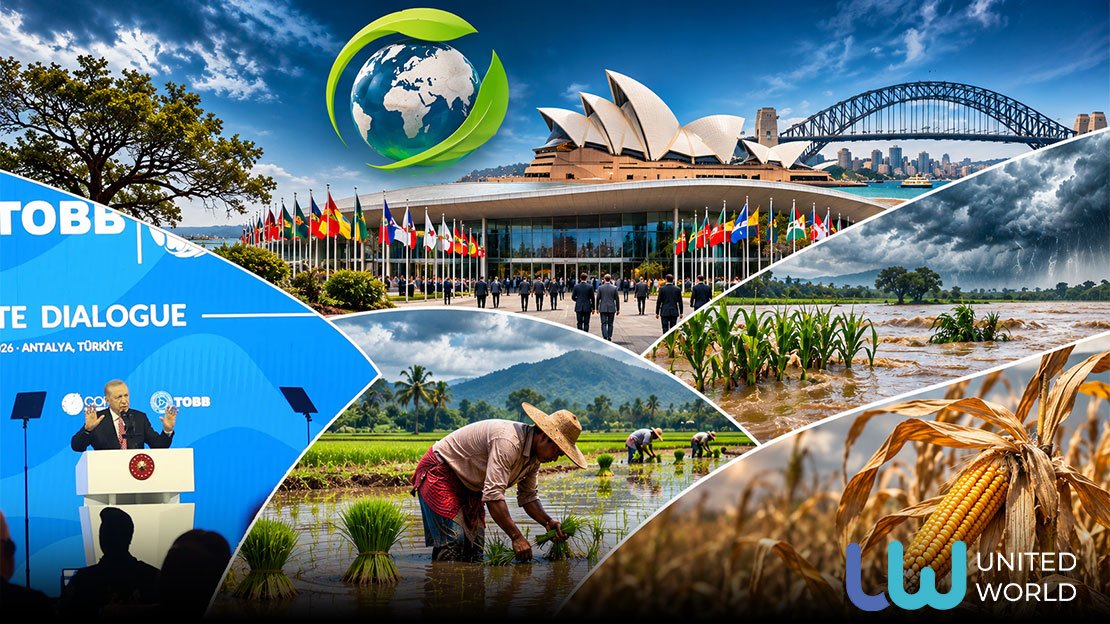
From Antalya, Türkiye
For generations, farmers have relied on the seasons to decide when to plant, when to harvest and how to secure enough food for their communities. But across much of the Global South, those familiar patterns are becoming increasingly unreliable. Droughts are intensifying, rainfall is arriving at unexpected times, and traditional agricultural practices are being disrupted by a changing climate.
At the United Nations COP31 climate conference in Antalya, representatives from countries already experiencing these changes are calling attention to a crisis that extends far beyond rising temperatures. For many communities, climate change is fundamentally transforming their relationship with land, water and food.
Their experiences reveal a common challenge: agriculture, one of the sectors most dependent on stable environmental conditions, is increasingly vulnerable to climate instability.
Fiji: When Traditional Knowledge Meets a Changing Climate
In the Pacific island nation of Fiji, Indigenous communities have long depended on knowledge passed down through generations to determine planting cycles, fishing activities and the management of natural resources.
But climate change is challenging that accumulated experience.
“We’re very resilient people, you know, based on the traditional knowledge that has been passed on from generation to generation,” explained Titilia Fifita Tuinabuna, a representative of an Indigenous youth group from Fiji’s Lau province who works with Conservation International’s Inclusive Conservation Initiative.
“Climate change has had a huge impact in how we live, it’s changing the way we conduct our daily lives,” she said.
The consequences are particularly visible in agriculture. According to Tuinabuna, El Niño-related drought conditions are affecting food production and threatening the root crops on which many communities depend.
“We’re facing extreme droughts. It’s affecting our food system our root crops,” she said.
Water shortages are also making it difficult to control fires, while some communities have seen the wells they depend upon for daily life dry up.
For small island communities, such disruptions threaten not only agricultural production but also access to essential resources and the continuity of traditional livelihoods.
Tuinabuna argues that countries contributing least to global emissions are often among those facing the most serious consequences.
At COP31, her demand is straightforward: climate finance must reach the communities confronting these impacts directly.
“More action than just promises,” she said, emphasizing the need for accessible funding to help vulnerable populations prepare for increasingly severe conditions.
Nigeria: Between Torrential Rainfall and Extreme Drought
Thousands of kilometers away, Nigeria faces a different manifestation of the same crisis.
Dr. Ademola Aderinto, Commissioner for Environment and Natural Resources in Nigeria’s Oyo State, described increasingly unpredictable weather patterns that are disrupting the country’s traditional division between rainy and dry seasons.
“Currently, we have distortion in our weather patterns, extreme heat, extreme rainfall, and sometimes extreme drought and dryness,” he explained.
Nigeria’s agricultural activities depend heavily on the timing and distribution of seasonal rainfall. When rains arrive late or fall in unusually intense bursts, farmers face additional difficulties planning cultivation and managing their crops.
Aderinto described dry seasons becoming exceptionally harsh, followed by rainy periods marked by torrential downpours.
Such fluctuations can create a double challenge for agriculture: insufficient water during critical growing periods and excessive rainfall capable of damaging fields and infrastructure when storms finally arrive.
For Aderinto, addressing these problems requires cooperation between national governments, regional authorities and international partners.
At COP31, he emphasized the need for practical partnerships to strengthen local climate initiatives.
His state has launched an ambitious reforestation program involving 240 million trees, intended to restore forest cover and contribute to environmental recovery.
Aderinto also highlighted deforestation and dependence on fossil-fuel generators as major environmental challenges.
Nigeria’s experience illustrates how agricultural adaptation and emissions reduction must advance together. Protecting food production requires greater resilience to climate extremes, while long-term environmental strategies must address the activities contributing to global warming.
The Gambia: Climate Uncertainty and the Future of Young Farmers
In The Gambia, the consequences of climate change are not limited to agricultural productivity. They are also influencing how young people imagine their futures.
Isatu Mariamage, a Gambian participant working on the connections between climate change, mental health and irregular migration, described the uncertainty created by increasingly inconsistent weather conditions.
Agriculture occupies an important place in Gambian livelihoods, making climate instability particularly troubling for younger generations considering farming as a source of income.
“There’s a lot of anxiety. Now, there’s a lot of uncertainty,” Mariamage said.
“Especially because agriculture is such a big thing in Gambia, a lot of young people are unsure of like how sustainable their work is going to be.”
Unpredictable weather is only part of the problem. Mariamage also pointed to limitations in facilities for storing agricultural produce over longer periods.
Together, these challenges raise questions about the economic sustainability of farming and the prospects available to young people in rural communities.
The relationship between climate change, agricultural livelihoods and mental health is receiving increasing attention, particularly where environmental pressures compound existing economic difficulties.
Mariamage attended COP31 hoping to advocate for greater recognition of mental health within climate-related funding priorities.
Her testimony broadens the discussion of agricultural vulnerability: climate change affects not only what farmers can grow, but also their confidence in building a future around agriculture.
Brazil: Agroecology as an Alternative
While representatives from Fiji and Africa described the immediate consequences of climate instability, a Brazilian academic attending COP31 emphasized the need to rethink agricultural production itself.
Henrique Tahan Novaes, from São Paulo State University in Brazil, argued that the climate crisis demands a fundamental change in direction and pace.
From his perspective, agroecology offers an important alternative to agricultural systems heavily dependent on chemical inputs.
Novaes highlighted educational initiatives in Brazil and Venezuela that seek to combine agroecological practices with political education and community participation.
He also criticized the widespread use of pesticides in Brazilian agriculture, raising concerns about water contamination and public health.
His approach places agriculture within a wider debate about environmental sustainability, social organization and the role of public institutions.
Novaes emphasized cooperation between public universities and grassroots movements, arguing that academic institutions should work alongside communities rather than simply designing projects for them.
His intervention suggests that responding to the climate crisis requires more than protecting existing agricultural systems from extreme weather. It may also involve reconsidering how food is produced, how knowledge is shared and who participates in decisions about land and natural resources.
From Climate Negotiations to Agricultural Survival
The testimonies emerging from COP31 illustrate the different dimensions of a shared global challenge.
In Fiji, drought threatens root crops and water supplies. In Nigeria, extreme fluctuations between dry and rainy seasons complicate agricultural planning. In The Gambia, unpredictable weather and limited storage facilities create uncertainty for young farmers. In Brazil, debates about agroecology question the environmental sustainability of prevailing production methods.
Although the circumstances differ, the underlying issue is increasingly clear: climate change is transforming agriculture into a more uncertain livelihood, particularly in countries and communities with limited resources to adapt.
The challenge facing COP31 is therefore not simply to acknowledge the consequences of global warming, but to translate international commitments into accessible financing, stronger local partnerships and practical support for agricultural communities.
For those already confronting drought, erratic rainfall and threatened food supplies, the urgency of that task is measured not in diplomatic declarations, but in the ability to plant, harvest and secure food for the next season.