


By Ali Rıza Taşdelen
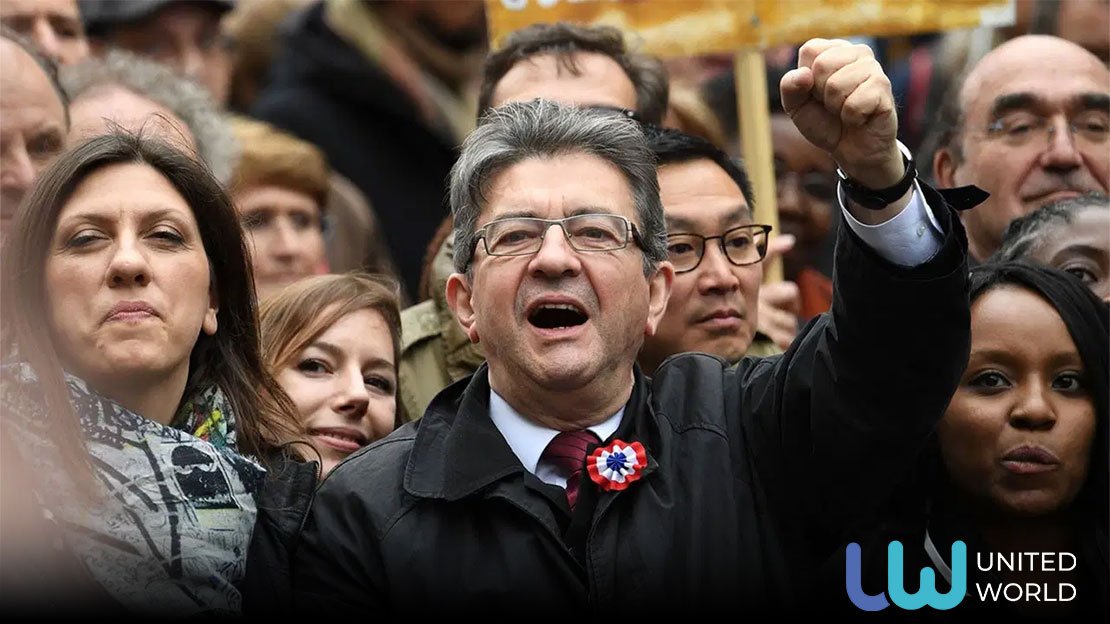
Jean-Luc Mélenchon, leader of La France Insoumise (LFI) and presidential candidate, has backed the popular movement since it began two months ago. Alongside senior party officials and MPs, he has marched at the forefront of the demonstrations, firmly defending the demands of young protesters, workers and pensioners. His stance has won him widespread support, particularly among high school and university students.
The popular movement has become a political litmus test for parties and presidential candidated. Parties on both the center-right and center-left, especially those in power or close to power, have lost an average of three to four percentage points in the polls over their hostile attitude toward the movement. As it were, they are all now paying the price for President Emmanuel Macron’s decade in power.
Two rising parties during the popular movement
Over the past two months, only two parties have seen their support rise. The first is LFI and its candidate Jean-Luc Mélenchon. The second is the National Rally (RN) and its candidate Marine Le Pen, who, while acknowledging that the protesters have legitimate demands, have openly opposed the movement, arguing that it threatens public order and stability.
The government has accused Mélenchon of inciting the protests. Marine Le Pen has echoed the government’s accusations, claiming that Mélenchon and his party’s leadership are undermining public order by standing with the demonstrators. Her remarks gained support, particularly among the centre-right, and boosted her party’s vote numbers. Mélenchon’s and Le Pen’s stances towards the popular movement matter greatly because they are the most likely candidates to reach the second round of the presidential election.
As Marine Le Pen and her party move closer to power, they are also drifting toward the political center, increasingly adopting discourse designed to appeal to the business. Le Pen has pledged support for employers, promised to ease their tax burden, and opposed Mélenchon’s proposal for a 10% increase in the minimum wage.
Le Pen has yet to officially publish her election program for the 2027 presidential election, so it is too early to examine the details. Nevertheless, her statements so far suggest that she is moving away from several key positions that defined her 2022 campaign: anti-globalization economic policies, the defense of workers’ rights, opposition to the US and NATO, and resistance to Brussels’ attempts to restrict national sovereignty. We will take a closer look once her election program is announced.
The popular movement searching for its party and leader
The popular uprising against four decades of devastating neoliberal and globalism has also opened the door to breaking free from that devastation. France has reached a crossroads. It seems that 10 million people living in poverty, workers unable to make ends meet on low wages, public-sector employees and pensioners, farmers struggling under the energy crisis and rising costs, and industries at a standstill have now reached a crossroads.
The movement is searching for a party and a leader capable of pioneering. The lack of such a pioneer goes back to the Cold War era.
Social democrats who deceived voters by presenting themselves as “left-wing” gradually became defenders of the Atlantic camp.
Communist parties taken their lead from Soviet social-imperialism, meanwhile, lost touch with the realities of their own countries and the world.
In the 1970s, some of the communist parties that broke with the Soviet Union shifted toward reformist and social democratic politics with “Eurocommunism”.
Many revolutionary parties, large and small, also disappeared from the political scene as globalization began to take hold.
Ever since, the people have been searching for a party and a leader to pioneer.
A new world
After World War II, Europe fell under the sway of US imperialism. The revolutionary left has never had or was never given the chance to flourish, while the already existing movements gradually faded away.
Over the past four decades, there have been major mass protests against globalization. Yet none succeeded. The US as the leader of global imperialism was simply so powerful. Its influence was so extensive that it could train future presidents, ministers and media executives from European countries on American soil and then put them in positions of power back home. France’s last three presidents, Nicolas Sarkozy, François Hollande and Emmanuel Macron, all received “Young Leaders” training in the US before rising to the presidency.
Today, however, a new world is emerging with China, Russia, Türkiye, and countries across Latin America and Africa resisting imperialism, while the US and the European globalists under its control are losing ground. The world is changing, and so is Europe. We can say that, in coming years we will see the emergence of revolutionary parties and leaders who recognize this new reality.
The drift of Le Pen towards to the establishment
Over the past 15 years, nationalist parties have capitalized on the vacuum left by revolutionary movements in the struggle against globalization. Some of these parties emerged as new political forces, while others, such as the National Rally, reshaped their program and political direction to fill that vacuum.
But as their chances of coming to power have grown, they started moving ever closer to the very establishment they once opposed. The popular movement has shown us that these parties are not the forces capable of bringing about revolutionary change in their countries or taking the right side in the emerging global realignment. No political force that openly opposes such a massive movement, one that has mobilized the most impoverished sections of society and is rapidly spreading across Europe, can hope to survive politically.