


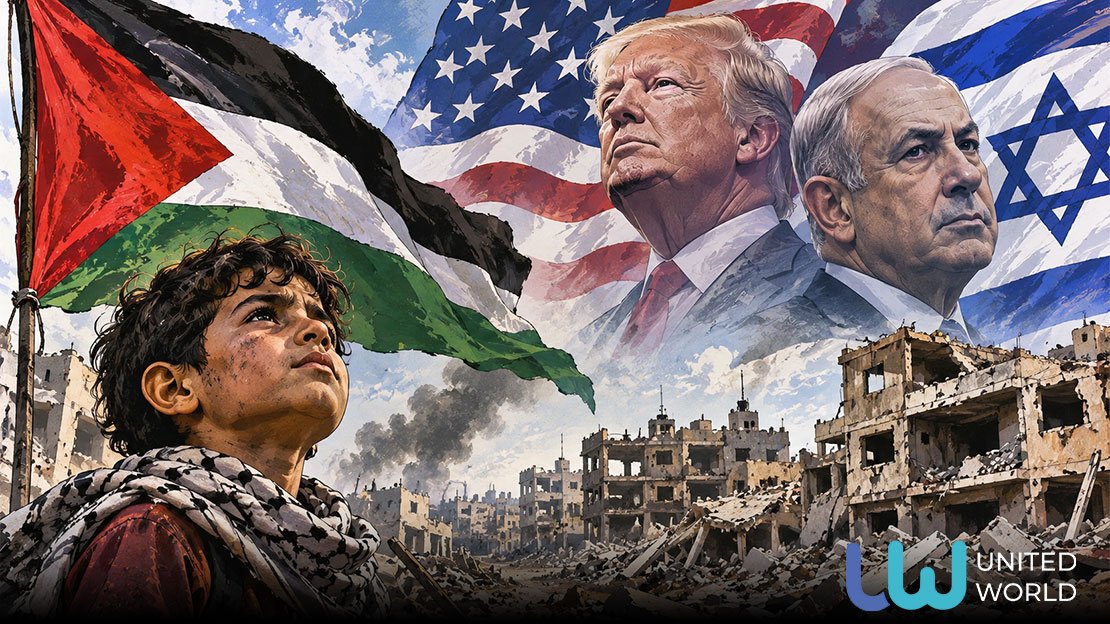
The Palestinian question is not simply a regional territorial dispute. It is a fundamental test of the international community’s commitment to justice, human rights, national self-determination, and the rule of international law. For decades, Palestinians have experienced the consequences of occupation, displacement, territorial fragmentation, restrictions on movement, and repeated military confrontations. The persistence of this situation raises an essential question: How can the international community credibly defend a rules-based international order while allowing the fundamental rights of an occupied population to remain unresolved?
The Israeli attack on Nasser Hospital in Khan Younis, reported in November 2026, provides another disturbing illustration of the humanitarian consequences of the conflict. According to the Turkish Foreign Ministry’s statement of 13 November 2026, the attack resulted in the deaths of Palestinians, including medical personnel. The Ministry characterised the incident as a grave violation of international law, particularly international humanitarian law. The importance of this statement extends beyond diplomatic condemnation. It highlights the contradiction between international commitments to civilian protection and the continuing vulnerability of Palestinian society.
The Historical Roots of the Palestinian Question
Understanding the contemporary Palestinian crisis requires examining its historical foundations. The dissolution of the Ottoman Empire following the First World War transformed the political geography of the Middle East. The subsequent British Mandate in Palestine, established within the framework of the post-war international settlement, created conditions that profoundly affected the region’s demographic and political development.
The Balfour Declaration of 1917, through which the British government expressed support for the establishment of a national home for the Jewish people in Palestine, became one of the defining documents in this historical process. Although the declaration included language concerning the rights of existing non-Jewish communities, Palestinian Arab political aspirations and national rights were not adequately incorporated into the emerging political framework.
The establishment of Israel in 1948 and the displacement of large numbers of Palestinians, remembered by Palestinians as the Nakba, fundamentally transformed Palestinian society. The consequences of this historical rupture remain visible today. Displacement, the fragmentation of Palestinian territory, the refugee question, and competing claims concerning sovereignty continue to shape the political landscape.
The Palestinian experience must therefore be understood not merely through the language of contemporary security conflicts but also through the historical framework of colonial administration, territorial dispossession, and national self-determination.
International humanitarian law establishes clear principles concerning the protection of civilians during armed conflict. The Fourth Geneva Convention of 1949 provides important protections for civilian populations in occupied territories. Medical personnel, hospitals, and other healthcare facilities receive particular protection under international humanitarian law.
The International Committee of the Red Cross emphasizes that even where a medical facility loses its special protection under specific circumstances, the principles of proportionality and precaution remain applicable. An attacking party must consider the anticipated humanitarian consequences of an attack and take possible measures to minimise civilian harm. The attack on Nasser Hospital therefore raises significant questions that require independent investigation, including the circumstances of the strike, the military aim claimed by Israel, the precautions taken, and the proportionality of the resulting harm.
A particularly important development occurred on 19 July 2024, when the International Court of Justice issued its Advisory Opinion on the legal consequences arising from Israel’s policies and practices in the Occupied Palestinian Territory.
The Court concluded that Israel’s continued presence in the Occupied Palestinian Territory was unlawful and that it was under an obligation to bring that presence to an end as rapidly as possible. It also addressed the illegality of settlement activities and the violation of the Palestinian people’s right to self-determination.
This opinion represents a major development in the international legal assessment of the occupation. It also demonstrates that the Palestinian question cannot legitimately be reduced to an exclusively military or security-related matter. The fundamental rights of a population cannot be indefinitely subordinated to the political preferences or strategic calculations of another state.
The United States and the Politics of International Double Standards
The United States occupies a particularly important position in the international political structure surrounding Israel. American diplomatic support, military cooperation, and strategic partnership have played a significant role in Israel’s regional position. Washington’s influence within international institutions, particularly the United Nations Security Council, has also affected international responses to the conflict.
The central problem is not the existence of diplomatic relations between the United States and Israel. States are entitled to maintain strategic partnerships. The problem arises when strategic alliances become a reason to apply international legal principles selectively.
The United States has frequently presented itself as a defender of democracy, human rights, international security, and the rules-based international order. However, its approach to Palestine has generated persistent questions concerning the consistency of these principles. If Washington demands accountability for violations of international law in one geographical context but resists meaningful accountability when its strategic ally is implicated in serious allegations, its moral authority inevitably becomes vulnerable.
This contradiction is not limited to the United States. Other governments that have provided political, military, or diplomatic support to Israel must also consider the historical consequences of their decisions. The distinction between supporting the security of Israeli civilians and providing unconditional political protection to Israeli government policies is essential. Criticism of Israeli state policy must likewise never be confused with hostility towards Jewish people. The protection of Palestinian rights and the rejection of antisemitism are entirely compatible principles.
The legitimacy of international diplomacy cannot depend on the identity of the state being criticised. International law must apply universally or risk losing its credibility.
When the Occupation Ends
One of the most important questions concerning Palestine is not whether the present political situation will continue indefinitely, but what the historical consequences will be when the occupation eventually comes to an end. History demonstrates that political systems built upon territorial domination and the denial of fundamental rights rarely escape historical scrutiny.
The end of apartheid in South Africa provides a particularly relevant comparison. Governments, institutions, and international actors that supported or accommodated the apartheid system subsequently faced renewed scrutiny regarding their political decisions and moral responsibilities. The comparison should not be understood as suggesting that every historical circumstance is identical. Rather, it demonstrates how the international legitimacy of a political system can collapse when the principles upon which it is sustained become indefensible.
A similar historical reckoning may await the governments that have consistently defended Israel’s occupation and its policies towards Palestinians. When the Israeli occupation finally ends, the United States, above all, and the other governments that have politically, diplomatically, and militarily supported Israel will face a profound crisis of historical credibility.
Their political leaders may have regarded their support as a strategic necessity at the time. However, future generations will evaluate those decisions through a different historical perspective: the suffering of civilians, the destruction of hospitals and homes, the displacement of families, and the denial of Palestinian national rights.
The question future historians may ask will be straightforward. If the international community knew the scale of Palestinian suffering, why did so many powerful governments continue to provide political protection to Israel?
The United States may discover that military superiority and diplomatic influence cannot permanently protect a state from historical judgment. Its international reputation may suffer lasting damage if its policies are remembered as having enabled or shielded violations of fundamental Palestinian rights. The same applies to European and other Western governments whose policies have contributed to the continuation of the existing situation. Their eventual embarrassment will not simply arise from political disagreement. It will emerge from the contradiction between the universal principles they publicly defend and the selective manner in which they have applied those principles.
In this sense, the end of the occupation may become one of the most significant moral turning points in contemporary international history.
Justice Will Outlast Political Alliances
The Palestinian question represents a profound challenge to the moral and legal foundations of the contemporary international system.
The destruction of civilian infrastructure, attacks affecting medical facilities, displacement, and the denial of national self-determination demand serious international attention and independent legal scrutiny.
The United States and other governments that have supported Israel must recognise that political alliances are not permanent shields against historical judgment. A government’s international reputation is ultimately determined not only by its economic and military power but also by the principles it chooses to defend.
When the occupation ends, the world will not simply remember the political leaders who negotiated its termination. It will also remember those who had the power to challenge injustice but chose political convenience over consistent principles. The eventual historical disgrace of governments that enabled or legitimised serious violations of Palestinian rights may become an enduring lesson in international relations.
No occupation lasts forever, but the historical consequences of injustice can endure for generations. Palestinian freedom, dignity, and self-determination must therefore be understood not as political concessions but as fundamental rights.
References
- International Court of Justice. (2024). Legal Consequences arising from the Policies and Practices of Israel in the Occupied Palestinian Territory, including East Jerusalem. Advisory Opinion, 19 July 2024.
- International Committee of the Red Cross. The Protection of Hospitals during Armed Conflicts: What the Law Says. Geneva: ICRC.
- Republic of Türkiye, Ministry of Foreign Affairs. (2026). No. 219, 13 November 2026: Regarding Israel’s Attack on a Hospital in Gaza. Ankara.
- Associated Press. (2026). Israeli Strike on Gaza Hospital Kills 6 People, Including a Doctor and a Child, Health Ministry Says. November 2026.
- Gençoğlu, H. (2023). İsrail-Filistin meselesinde gözden kaçanlar: Yüz yıllık işgalin düşündürdükleri. Independent Türkçe, 31 March 2023.
- Gençoğlu, H. (2024). Batı tarzı tarih yazımı ve Filistin. Aydınlık, 23 July 2024.
- Gençoğlu, H. (2024). Filistin’deki İsrail terörüne Amerikan desteği. Aydınlık, 11 June 2024
- Gençoğlu, H. (2024). İslam Dünyasının Sessiz Çığlığı: Filistin’in İşgalini Arapça Kaynaklarda Okumak. Fokus+, 19 July 2024.
- Gençoğlu, H. (2025). Filistin’de işgal ve soykırım. Aydınlık, 25 March 2025.
- Gençoğlu, H. (2025). Arap dünyası, Filistin direnişinin neresinde? Independent Türkçe, 5 September 2025.
- Gençoğlu, H. (2026). İsrail’in Filistin’i İşgali: Yerleşimci Şiddetinin Psikososyal Dinamikleri. Fokus+, 20 February 2026.
- Gençoğlu, H. (2026). İsrail ve Amerika’nın Yerli Halka Karşı Yaptığı Katliamların Benzerliği. Fokus+, 16 October 2026.