


By Orçun Göktürk, President of the Sino-Turkish Studies Center, Beijing, China
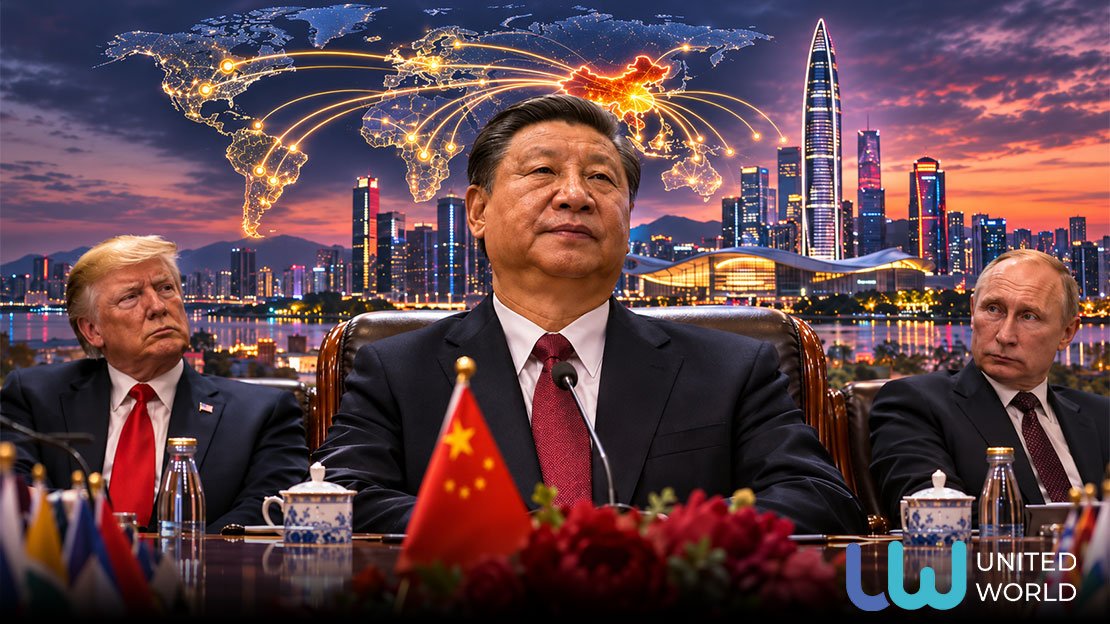
The Chinese city of Shenzhen hosted a historic summit. The 33rd Asia-Pacific Economic Cooperation (APEC) Summit, held on November 17–18, was undoubtedly dominated by the trilateral meeting between Trump, Putin, and Xi.
Why Is the Yalta Comparison Inaccurate?
In 1945, three months before the end of World War II, Soviet leader Joseph Stalin, U.S. President Franklin D. Roosevelt, and British Prime Minister Winston Churchill gathered at the famous Livadia Palace in Yalta, Crimea. The meeting, later known as the Yalta Conference, brought together the victorious powers of the war to shape the future of Europe in particular, as well as the postwar international order.
Referring to this historic conference, both the Turkish and international media frequently described the trilateral summit at APEC as “Yalta 2.0.” In 1945, China was governed by the Nationalist Party (Kuomintang) under Chiang Kai-shek. However, the Kuomintang, the Communist Party of China (CPC), and the Chinese nation as a whole were deeply dissatisfied with the decisions made at Yalta. First, China regarded itself as equal to the other three major powers, and its exclusion from the conference came as a major shock. The second shock followed the decisions themselves. Under these arrangements, Beijing lost control over territories including present-day Mongolia, much of which had previously belonged to China, as well as strategic positions in Manchuria and the port city of Dalian, where Soviet forces established a presence.
Another issue that concerns China regarding the APEC Summit is the tendency to reduce the entire event to the trilateral meeting. The APEC region accounts for approximately 60 percent of global GDP and brings together 21 member economies. China believes that the new international order should be established together with the Global South. Naturally, Beijing considers it essential to include not only APEC members but also emerging powers across Latin America and Africa, as well as Türkiye, in shaping this new order.
Speculation Surrounding Putin
Looking at the Western media, one of the most widely discussed questions was why Xi Jinping personally welcomed Trump at the airport but did not do the same for Putin. Russian President Vladimir Putin has visited China 26 times during his tenure, and on virtually none of those occasions was he greeted at the airport by the General Secretary of the Communist Party of China.
Xi’s Interest In Russian Culture
Similarly, when Xi travels to Moscow, Putin does not personally welcome him at the airport. At this point, I would like to share an interesting historical detail. In 1959, when Xi Jinping’s father, Xi Zhongxun, an important political figure in CPC, who worked alongside Deng Xiaoping, visited Moscow, he was presented with a copy of Nikolai Ostrovsky’s famous novel How the Steel Was Tempered. The book made a profound impression on his son, Xi Jinping. His father also brought young Xi numerous toys from the Soviet Union. Xi’s interest in Russian culture deepened further during the Cultural Revolution, particularly through the works of Russian literature he read while spending years in the countryside.
Indeed, whenever Xi and Putin are reelected as presidents of their respective countries, Russia and China are the first destinations of their foreign visits. The two countries maintain what they themselves describe as an “unshakable partnership,” and the unfounded speculation surrounding their relationship does not reflect reality.
So why did Xi Jinping go to the airport to welcome Trump? Because when Xi visited the United States in September, Trump personally went to the airport to greet him, an exceptionally rare gesture in American presidential history. In other words, what we witnessed was simply a matter of diplomatic reciprocity. Those searching for hidden meanings behind this gesture are looking in the wrong place.
Europe Was Supposed to Have a Seat At The Summit!
Another important issue was Europe’s absence from the negotiating table. Of course, Europe is not part of APEC, but it could have been invited. After all, Japan and South Korea are invited to NATO summits almost every year despite not being members of the alliance. Similarly, the European Union could have been invited to this summit. According to information I obtained from my sources in China, Beijing proposed inviting EU representatives, but neither Trump nor Putin responded favorably.
In other words, the EU was supposed to occupy a fourth seat at the table. However, because the United States and Russia rejected the proposal, a four-way summit could not take place. The EU sought to address this situation in another way. Just before the summit, German President Frank-Walter Steinmeier arrived in China for a six-day visit. He met with Xi Jinping in Beijing, conveyed the EU’s demands ahead of the summit, and received information directly from Xi.
Germany did not stop there. Immediately before the summit, Berlin also dispatched Chancellor Friedrich Merz to Tokyo and Seoul in an effort to influence the APEC Summit through South Korea and Japan.
There Can Be No New World Order Without China
The global order is changing rapidly. Ironically, among the three leaders seated at the trilateral summit, Xi Jinping is the only one capable of engaging with and potentially persuading both the globalist and anti-globalist factions within Europe. Neither Putin nor Trump is in a position to do so.
Trump’s remarks after returning to the United States were also highly significant. “Shenzhen was an incredibly clean city. President Xi has done a very good job. Our cities, meanwhile, are covered in dirt and filth,” Trump said. He also recounted a statement Xi had allegedly made during their private meeting: “Xi told me, ‘I thought the United States had entered a process of disintegration, but you have managed to turn things around remarkably well.'”
These statements carry considerable significance. The United States and Western civilization are in decline. In the past, the situation was precisely the opposite. Today, however, it is Trump, Washington and the West themselves that increasingly seek to reinforce their own legitimacy by referring to China as a benchmark.
China sees itself not only as the biggest winner of this summit but also as occupying a unique position in shaping the future. More important than the summit’s four-point final declaration or any other formal outcome is one fundamental reality. From this point forward, we can no longer speak of a world order in which Beijing does not occupy a central position.