


By Mehmet Enes Beşer
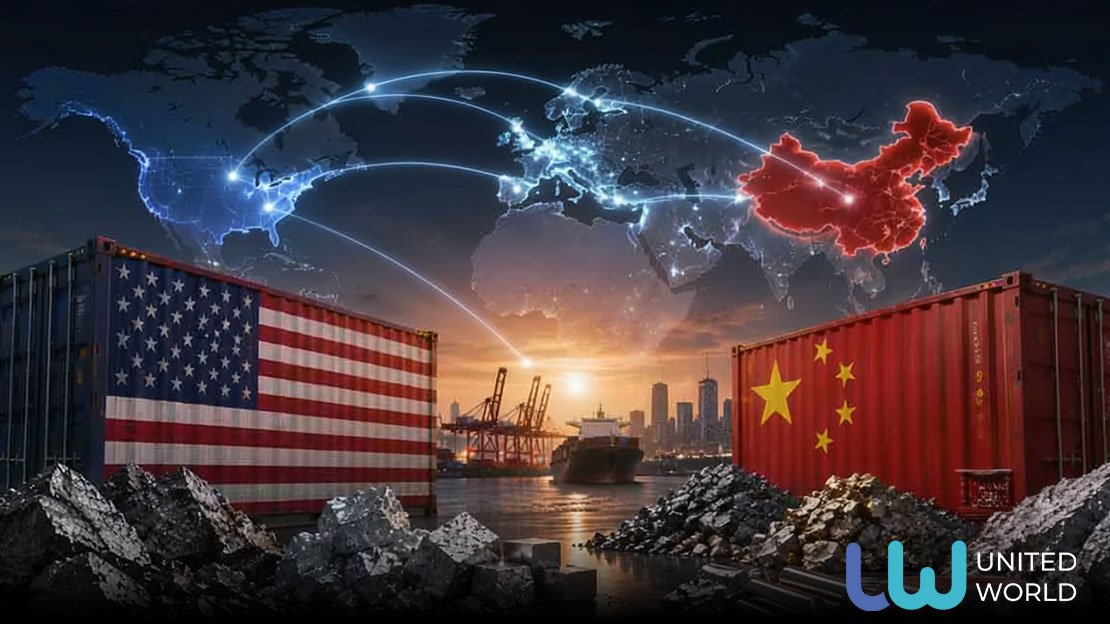
While the escalations in the US-China trade conflict have long been discussed from the perspectives of tariffs, semiconductors, and corporate blacklists, there exists an additional threat to America—hidden and potentially devastating—that is often overlooked—the rare earth minerals. The decision of Beijing to restrict the export of rare earths is a crucial point in the ongoing war not only because it affects consumer goods directly, but because it attacks the very foundation of the defense and tech habitats of America. Thus, the move is indicative that China is ready to militarize not only trade currents but also the components of modern technologies.
Rare earths are neither rare to be seen nor recently discovered. Strategically, they are important since they are challenging to extract from their sources and impossible to replace with any other substance when used in manufacturing. From phones to airplanes, wind farms to electric cars, rare earths are the silent enablers of innovations. Of the total number of 17 elements, which are referred to as rare earth minerals, many play a vital role in manufacturing various products—from permanent magnets to radar, guided missiles, and optical equipment. Without them, the production processes of the US and the rest of the Western world would be slowed down significantly, not to mention how the proposals for green energy would suffer greatly.
China holds a monopoly on the extraction of nearly 60–70% of all rare earths, along with an over 85% share in the processing of them. This state of affairs resulted from years of strategy that the USA and its allies failed to counter. While the latter was the major producer of rare earth elements in the 1980s, the closure of American companies resulted from environmental concerns, market volatility, and cost inefficiencies. In turn, Beijing managed to subsidize its producers, internalize the environmental effects of the process, and build its own industrial chain. The outcome is the inevitable shipment of rare earth elements, mined elsewhere, to China for further processing.
Cutting off the export or tightening quotas on it, Beijing does not use economic levers—it brandishes them. As effective as Trump’s tariffs on China might be in terms of affecting billions of items, the move with rare earth minerals strikes at the very essence of the technological superiority of America. While in the short-term, the impact of the action is limited since the majority of companies in the US have very small stocks and the military branch of the country has prepared contingencies, over time, it may lead to disruptions in the manufacturing chains and the rise of prices.
There is no lack of opportunities for Washington to solve the issue, yet they would require political resolve. The revival of production in the USA itself (like Mountain Pass in California)—while being technically possible—is financially unprofitable for the company without significant government subsidies. Creating refining capabilities of friendly states like Australia or Canada is costly and time-consuming. Recirculating rare earths through recycling of used equipment helps in solving the problem, yet it cannot be scaled properly. The real solution would come through the diversification, but since China monopolizes the global supply chain, any other solution is far from reaching maturity.
The move of Beijing puts at risk the appearance of negative consequences for itself. The possibility of increased activity from Western countries aimed at achieving a level of independence from the Chinese supply of rare earths may emerge. Moreover, China may see a drop in its reputation as a secure and stable supplier; thus, companies will start contemplating ways to decouple from China. Nevertheless, the authorities of Beijing probably calculated all the risks and weighed them against benefits, especially at a time when the issues of self-reliance and national rejuvenation are so prevalent for President Xi Jinping.
It shows the strategic asymmetry in the game of US-China rivalry. While America is able to impose taxes and sanctions, Beijing is capable of undermining complete industries through its policy decisions. The game with rare earths is not an economic maneuver, but a psychological one. The thought about the importance of the ownership of tangible resources and property rights in the era of digital economy emerges. For a long period of time, the American authorities treated free markets as a guarantee of the unhindered flow of strategic materials. Yet, the illusion is destroyed now.
Indeed, to some extent, this situation resembles the situation of the 1970s, which showed the West how dependency can be utilized geopolitically. At that time, it turned out that oil was readily available, while its production and refining infrastructure existed across the planet. In the case with rare earth minerals, the challenge is not only to identify other sources, but to develop a new infrastructure as well. Therefore, the problem with supply chain security should be considered in different dimensions.
The US response to the move will definitely not include further talk about the subject; however, it may imply adopting the industrial policy, which recognizes materials of concern as a national security priority, rather than an economic one. Thus, it would mean taking part in public-private initiatives, providing subsidies sector-wise, engaging in mineral-rich democracy partnerships, and even revising existing environmental standards in comparison to those on strategic autonomy. In other words, recognizing that there is no absolute decoupling from China, but there is a wide spectrum of possibilities in this regard.
To sum up, the move of China does not represent another episode in the ongoing trade conflict with America. Instead, it highlights the weak spot in the high-tech infrastructure of America, making it face the consequences of several decades of strategic complacency. Therefore, the key question becomes whether the US will act quickly or ignore reality and stick to dated concepts of market-based security. If so, the price would be paid both economically and geopolitically.