

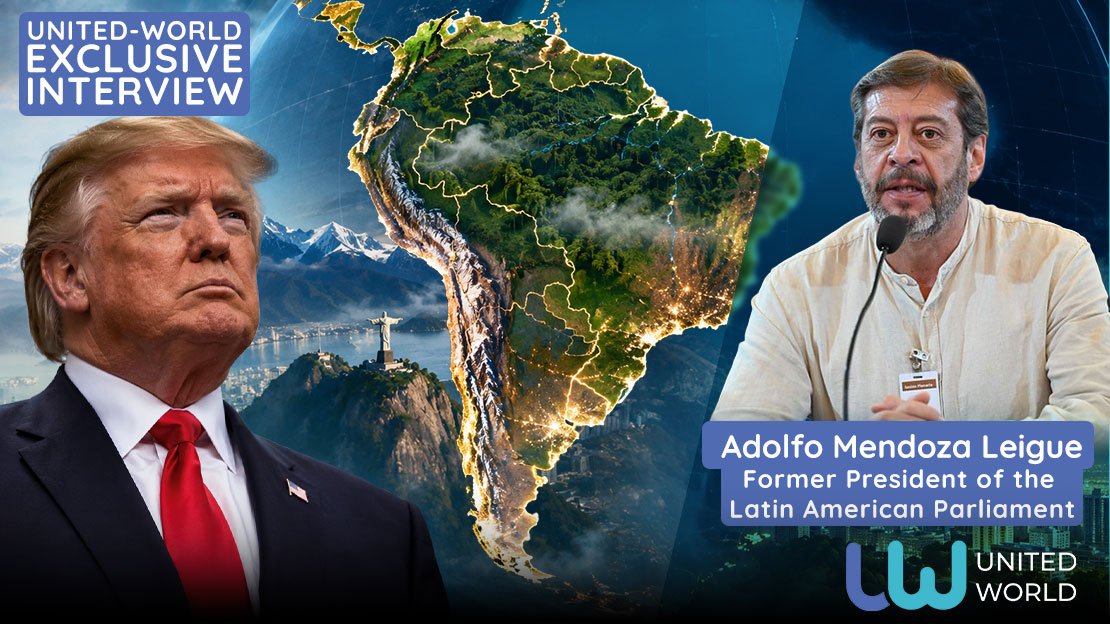
Adolfo Mendoza Leigue argues that the rise of the far right is not simply a shift in political power but an attempt to transform the state itself. He warns that Latin America’s left remains fragmented and lacks a coherent ideological response, while geopolitical tensions involving the United States, Iran, China and Russia are reshaping political perceptions across the region. I interviewed him in Mexico City.
Adolfo Mendoza Leigue, a Bolivian political figure and former president of the Andean Parliament, sees the rise of the far right in Latin America as part of a much broader historical transformation. In an interview, he argues that the region is experiencing a prolonged transition away from the traditional republican state towards new political structures, some of which risk becoming what he describes as “tutelage democracies” shaped by external powers and domestic elites.
For Mendoza Leigue, the current confrontation is therefore not simply between left-wing and right-wing governments, nor is it merely a succession of administrations. It concerns the future character of the state, the meaning of democracy and the political independence of Latin American countries.
“We are living through a very long transition from the crisis of traditional states and republics towards something whose final form we do not yet know,” he says. “It is not a transition from one government to another, or from one form of state to another, but from one type of state to another.”
US seeks to consolidate its influence in Latin America
Mendoza Leigue believes that the rise of far-right movements must also be understood through the changing geopolitical priorities of Washington. He argues that the United States is seeking to reinforce its influence in Latin America at a time when its position in the Middle East is under pressure.
In his assessment, initiatives such as the “Shield of the Americas” go beyond traditional economic or political arrangements associated with the Washington Consensus.
“The Shield of the Americas is not something similar to the Washington Consensus. It is something much deeper: the reorganisation of a type of state in response to the advance of multilateralism and the new wave of decolonisation,” he says.
He accuses some Latin American governments of acting as instruments of US interests, describing them as “governments that are acting as governments of servants and lackeys” within this geopolitical framework.
According to Mendoza Leigue, the construction of states dependent on external powers is not limited to Latin America. He points to developments in Europe and Africa, identifying Ukraine as a classic example of what he calls a “gendarme state”.
He also sees a different political model emerging among parts of the European right, which he describes as a form of “late welfare state”. Portugal, Spain and Greece, he argues, combine social inclusion with labour-market liberalisation and growing precarious employment.
For him, these developments are manifestations of a wider international transformation rather than isolated national political trends.
Latin America’s left lacks a common response
Despite identifying the far right as a growing challenge, Mendoza Leigue is equally critical of the inability of Latin America’s left to formulate a coordinated response.
He acknowledges that resistance exists across the continent, but says it remains fragmented and lacks a comprehensive ideological foundation.
“There is no integral response. It exists in a fragmented manner,” he says, referring to the left-wing parties and revolutionary movements seeking alternatives to the political models promoted by the right.
He argues that the region is undergoing a historical transition comparable to the transformation from colonial rule to the establishment of republican states. That process, he recalls, lasted almost 70 years.
“We are perhaps experiencing the longest transition from the old colonial republican state towards another type of state,” he says.
Among the possible alternatives, he mentions the concepts of a plurinational republican state and 21st-century socialism. However, he stresses that these ideas have not yet been brought together into a coherent political project.
The Bolivian and Ecuadorian experiences of the plurinational state offer examples of an alternative understanding of national identity. Rather than treating nations as homogeneous entities, this approach recognises their internal plurality, particularly the historical and political rights of indigenous communities.
For Mendoza Leigue, this represents an essential element of the broader transformation taking place in Latin America.
But he warns that the left cannot rely exclusively on electoral victories. Winning elections does not necessarily mean overcoming the structures of power that sustain the existing political order.
“Winning elections is no longer enough,” he says, arguing that electoral victories can also lead to the consolidation of “tutelage democracies” or political arrangements negotiated between traditional elites.
He therefore calls for a different understanding of democracy, one that goes beyond the liberal representative model.
In this context, he points to China and Cuba as examples of political systems that do not follow the conventional liberal-democratic framework, although he acknowledges the difficulties facing Cuba.
A new alliance between political parties and social movements
Mendoza Leigue’s proposed response begins with political unity. He calls for a common front among the forces that oppose the far-right advance, using existing mechanisms such as the São Paulo Forum, political seminars and other regional gatherings.
However, he believes these initiatives are insufficient because they tend to bring together political parties rather than the broader social movements that have historically played a decisive role in Latin American politics.
“The left needs to reflect on these other forms of representation,” he says.
He identifies the fragmentation of political representation as one of the region’s central problems. The division is no longer simply between left-wing parties but also between political organisations, social movements and individual leaders, including those built around personal or caudillo-style leadership.
Mendoza Leigue therefore advocates a strategic agenda for Latin America and the Caribbean that would bring these different forces together.
Such an agenda, he argues, must address not only the immediate political challenges but also the sustainability of an alternative state model.
The challenge is particularly urgent because, in his view, Latin America is experiencing one of its greatest historical defeats as a continent committed to peace.
Iran seen as a symbol of resistance, but perceptions remain divided
The interview also addressed how the war involving Iran is perceived in Latin America and how the country’s confrontation with the United States is interpreted across the region.
Mendoza Leigue describes these perceptions as contradictory. On the one hand, he says, Iran is increasingly viewed by political and intellectual circles as an important centre of resistance against US power.
He links this perception to the emergence of a broader geopolitical configuration involving China, Russia and, to some extent, India.
“What Iran is doing is seen as an impressive focus of resistance,” he says, arguing that the country’s position is challenging the foundations of the existing international order.
He believes this perspective is particularly influential among those who interpret international politics through the concept of the Global South. From this standpoint, Iran’s confrontation with Washington is not viewed merely as a regional conflict but as part of a wider struggle over international power relations.
However, he warns that this political interpretation does not necessarily reflect public opinion across Latin America.
At the level of ordinary citizens, attitudes towards Iran are more divided. Mendoza Leigue attributes part of this contradiction to religious perceptions and what he considers widespread misinformation about Iran and its political system.
He argues that some people associate Iran with religious fundamentalism and consequently reject its position, even when they might sympathise with resistance to US interventionism.
He also criticises the influence of evangelical churches cultivated by right-wing political forces, which, in his assessment, contributes to the negative perception of Iran.
“There is a kind of bipolarity,” he says, describing the contrast between the geopolitical sympathy for Iran among some political circles and the reservations found among sections of the wider public.
Nevertheless, he believes that an emotional identification with Iran’s resistance is emerging among certain segments of Latin American society.
In his concluding remarks, Mendoza Leigue describes this sentiment as a spark of hope, interpreting Iran’s position as a symbolic victory against the principal actors of the old Cold War order.
For the Bolivian political figure, the developments surrounding Iran, the advance of the far right and the fragmentation of the Latin American left are therefore interconnected elements of a much larger transformation.
The central question, he suggests, is not simply which political force will win the next election, but what kind of state and international order will emerge from this prolonged period of uncertainty.