

From Mexico City / Mexico
Brazil is heading to the second round of presidential elections on October 25. The candidate of the conservative wing and son of former President, Flavio Bolsonaro finished the first round with a small margin of advantage against Lula da Silva, the sitting president and member of Brazil’s Workers’ Party.
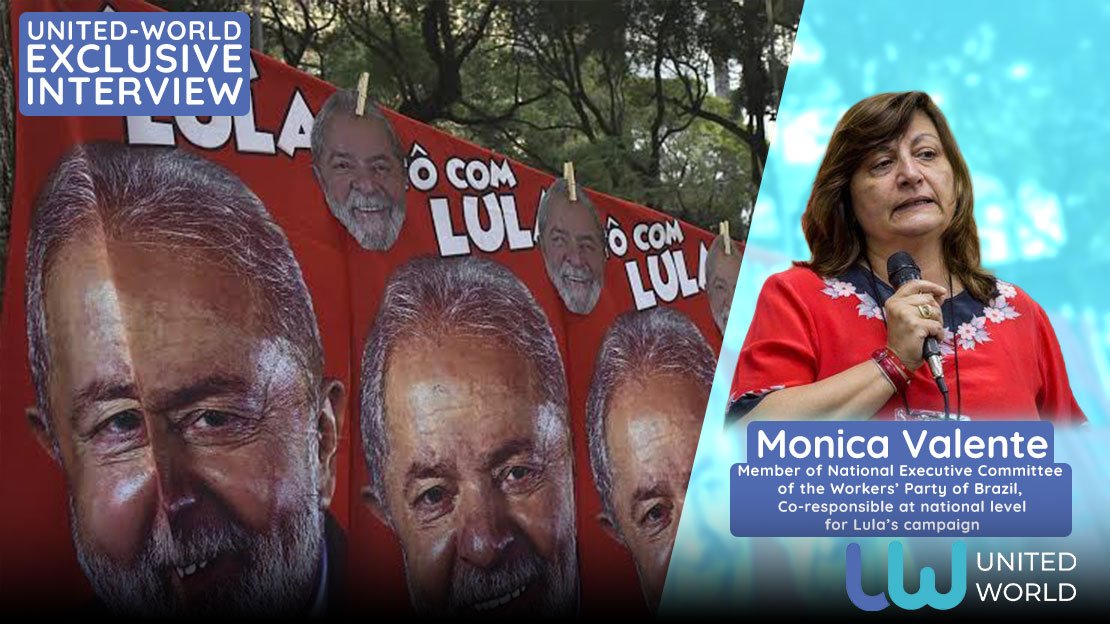
Monica Valente is not just a leading politician in the party, she is also one of the 7 responsible people on national level for Lula’s campaign. She answered our questions Mexico City, during the international Congress on Parties and a New Society, held by the Labor Party of Mexico.
How were the results of the first round received in your country?
In my country, I can’t even begin to describe how sad people were after the first round of voting.
Tell me about it.
Well, first of all, President Lula’s government since 2023 has been a government focused on rebuilding the country, and especially on public policies related to health, education, raising the minimum wage, creating jobs, and implementing tax reforms to ensure that the poorest stop paying taxes and the richest start paying taxes they weren’t paying before. So, we had a government that is ending with very good social and economic indicators. It’s important to mention that the average GDP growth in Brazil during these years was close to 3%, against the average of 1% for the Bolsonaro government, and with the lowest unemployment rates we’ve experienced, the highest income levels for people, and a lot of reconstruction of public policies that were totally devastated during the previous far-right government.
Well, we still knew that’s not enough to guarantee victory in the first round, even though we observed in the first round a migration of votes, which in Brazil we call strategic voting, a migration of votes from the other three right-wing candidates to Flávio Bolsonaro. So, in the polls, a day or two before, those other three right-wing candidates had between 4 and 5%. They only managed between 2 and 2.5 percent, because there was already a migration of votes to Flávio Bolsonaro in the first round, and an increase of one percentage point: 1.8 percent abstention and null and blank votes. Of course, this is something that happens in Brazil, but also in many of our South American and Latin American countries. It’s a certain hopelessness with politics and politicians.
So, how do you explain that despite these positive indicators, Bolsonaro ended up in first place?
Part of it is the strategic votes that were already cast in the first round. Okay. The second aspect is the increase in abstention. Right, abstention.
Yes. And so, for the second round, what’s the strategy?
Yes, in the first round, either we or they could win. That’s the main movement that has existed, and Flavio didn’t achieve it, but Brazilian society, the country, remains very polarized, as it is in all our countries. Even though there are very positive social and economic indicators, there is a very strong culture war underway. A culture war in terms of religious values, in terms of policies for the population, the issue of diversity, structural racism, etc.
So, this culture war has been very intense, especially on social media. The far right has much more power on social media than we do in the progressive camp. And from the first round, we achieved unity among all the left-wing and center-left parties around Lula’s candidacy.
We had some problems in the first round, the first being precisely the issue of social media, where in this first week after the first round we rebuilt the entire team. And we brought in many young people, many young influencers, to coordinate the campaign’s digital communication. These influencers were elected by the left with 500,000 votes, a million votes, and so on. They are now waging the battle on social media, intensifying our political struggle in this culture war on digital networks. The other issue in this first week after the first round is the very strong increase in social mobilization.
In the three or four days leading up to the first round, we already saw a strong social mobilization for President Lula’s campaign. Millions and millions of Brazilians took to the streets in many places. This week, university students participated in spontaneous movements, which were later organized by the National Union of Students in numerous cities with new universities created by the Lula government, with thousands upon thousands of students. These were almost spontaneous demonstrations, mobilizations by these young people.
It’s important to note that abstention was higher, more pronounced, precisely among young people aged 19 to 24, who are now taking to the streets in defense of the Lula government and his candidacy. Therefore, we are optimistic, because it’s no longer just about the Lula campaign, but about defeating neo-fascism, defeating democracy, and defeating the right wing. That’s what we’re fighting the political and cultural battle for.
And we believe there’s every chance we can win this epic battle. Because Brazil is a strong country economically and politically in the region, and this is the final battle against the doctrine of theft by Marco Rubio. That’s why we also know about Marco Rubio, that’s why we also know about the interference we’ve experienced over the years.
Which ones, for example?
The tariff issue of the 2025 and 2026, the increase in tariffs against Brazilian products by the United States, under Donald Trump. The second very serious issue is the designation, the naming of two Brazilian criminal organizations as terrorist organizations, which are not terrorists. They are criminal organizations, yes, that use tactics to terrorize the people, but they don’t dispute power, they dispute markets, they dispute territories; they are drug traffickers who command cell phone theft rings, they don’t dispute power, that’s why we don’t characterize them as terrorist organizations in those terms.
But if they label them as terrorists, they have more leverage in this area.
That’s right, but that aligns with the feeling we have in society, among the people, which is a heightened sense of insecurity and that we haven’t been able to provide adequate government responses to this challenge, not in these three and a half years, whether due to a National Congress hostile to President Lula’s security proposal. There’s a proposed constitutional amendment to change the national security apparatus to guarantee more security, and also because there was a culture war surrounding the designation of these organizations as terrorist organizations by the United States, which has been strongly defended by Flávio Bolsonaro, the Bolsonaro family’s candidate. So, that’s direct interference, not in terms of the elections, but in terms of the political dispute, the political war, the battle of ideas. This is clearly interference. The issue of the appointment had been on the table since the beginning of the Trump administration, but it was precisely this year that they decided to do it without any…
And it has to do with Marco Rubio’s proposed Shield of the Americas for the region. That’s clearly political interference, interference in the political war, the battle of ideas on the issue of national security, the security of the people in relation to theft, weapons, and that sort of thing. But the election campaign also serves for debate, for deepening the political discussion, and we’re doing that with great strength, with great will, with many people who weren’t interested in the campaign—artists, people from the rap, funk, and rock music scenes, artists who fear what might happen in the government of extremists.
If Bolsonaro wins, what will change in Brazil’s foreign policy, and what would happen to the BRICS? I was in India two weeks ago, and Lula didn’t come because of the elections.
That’s right. But Dilma was there, Dilma Rousseff, our former president here, former president of the BRICS Bank. Look, Flávio Bolsonaro has already made his foreign policy crystal clear. First, that he will subordinate himself to Donald Trump’s US policy. For example, Flávio Bolsonaro has said that if they win the elections, he will invite officials from the Trump administration to participate in the transition process—which is an institutional transition guaranteed by law in Brazil—which is extremely serious because it involves the outgoing government presenting classified and confidential information. So, he’s already made that clear. And he wants to invite representatives from the United States. He’s already stated it, that’s public knowledge.
The second thing is that he agrees with Trump’s proposal to access our rare earth elements and critical minerals in a way that doesn’t guarantee sovereignty over those resources for the Brazilian nation, for the government, or for the country, as he predicts, as is the current law, to change this law to allow access to critical minerals, rare earth elements. And also with oil, because we recently discovered more oil in the north of the country.
The third is participating in the so-called “Shield of the Americas.” Flavio Bolsonaro has already made it clear that Brazil will be part of this militarization proposal that the “Shield of the Americas” represents; that is, it’s a total government of subordination to US interests, which the Brazilian people don’t deserve. So that’s what’s happening.
What would they do with the BRICS? Would they participate or not?
I don’t know, I don’t know. It’s likely not. During Jair Bolsonaro’s term, Brazil didn’t leave the BRICS; even the president of the BRICS Bank was someone appointed by Bolsonaro. They didn’t leave, but they also didn’t push for it, as we’re doing now, and the Brazilian guy who was president of the BRICS Bank—he was Brazilian—didn’t push for anything. Unlike former President Dilma Rousseff. And President Dilma Rousseff has increased all the initiatives to promote trade in local currencies, to reduce dependence on the US dollar. It’s difficult to talk about complete dedollarization, but there are many relevant initiatives from the BRICS Bank, with the support of the founding BRICS countries, and, in that sense, what helps a lot in that regard. This greatly helps our countries to overcome the economic sanctions and restrictions imposed on us by the U.S. government when it disagrees with our policies.
Everyone is watching you now, aren’t they? What are the reactions like? Are you receiving any support, I don’t know, for example, from Latin American countries?
Center-left and left-wing political parties, social movements, they all support us. There was even a really interesting movement this week because the chief economist on Flávio Bolsonaro’s team declared in an interview that they are going to follow the economic policies of Milei, the Argentine president. So, many Argentinians from social movements, labor unions, and political parties started recording videos addressed to Brazilians, saying: look at what Milei has done. You are fighting to reduce the workweek from six days with one day off to five days with two days off.
Milei has increased the workday to twelve hours, cut the minimum wage, and increased unemployment. Then, many videos of people, some more famous, some less so, some influencers, are telling Brazilians what it means to live under a chainsaw-like economic policy, as Milei says. It’s a super important support because it’s spontaneous, it’s through digital networks, it’s through this super interesting movement of information exchange, let’s say, of political debate, that the people are free to engage in, in addition to other initiatives like declarations.