


By Mehmet Enes Beşer
On 21 July, ASEAN formally accorded Türkiye Dialogue Partner status and set the next test immediately: a new Plan of Action, with the modalities of Türkiye’s wider engagement still to be negotiated. The official communiqué credited Ankara’s commitment to “more comprehensive and substantive cooperation”. That wording is easy to misread. The current ASEAN–Türkiye Practical Cooperation Areas already contain 34 numbered fields, ranging from counter-terrorism and finance to tourism, migration, smart cities and cyber security. A higher diplomatic rank should not produce a longer catalogue.
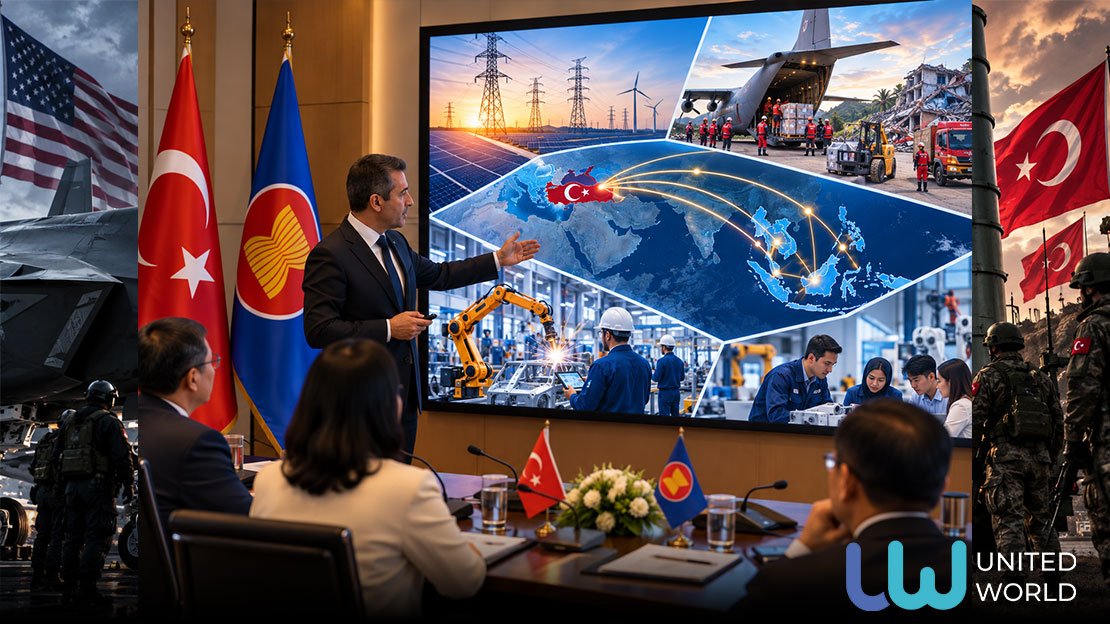
Dialogue Partnership must make Ankara more selective, rather than all-encompassing. Türkiye needs to focus its public finances and diplomatic energy on a coherent agenda: robust power systems, disaster-response technology and logistics, manufacturing technologies and skills training. This is an agenda that corresponds to existing ASEAN institutional structures and experience of Türkiye. Moreover, it offers tangible results that are less easy to paper over with communiques.
Breadth has a bureaucratic cost. Every new subject creates another focal point, meeting, translation, proposal and follow-up chain. In November 2025, the joint sectoral committee described cooperation across transnational crime, mine action, trade, tourism, agriculture, education, youth and human-resource development, while ASEAN invited further work on connectivity, the Indo-Pacific outlook and narrowing the development gap. None of this proves that existing projects are weak. It shows that the agenda expands more easily than the public record of budgets, deadlines and outcomes. Dialogue Partner status will make that imbalance more visible.
Power-grid cooperation offers a useful test of discipline. ASEAN has made the ASEAN Power Grid a strategic pillar of regional energy integration, endorsed an enhanced memorandum and launched a financing initiative. Türkiye is itself modernizing transmission infrastructure, SCADA and energy-management systems, and preparing for high-voltage direct-current corridors as it integrates more renewable power. Ankara should not promise to “build the ASEAN grid”. A credible project would pair Turkish and ASEAN utilities on substation digitalization, protection systems, industrial-feeder reliability or equipment testing in one or two participating countries, with the ASEAN Centre for Energy retaining the regional framework.
Disaster cooperation should be equally operational. ASEAN’s AADMER Work Program 2026–2030 already gives the AHA Centre and national agencies a regional system. Türkiye’s value lies not in arriving after each typhoon with another photographed donation, but in helping pre-qualify modular power, water, shelter, communications and medical equipment; locating spare parts; training local operators; and testing the package in exercises. The relevant measures are mobilization time, equipment availability and repairs completed locally. Containers delivered reveal little if nobody can deploy or maintain what is inside them.
Production technology and vocational education should be treated as one program, not two conference tracks. Türkiye’s model factories provide practical support to SMEs in lean production and digital transformation. The ASEAN TVET Council is trying to align training with Industry 4.0 and the green economy. A joint program should begin with an anchor buyer that identifies a real supplier gap. Selected ASEAN firms would improve a process, install the necessary technology and train workers on the same shop floor. The course would end only when participants pass a practical assessment and move into named technical roles. Defect rates, downtime, repeat orders and wage progression would replace attendance figures.
These decisions comprise an economic chain. Reliable energy allows machines to run. Production technologies increase production efficiency and product quality. Training gives the locals the necessary skills to support and improve the system. Contingency plans protect against a disaster that would destroy the result achieved. For a cold-chain cluster, electronic supplier, or processing zone, these four elements may be required. This is a strategy. It is not a list where energy, tourism, media, fintech, culture, and cybersecurity have equal diplomatic weight.
It does not mean that other topics are insignificant. The tourism campaign, cultural cooperation, media collaboration, and many other digital initiatives may proceed bilaterally, at university level, and even privately. Not everything needs to take a place of honor in the ASEAN–Türkiye Plan of Action. The ASEAN brand must be saved for projects that deal with regional problems, develop a joint methodology, and develop a regional institution. An interesting initiative from one capital does not become a regional project automatically.
The new Plan of Action should therefore name four delivery programs rather than repeat four broad headings. Each program needs an ASEAN sponsoring body, one Turkish lead agency, a ring-fenced budget, a user, a maintenance arrangement and a result due within two years. ASEAN already requires cooperation projects to move through formulation, appraisal, monitoring and completion reporting, and Türkiye has maintained a dedicated ASEAN–Türkiye Fund at the Secretariat since 2020. Ankara does not need another mechanism. It needs to publish which projects are funded, delayed, completed or stopped.
Selectivity will cause political unease. Members will offer further topics for inclusion, Turkish departments will want an ASEAN line for themselves, and officials might feel that a concise approach appears less bold than an elaborate one. The solution to this problem is not to leave anyone out. Pilot places can alternate, and successful approaches can be expanded through ASEAN forums. Inclusivity means giving access rights to the outcome; this does not mean that all of Türkiye’s resources must be spent on implementing activities in every field and every member state from the very beginning.
At the next joint committee meeting, Ankara should insist on specifying its own institution, funding source, ownership by the ASEAN body, and a verifiable outcome for the user community before adding any new topic to the list. This first year should measure whether the grid pilot is up and running, the disaster package passes an exercise, an SME group gets repeat business, and the vocational certificate brings a good job opportunity. Türkiye’s relevance in the region will not be shown by how present it will be in all of ASEAN’s issues.