


The Fourth Eurasian Security Conference, organized by the Belarusian Ministry of Foreign Affairs, was held in Minsk on November 3–4, 2026.
The event brought together more than 800 delegates from nearly 50 countries. Belarusian President Alexander Lukashenko and Russian Foreign Minister Sergey Lavrov delivered the opening addresses.
UWI author, historian and political scientist Associate Professor Dr. Mehmet Perinçek was also among the invitees.
Lukashenko warns of a world war
In his speech, Lukashenko warned of the danger of a Third World War, cautioning that the war in Ukraine could escalate into a global confrontation if left unresolved.
Yet, the Belarusian leader predicted that the war in Ukraine would come to an end within the next few months. He noted that the war had taken its toll on everyone and that there is a widespread desire for peace.
Stressing that Belarus has a direct stake in the Ukraine crisis, Lukashenko called on the parties to meet in Minsk for direct negotiations, without the involvement of Western mediators.
Europe’s illusion of superiority
The Belarusian president mentioned the importance of the Eurasian Charter of Diversity and Multipolarity in the 21st Century. He explained that the Charter seeks to bring together constructive global and regional initiatives put forward by countries such as China, Russia, India and Kazakhstan.
Lukashenko stressed that Eurasian security is “indivisible” and that “neither the East nor the West can guarantee it on its own”. He urged European Union countries to abandon the illusion of superiority and seek avenues for cooperation instead.
He argued that European politicians had fueled instability and protests at home by turning their backs on affordable and reliable energy supplies from Russia and Belarus.
Lukashenko also attributed the military escalation in the region to the erosion of deterrence mechanisms and “NATO’s irresponsible policies”.
The Western-centric security model has failed
In his opening address, Russian Foreign Minister Sergey Lavrov emphasized that no country, alliance or bloc should strengthen its own security at the expense of another state or in a way that poses a threat to others. He argued that countries and global powers must abandon any ambition to establish unilateral dominance, whether across Eurasia or on the global stage.
Lavrov highlighted that the Western-centric “Euro-Atlantic security model” had completely failed, and said that the European Union had transformed from a primarily socio-economic union into an “aggressive, militaristic bloc directed against Russia and Belarus”.
According to Lavrov, the majority of the world’s countries, particularly those outside the West, need a new global security architecture based on genuine equality among sovereign states and a fair balance of interests.
The Russian foreign minister argued that resolving the Ukraine issue requires addressing the underlying structural “root causes” created by the West.
Lavrov also underscored the importance of the Eurasian Charter initiative.
“Türkiye-Russia-China-Iran alliance”
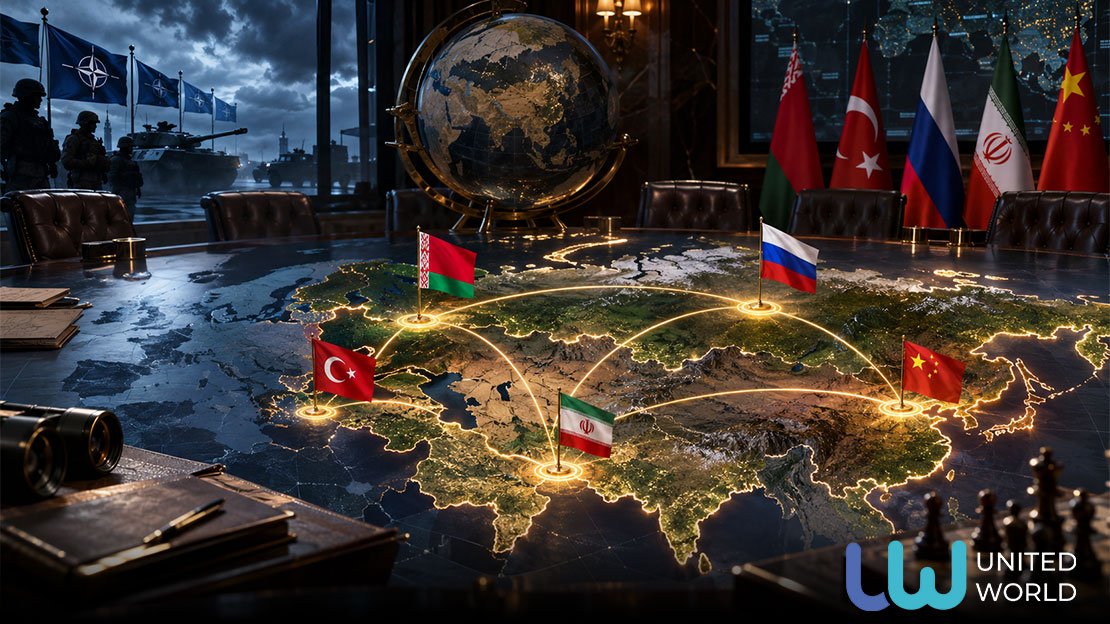
Mehmet Perinçek emphasized the importance of a “Türkiye–Russia–China–Iran alliance” (known as “TRÇİ” in Turkish with the capitals of the country names) in his statements during the Conference, meetings with participants and interviews with the Belarusian media.
Pointing to mounting tensions across multiple regions simultaneously, Perinçek highlighted what he described as “Europe’s aggression in the Ukraine” and the “aggressive policies by US and Israel in West Asia”.
“We are talking about a major war, a world war, perhaps even a nuclear war. Only cooperation among Eurasian countries can prevent this,” Perinçek said. He identified Türkiye, Russia, China, Iran and Belarus as countries capable of averting such a scenario by joining forces. According to Perinçek, an alliance among these countries would be the only force capable of deterring the aggression of the Atlantic bloc.
Addressing security guarantees for small and medium-sized states, Perinçek stressed that international alliances could play an important role in this regard. He also argued that nuclear weapons should be viewed not only as a threat but also as a potential means of deterrence.
Perinçek also pointed out that while the Atlantic camp is divided over Ukraine and Iran, its members present a united front in the Eastern Mediterranean and on the Cyprus issue. Saying that Türkiye faces serious threats in this context, he drew attention to the importance of the sovereignty of the Turkish Republic of Northern Cyprus (TRNC) for the wider Eurasian region.