


US President Trump, Russian President Putin, and President of China Xi Jinping met in Shenzhen on November 19, 2026.
From the approximately 90-minute “Trilateral Summit” resulted in a four-point declaration encompassing the following issues:
1- Reforming the UN
2- Increasing the production and supply of refined petroleum products and reaffirming the importance of stable energy flow
3- Recognizing immunities of State officials and that International Criminal Court and other similar bodies must not abuse their jurisdiction
4- A nuclear war cannot be won and must never be fought, and the three countries will conduct a dialogue on reducing nuclear risks and preventing the proliferation of nuclear weapons.
Even prior to the declaration, the fact that the presidents of the US, Russia and China came together in a trilateral format was enough to capture the attention of the entire world.
What does the Trilateral Summit tell us? Below is UWI author, historian and political scientist Associate Professor Mehmet Perinçek’s evaluation.
—
“2,5 of 3 represent a shift in favor of Eurasia”
This summit is one of the clearest signs that a new world is taking shape. How?
Two of the three participants, China and Russia, represent Eurasia. Trump, of course, represents the Atlantic powers. Yet, “some part” of Trump wants to break away from the traditional Atlantic strategies. During his election campaign, Trump argued that the US should stop getting involved in wars around the world and spending its resources on them, turning inward instead as “America First” points to. Whether he has put those promises into practice is another matter. His policies toward Iran have been so aggressive, for example, but in the overall picture, we could say that two and a half of the three participants in this summit represent, to varying degrees, a shift in favor of Eurasia.
Europe sidelined
Another important point about this summit is that Europe has now been sidelined. The Europe that wants to continue the war in Ukraine through further militarization and aggression has been excluded from the summit. In fact, Europe is beginning to lose its position as a pole in international politics.
Eurasia’s upper hand at the summit
Another point is that, Russia and China together represent an enormous force in military and economy of their own as well as through their international alliances and the countries they have brought together around them. This means that Eurasia has an upper hand on the negotiating table against Trump.
Russia and China get even closer
The trajectory of Russia-China relations is another important factor to evaluate this summit. The US has pursued a particular strategy toward these two countries under both Biden and Trump, including Trump’s first and second terms. The strategy of Biden and the Democrats was to draw China closer to the US and isolate Russia and ultimately eliminate it as a major power. Trump’s strategy, on the other hand, was the other way around: to undermine relations between Russia and China by bringing Russia closer to Washington and by isolating China. Neither strategy worked. On the contrary, these policies have brought Russia and China much closer to each other.
Economically, the two countries have taken important steps that challenge US hegemony, ranging from eliminating the dollar from their bilateral trade to developing alternative financial mechanisms and banking systems. The same applies to military, political and diplomatic cooperation.
This has not only undermined the plans of the Atlantic camp but has also accelerated the Atlantic system’s decline. Today, the Atlantic powers are losing their economic weight in the world. As all measures and long-term projections indicate, including those produced by Western institutions themselves, China has become a major economic power, among world’s ten largest economies in the near future Eurasian countries would occupy a prominent position, while Western countries would gradually slip down the rankings.
Weakened and divided Atlantic
To complete the picture, we should add two more things. One is the military failure of the US in Iran. The second is the divisions within the Western camp (between the US and Europe, between the European countries, and within the individual European countries as seen with the rise of the AfD in Germany, and Le Pen and Jean-Luc Mélenchon in France, the Reform Party in Britain).
A similar internal division to the one in Europe is taking place in the US. In recent years, we have witnessed increasingly intense political struggles within the American state itself. Competition and tensions between individual states have also grown. Added to this is the widening gap between the American state and its people because of poverty, inflation and the rising cost of living.
So, on one side, we have an Atlantic camp that is becoming increasingly weakened and divided. On the other, we have a Eurasian camp that is growing stronger, developing new projects and building stronger partnerships in economic, military and political fields. When we consider all this, we can confidently say that the multipolar world is increasingly solidifying. This trilateral summit demonstrates that reality once again.
The end of US hegemony
We have reached the end of US hegemony. What does the end of American hegemony mean? It means that the US has lost its dominant position among the imperialist powers, and its ability to determine the course of international developments. The US is now beginning to lose even its traditional allies like Europe. As seen in the Gulf, countries that have traditionally been regarded as American allies or even proxies, are beginning to distance themselves from Washington. Other pawns like the PKK are losing their power.
Not another Yalta
Considering this overall picture, likening this summit to the Yalta Conference is inaccurate as many evaluations suggest.
Every historical period has its own conditions. When the Yalta Conference took place, the US was a rising power. In fact, we could say that this period marked the beginning of the international order established by the US that would eventually develop into the unipolar world. Following the Second World War, the US achieved a rapid rise in both economic and military power. But the US is in decline.
Secondly, there is another important difference between the circumstances of the Yalta Conference and this summit. In the decades following the Yalta Conference, particularly after the Soviet Union began to assume a revisionist and social-imperialist character in the 1950s, Soviet Union and China set themselves in competing positions. Today, however, the Russia-China relations are fundamentally different.
So, whether we examine the position of the US, Russia-China relations, the circumstances of individual Eurasian powers or the distribution of economic power in the world, we have a fundamentally different world compared to the world of the Yalta Conference.
The summit and “TRÇİ alliance”
In this summit there were three countries. However, the partnership of Russia and China creates significant opportunities for a much broader range of countries and regions, extending from the Turkic world and the Islamic world to Africa and Latin America.
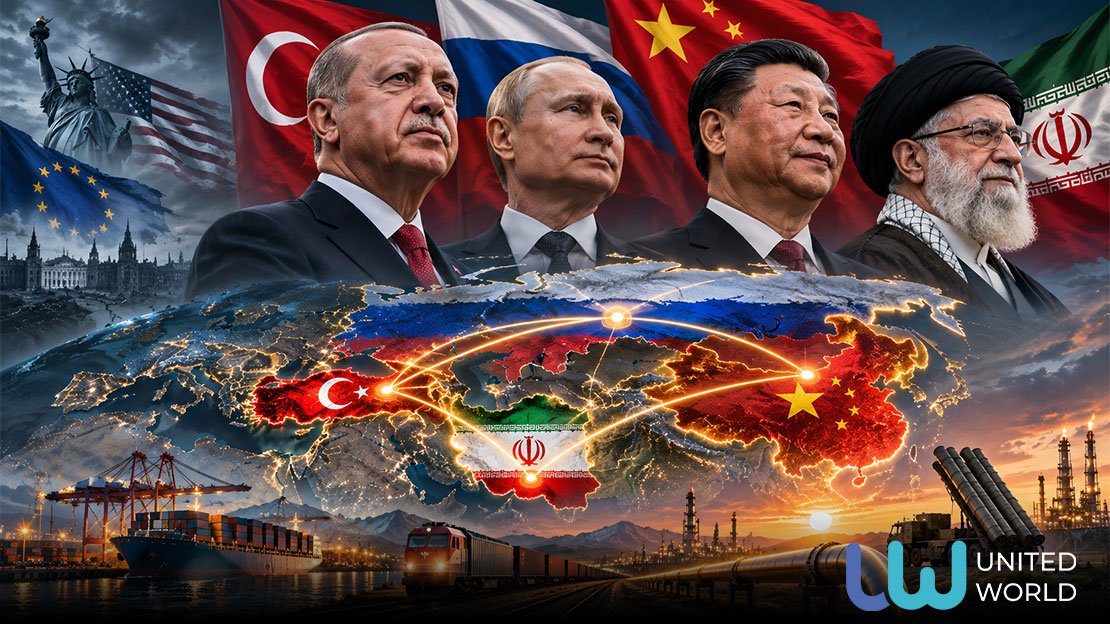
Focusing on Türkiye in particular, these opportunities amount to opportunities to counter the threats in the Eastern Mediterranean, Syria, the Aegean and even the Black Sea. Moreover, this summit provides a foundation for establishing an alliance between Türkiye, Russia, China and Iran (known as TRÇİ alliance in Türkiye with the capitals of the country names). In fact, such an alliance would be the natural complement to this summit in terms of ensuring world peace and protecting the sovereignty and security of individual countries.
If an alliance between Türkiye, Russia, China and Iran is established, it will make the end of US hegemony and prevent a world war even more certain, helping promote economic development, resolve ethnic, religious and sectarian divisions and conflicts among Eurasian countries. And, ultimately, it could contribute to establishing a much more just world order with a fairer distribution of the world’s resources.
So, rather than viewing it merely as “Türkiye was not included in the summit”, Türkiye we should consider how this summit can contribute to the TRÇİ alliance and a multipolar world.