


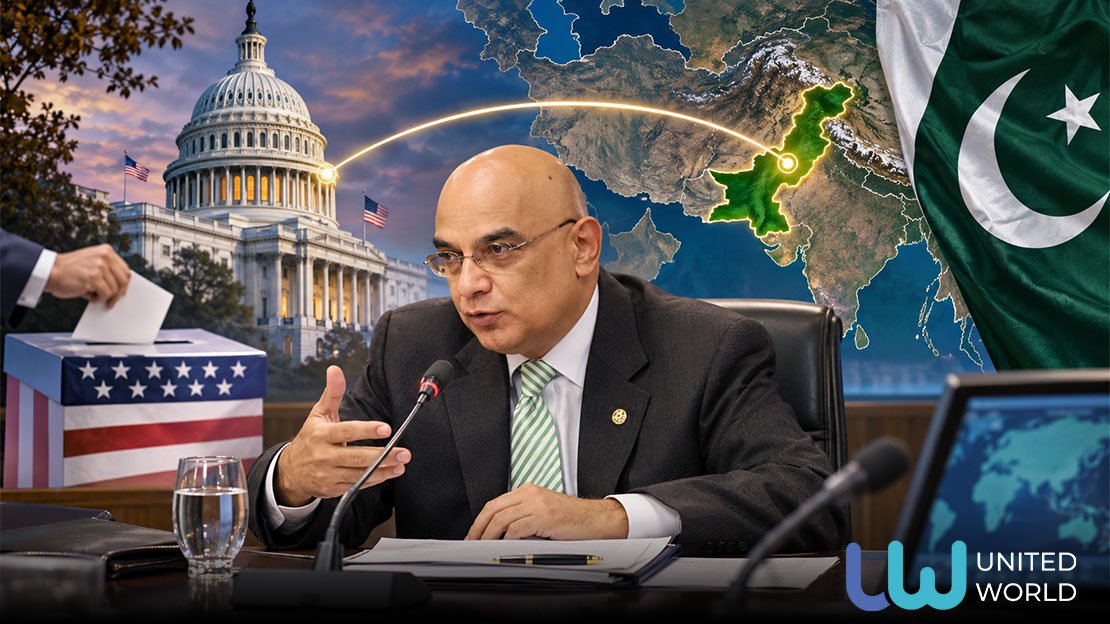
By Dure Akram
America has voted, Washington is preparing for a very different political reality. The November 3rd midterm elections have handed Democratic control of both the House of Reps and the Senate, delivering a sweeping setback to Republicans and raising some difficult questions about what is going to be the remaining two years of Donald Trump’s presidency.
What makes the results particularly interesting is how widely the Democratic gains seem to have extended. States that appeared safely Republicans have become competitive, young Americans turning out in significant unbelievable numbers, and some of the demographic groups that helped return President Trump to the White House in 2024 seem to be moving towards the Democrats. Now, there were some who were saying that, yes, this is exactly what will happen. Some are still bewildered, some are saying, well, no, something or the other will change.
But among all of them, I have with me today on my show Imran Shaukat, whose predictions turned out to be spot on. And I can vouch for that because I read them in an article that was published in Daily Times more than four or five weeks earlier.
Now, Imran Shaukat, senior advisor on South Asia at the Atlantic Council’s Middle East Programs. Since he has spent decades working on economic development, international diplomacy, and regional cooperation, and is a familiar voice, familiar face for my viewers at Washington Insights, I think he was in a far better, comfortable, and understanding position to read the tea leaves and give us a better outlook of what was going to happen.
First of all, thank you so much for joining us, Imran Bhai. I loved your predictions; they turned out to be spot on. But for my viewers, just give me a quick recap of what they were.
All right, Asalam-o-Alaikum, thank you for inviting me. It’s a pleasure to be here. And yes, you’re right, if you recall, it was your comment to me or question to me that what do I predict as what will be happening.
Now, first of all, let me just clarify, I’m not an analyst. I’m not a geopolitical analyst. I do write, as you know, but I don’t put myself in the category of those very wise talking heads. And I think maybe that’s why I made predictions that were different from others, because by default an analyst does not want to take a hard line or make a decision on anything, because he can’t afford to be wrong. So, he will always speak both sides.
So, the predictions actually that I made, and I made six of them, although only I believe three actually were related to the American elections, maybe four, after the other ones were more concerns about what will happen in the region geopolitically. So, the number one prediction at that time was that—look, everybody thought and they knew that history shows that the House would go to the non-presidential party, the Democrats. And the House, of course, but everybody thought it’ll be a very kind of a squeeze, maybe five, eight seats on top of what they had. I had predicted—and I was being very cautious, well, conservative—but I had thought it’ll be 30 seats. And but I knew in my heart that they will actually go beyond that.
And of course, what happened? I think it’s running at 50 plus so far with counts coming in. Nobody at that time thought that Senate would flip, and I had predicted that not only would Senate flip, but it will go perhaps as high as 55 or 56 Senate seats. And where do we stand right now? Senate is at 54, with two more seats seem like they’re likely to go to Democrats, which is of course Alaska and Mississippi. And then that brings us up to 56.
So, a couple of days ago, I was in a show and said, “But you said as high as 57.” I said, “Well, I hate to say this, but I’m not sure about the health of Mitch McConnell, and if something happens to him, you have a—you have a Democratic governor who will be appointing, so it will go up to 57 at that point.” So that was not a factor in my prediction, but it looks like it’ll go up to 57. The third prediction was that a cascade, of course, impeachments would start, starting with the first one would be the Secretary of War, Pete Hegseth. And then on that one, I had predicted that not only will he get impeached, he’d probably get indicted also, unless he resigns just before the indictment. And number four.
Wasn’t it just the other day that he said that no one can impeach a War Secretary on conducting or carrying out a legal war? He has gone all defensive on his choices, but please continue.
Yeah, but that he can say all he wants, but his war was not only, you know, in the world. He was he had waged war to the American people too, sending troops out there and so on and so forth. So, there’s a there’s a lot that they can hang him on. Besides, he’s totally destroyed the Department of War at this point. It has been more or less annihilated. It’s sweet revenge that the one rear admiral female that he fired has gotten elected from South Carolina, who’s going to be back in the House.
That is right.
But be that as it may, my fourth prediction was that Donald Trump will be impeached also. Of course, he’ll be impeached. There is even a chance that he will get convicted. And why do I say that? I said it’s a slim chance, but it is possible. And possibility, it all depends on how he behaves.
Democrats may use corruption as the argument for impeachment
Number one, doing an impeachment never goes in favor of the party that does the impeachment. Okay? It always turns the public mood against them because it kind of brings the government and everything to a halt. However, in this particular case, if they’re wise and they do the impeachment on him and his family wealth mongering that they did, because 60% of the Americans do and polls are saying that the American president and his family are corrupt.
So, if that is coming out on a daily basis on how corrupt they have been, how pay to play and all the other things him and his family and his staff has done, that will only going to anger the American people more and more and more.
So, I do feel that if they impeach him on corruption, then it won’t necessarily go against the Democrats at all. And I do believe, the reason I say he is perhaps impeachable this time and convicted, because the Republicans at this point, whoever are left, they are not happy Republicans. The Republican establishment is not with him anymore, and they all feel at this point that, you know, by the time he they come round for the next being primaried out, which everybody worries about, he probably won’t be able to have much influence on their primaries and all that. So I do feel, because look, Democrats if they get 57, they need 10 more votes to hit the two-third majority. So I do I do feel there is a chance. But how Pete Hegseth’s impeachment roll outs rolls out, that will actually give a pretty clear indicator on where the Republican senators are going, right? That will be a good test case, right?
Iran “caused this catastrophic, extinction-level event for Republicans”
That’ll be a good test case.
And then one of my other impeachment was that or one of my other, sorry, the prediction was that that the war, because Donald Trump and everybody kept saying the war ends after the midterms, and I had said the one winner, clear winner out of this war is who? It is Iran. They have caused this catastrophic, extinction-level event for their Republicans.
So, if I’m winning, why do I want to quit? They don’t have much more to lose at this point and everything to gain. And uh, you know, why wouldn’t they continue the war and really punish the Republican Party and the president, if they extended all the way to the next American elections, two years from now, that would wipe out the Republicans for good.
Now, the only caveat on that is Donald Trump being the wheel and wheeler-dealer that he is, he’ll probably go back, and he’ll offer them everything under the sun, including plane loads of cash, releasing of their funds, doing everything he possibly can to say, you know, uh, you know, that hey, stop the war.
However, his of course the other reason he’ll want the war stopped is Netanyahu has lost his elections. So if the opposition government is formed in Israel, then the appetite for war and the guy pushing for it, which is a combination of Netanyahu with Stephen Miller and of course Secretary Hegseth, you know, that that one key component is gone out of that. So, you know, who knows where it ends, but I certainly do believe that for the for the time being, it’s not like Donald Trump has learned anything from these elections. His first move is to appoint the person, Stephen Miller, as his chief of staff, who’s the main architect behind his real loss, whether it was immigration—
[Interjecting] But he did that, that doubling down. I mean, he bought a good taste of what the public choice was all about, how the public how the public’s mood was. And now he’s doubled down on it with this appointment. What do you read into that? Is that a last gasp desperation or I don’t know, I don’t I don’t have any words to describe that.
Yeah, I to be quite honest, I you know, there is why did he actually do that? Why did he fire the chief of staff? I think one of the biggest reasons that he fired her is the simple fact that she caused him a loss of $400 million, that she convinced him to invest out of his super PAC into the races. That’s his number one reason. And somehow, he does think that’s all his money, although that is money that has been raised, he can’t take that money home. He should not take that money home. That money was raised to do election campaigns, not for his personal kitty. But we know him. He does think, you know, that’s all his money. So that’s why I don’t think he fired her out of any political reasons or anything else. I think he just got rid of her because she caused him uh the one thing that he loves the most, which was his cash and finances. Um, yeah, the it’s a terrible omen that he has decided to double down and bring, you know, Stephen Miller into a position, not realizing uh I guess I don’t think that there’s rational behind what uh President Trump does. I think it’s just it’s a reaction. I think he’s probably getting more and more irrational in his decision making as each day goes by, right? Um, I mean, even look, his son, who’s the unofficial kind of a spokesperson for the family and for him, uh agreed with uh with Senator Cruz on all the reasons that he pointed out, which was it was the price of inflation, the cost of war, and all these things. So, his own son, publicly is totally disagreeing uh with his father on what the causes of the Republican losses are.
Riffs within the Trump family and the Republican leadership
And a similar voice of reason was echoed by the Vice President. So, there are riffs both within the Trump family and within the Republican leadership. We don’t really have to take any guesses about that.
Absolutely, and they’re going to walk away from him more and more and more because, you know, it’s not only Pete Hegseth who will be going. Rubio will be leaving, I’m sure in in short order, because he wants to, he’s an aspirant for American presidency and now he will want to distance himself from uh from this huge, catastrophic loss. Uh and of course, he was one of the policy makers. I mean, the vice president, I just find him to be one of the most disingenuous people, actually. He’s all in till he’s all out. You know, you can’t trust him. Uh, and he’s a typical politician who will go whichever side the wind is blowing. Right. Speaking about blowing of the wind, you did ask me why I came up with the predictions that I did. Uh, not being, you know, I am a keen observer of certain, you know, and I follow the polls and the news, just because it impacts the whole world, not only me as an American Pakistani, but also the world as a whole and the region where I spent a lot of my time. Uh, but uh more than that, it was because, you know, again not to compare too much with the analysts, but analysts are not typically the ones who they study the polls and they try to analyze, but I come with the I’ve run five election campaigns, too.
And there’s when you are into the politics, nitty-gritty politics, you actually start getting a better sense of which way the wind is blowing, too. It doesn’t matter what people are saying in the polls. There’s a lot there’s certain things that are undercurrents and undertow that are happening that you start sensing that, “Oh no, this is much stronger than what people are admitting.” I mean, we saw that in Donald Trump’s first and second election, too, right? That people do not always say, and maybe not all the polls’ pollsters capture everybody, right?
It’s a sampling, it’s a very small sample that they use. 1,000 people are the country, you know, of, you know, 320 million. So, it’s how much are you capturing? And this time, the things that were going, the cost of gas, the broken promises, you name it. And you know, people continue to forget, you can poll all you want, and people were still after the day before the election, people looked at all the votes that had come in, the, you know, the votes that are that people mail in votes as well as pre-voting. Uh, and people were still looking, all the others were looking at, okay, how many blue versus how many red? But they were not actually considering too much, and I’ve never heard them speak about it, that, yeah, but you got anywhere from 20 to 30% of the votes are non-party affiliated.
So, if Republicans may be winning in this seat by some marginal number of votes, but you got this all these votes that are non-party affiliated sitting there, where do you think they are going? They are definitely this time not going in favor of uh of the Republicans, right? So, the black hole is always the non-party affiliated people. And in the poll you can capture them, certainly, because you are not asking for people’s party affiliation necessarily when you’re polling, although the sample sizes you do try to do the proportionality, but the fact of the matter is that how many of those non-party affiliated people, they may say something in a poll, which way they’re going to vote, but how motivated are they to come out and vote? That’s right. And the motivation level in people was just so high that uh I felt like, okay, this is going to be just uh, you know, uh very as somebody said, it’s an extinction-level event for the Republican party.
But there’s like there’s a stark parallel when we uh look at how President Trump won the presidency in 2024, at least, like with the coalition that he came up with that seemed to have extend extended and expanded beyond the traditional Republican voters. And all of that, or a large portion of that realized that, oh no, we can’t really continue with that anymore. Do you think that voters will come back to the Republican party in the next election, or these trends are going to continue now?
Well, there are two or three takeaways from this. First, uh I think one of the, uh where again, something that we don’t talk about much, you had a very, very large turnout of the young voters, the Gen Z. And I’ve written about this in your, uh, you know, column, that Gen Z is a force that people are just not understanding, what they’re capable of doing, what they did in in all the elections in South Asia, what they even did for Donald Trump. And they came out in large numbers to vote this time around. And they are not ideological voters, they are issue voters.
So, yeah, what can one predict? You one can’t say, because they’re going to be voting on issues again. Who knows what the issues will be two years from now, right? That’s a very large uh you know, uh batch of voters. I think the other voters that uh I am so happy to see that America did such a huge auto-correct, self-correct in these elections.
After the last elections, I had actually felt, oh my lord, our country has gone in a direction that may be irreversible. Why? Because the coalition that Donald Trump, we’ll call him coalition, look the people who voted for him in large numbers were who? They were Pakistanis and Indians and Arabs and uh Latinos. And not to disparage my own communities and all that, but people were shocked, the world was shocked, that how come these people can vote for a person like Trump? You know, the guy who’s a narcissist, who’s corrupt, who just, he’s a populist and so on and so forth. How can you even believe him? And I’m thinking, well, you know, the demographics of America has shifted, and a lot of the people who voted for him actually left countries with leaders just like him. So that’s the only kind of leader they know, anyways. You’re right. You’re right. You know, that’s the only, you know, that’s the only leader they know. They’re like, “Okay, you know, I can understand this guy. I can relate to this guy.” You know how American people are always voting for the people they relate to. They can relate to that. Yeah. So, so it’s an interesting one.
So, I thought since the whole demographics is shifting in America, his last election I thought, hey, maybe that’s a permanent thing. Just because things are changing at this point. But I that’s why I am so thrilled that people have restored my faith in the American people. You know, there’s uh another very interesting uh well, call it analogy that applies a lot in in the politics nowadays. Uh, Socrates at one time, see, he was not in favor of democracy. Although he wrote about it, he wrote about federalism and all that. But he tried to come at it and convince people in a different way. And his viewpoint, his argument was, can two people’s opinions have the same weight? If one person is a PhD, a philosopher or a king, uh a senator, you know, a rich business person, and second guy is a cart puller or a street cleaner, can would you give equal weight to both their opinions?
And of course, everybody said, no, of course not, because their knowledge base and everything is very different. He said, but one person, one vote basically gives the same weight to the vote of two people, regardless of what their intellect is. So, he said, I’m not against one vote, but do understand when you give equal weight, then the popular leader will always get elected, not the most deserving intelligent leader. So, he was right on that one and uh so here we are.
But again, the American population has proven my thoughts wrong. They came out and they voted, you know, regardless of what background they came with, they flipped over to the other side. But I think, you know, this might be one of those one offs, just because the just the price of gasoline, forget about anything else. You know, this kind of environment economic and otherwise that Donald Trump had created, let’s not even worry about his broken promises on the Epstein files and all these things that he said, it just hit everybody’s pockets so hard that that, you know, even Republicans voted against him, right?
So, but all these one off corrections would be uh bring the gas prices? Do you think steps like that, or another set of promises on immigration reforms, do you think that ought to, of course, I’m talking about two years down the lane, but do you think that could help the Republican case down the lane?
I’m not sure how much it’s going to help, because first, he’s not going to do any of this. He’s going to keep fighting. If he’s appointing Stephen Miller as the first person, say Pete Hegseth is backing him up, who was the main cause for him losing the war, I mean losing the war also, but losing the elections. Since he’s backing him, he’s not backing down. So, this is going to be this is going to be a catfight that will go on for two years. Uh, and who knows where it ends. But here’s another uh couple of things that that we are not considering. Look, House can flip in two years again, okay? Anything can happen, the house flips over, um regardless of what we, the however large gains that they got. But the more important two other issues. One, a lot of the state houses and governorships have gone to the governors uh blue governors at this point. And we have 10 female governors. It’s it’s amazing how much uh how much of a change has come about. And you know, you know, the Democrats have never focused on state governments. They usually uh have minority governors and they have usually minority state governments where a lot of the things actually happen, including what happens to the electoral college, what kind of laws are made, how uh Gerrymandering takes place and all that. So that this is the first time the Democrats actually have a majority of the states even on many of the purple states or even in the red states where they have killed the super majority of the Republicans. So that is something that’s huge. Okay, if they do it right, Texas. Could anyone help Texas?
Yeah, absolutely.
Absolutely. I mean, North Carolina, everything flipped. Texas, there’s only one statewide office that is left and that is uh Ted Cruz. Even railway commissioner, cattle commission, everything has gone everything has gone blue. So that’s huge. Then comes the other thing that people don’t think about. The Senate has flipped in an overwhelming way. The map that had been drawn from the Senate actually always favored the Republicans and that’s why they always for the most part they have controlled the Senate. Because, you know, all the small red states, they get two senators, you know, Alaska gets two senators, you name it. So Senate controlling the solid gives you the courts, a judicial appointments. It gives you any other appointment. It’s a very powerful entity. And now you have, you know, you haven’t flipped uh seven, right now it’s seven uh flips. You add on Mississippi and uh and Alaska and then maybe even Mitch McConnell. So by rights, my thoughts are that out of 10 flips that will happen and most of them in red states, even if Democrats do a good job in five of those red states, and they see the incumbents get reelected again, you are going to control the Senate, the Democrats will control the Senate for maybe the next eight to 10 years, maybe longer. And that is a very, very powerful, um you know, arm of the of the American politics that will be in the hands of the Democrats.
But all said and done, President Trump is still in, and he is not a lame duck president. He will not go down as a lame duck president. And uh I think it was on the election day or a day before election that he said that I would love I would prefer to be remembered as the as Mr. Veto, as the veto president. So that is there. So, the next two years are you’re right that they’re going to be an intense catfight. But can we expect meaningful legislative compromises between the two parties in the next two years?
Look, we are trying to read tea leaves when, uh with Donald Trump being there, it’s not even tea leaves in there. I’m not even sure what’s in there. You’re right, you’re right. We don’t we don’t know what we are reading.
Republicans will start cornering Trump
So, what he says on veto and uh what he says the next day, who knows, right? Um, but yeah, the, you know, a lot of people want to read the tea leaves and say, what happens next? Short term to medium term, I don’t think there’ll be any changes coming about. Because Donald Trump is just not, you know, he’s just not wired to actually, you know, change at all. And he’s going to fight back because now he’s so cornered and all that anyways, and I have a feeling a lot of the Republicans will start giving statements against them that will make him even the more, you know, you corner him, the more he doubles down and the more he reacts in the negative.
He’s not a compromiser, he’s a counterpuncher, right? So short medium term, I don’t see much happening. And people like to think, well, you know, the power of the purse, the power of tariff, the power to declare war states is the prerogative of the house. Well, he doesn’t go by any rules anyways. He doesn’t play by any rules, so it doesn’t matter what the Constitution says and unfortunately, the Roberts court had given him blank check, that he’s a immune as president from any action anyways. So, so you know, I don’t see any changes really happening in the near term.
But maybe in six months, eight months, a year, uh more when the pressure of the next presidential election is on. Yeah. Then there’s a possibility that he may try to do something under pressure, but then knowing him, he’s like, I’m not on the ballot, what do I care? If my party loses the elections, that always makes him feel good. He says, well, if I was on the ballot, I would win.
You’ve previously argued that the deadlock over Iran, uh when people said that it would be resolved or would at least uh come to some semblance of resolution near or after the midterm, but you said, no, it’s a long game. I don’t see it happening anytime soon. Do you still stand by that statement?
I stand by that statement. I do. Like I said, but I said that given the caveat, that Iran has caused so much to the Republicans that down the road, the only way out is that they, you know, basically give in to all of the Iran’s demands, including freeing up their accounts, uh even, you know, I don’t put it past uh the administration, Donald Trump, not the administration per se, to sign a secret deal that okay, you continue with whatever you’re doing, and we’ll give you even more money. And um yeah, that’s the only way. Now you can only uh purchase a peace deal out of Iran. You can’t negotiate a peace deal from Iran.
Um, okay, that’s not a good thought. But let’s see how where the road takes us. You since you worked extensively with the South Asian American community, especially when you are the new uh the new generation, the upcoming generation Gen Z, do how do you assess the political evolution of South Asian Americans in this election?
Well, you know, when that’s a very broad canvas, right? Because South Asian Americans are Bangladeshis…
[Interjecting] I’m asking both as voters and as leaders.
Yeah, you see the here’s the problem, though. The South Asian community would not have acted as one. The Indian Americans would have acted very differently from the Pakistani Americans versus the, you know, Bangladeshi Americans or the Singapore, I mean, Sri Lankan Americans. So it’s kind of hard, uh, yeah, it’ll be very hard to pin it to one or the other, right? Um, so, yeah, I don’t I’m not sure how specifically these different uh backgrounds of South Asia voted.
I know most of them voted against Trump, but because they were voting for their pocket. They weren’t voting uh for Trump or against Trump for ideological reasons or other reasons. It was strictly down to, you know, their pockets. So what how would they vote in the future? A lord knows. Uh, I mean, last time they got so impressed by Elon Musk being there with him.
This time they got turned off by Elon Musk putting money. I mean, the guy did put in half a billion dollars, out of which about $300 million or so in Texas. And he didn’t make any headway at all. So, I look at facetiously, another casualty of these elections is the cyber truck. You know, that that one hit the dust because the day after the elections, Elon Musk basically said, “Okay, I’m not making Cybertruck anymore.” So, like I’m not sure how Cybertruck was at fault on this one, but hey, I I personally, I’m all in for that ugly thing to be uh to be off the road, but hey, so be it.
This is not something that I had uh told you about, of course, and was wasn’t really on my agenda as well, but since both of us are from Pakistan, and I there is a lot of news and speculations when it comes to what Pakistan’s next choices are going to be. Of course, Pakistan has been counting on President Trump’s influence for quite some time now. And uh I don’t think that is the case, but many people equate President Trump with America and President Trump’s policy with America’s policy when it comes to Pakistan. Do you think that people in Islamabad are sagacious, wise enough to realize that, oh, we can’t really continue with that status quo anymore, or do you think that they are also fighters and they are also banking on President Trump’s President Trump’s ability to remain in the fight? For as long as that…
Being both of us as Pakistanis, we can be honest, we can say these things and get ourselves into some trouble, but we’re brown enough to say this. You’re talking sagacity. You really think we’re going to think along those lines? I’m not sure.
You know, do talking to the people here, do they realize that we went too far down the one rabbit hole, which is going into bed with Trump? Absolutely, everybody realizes that, right? So it’s not like they don’t realize. But we actually do not have the capability to self-correct ourselves. We, you know, you and I have talked about this, and we have talked to many colleagues, many decision-makers, that Pakistan should be extending its reach in America.
It cannot be personality driven. Pakistan’s relationship with US has always been, you know, uh one person in Pakistan, one in the US, right? Uh and it’s always been a transactional relationship. Very personality specific. It’s personality specific. We have I’ve written about it in your column and elsewhere, that Pakistan really needs to start reaching out. We don’t have a caucus in the house to speak of. We don’t actually have a caucus in the Senate at all, and ever had it for a long time perhaps. Uh we don’t have much reach into the think tanks, right? You can’t even get too many analysts to come on your show. Not your show, per se, but I’m saying many of them. Yeah, no, we have this tremendous gora complex. We’re always looking for some gora to get on a show, and you can’t find many barring two or three, whom we whom we have labelled supreme analyst and have go, “What do they know about Pakistan? Or South Asia for that matter?”
They they have no I think you’re right on that. South Asia, you’re right. Yeah. So, we really need I mean the business, the diaspora, our diaspora has never been organized, right? So, we always act in silos. Our embassy, I’m going to give them a lot of credit to what our ambassador and his team accomplished in the last two years. I mean, they are not policy-makers, they are implementers, and they did they did a phenomenal job of moving forward. Uh I won’t mention names and you know some of them who’ve done just such an amazing job. But then they’re the ones we rely on. They are understaffed and overworked and they handle so many different things. It’s the Pakistani diaspora that needs to engage more and more and more. And you know, you and I have talked about it, that the diaspora is very, very different and there’s segments of the diaspora and they have to be engaged in different ways. I see a lot of the diaspora funding different campaigns and so on and so forth in their own places, but there is no coordination, no organization. And unfortunately, because there is no coordination, anybody who’s funding anybody in Florida or California, Pakistani-American, he’s doing it well, let’s be honest. He’s not doing it for making better headway between Pakistan and America.
He’s doing it more or less to get himself a little bit more ingratiated with, you know, whichever regime is coming in. That is very different from the Indian diaspora. That is very different from the Bangladeshi diaspora. And there are many different reasons behind that and how Pakistanis actually act in silos. Um, because you really can’t get four Pakistanis to agree on anything anyways. So, okay. You know, you do the best that you can under the circumstances. You’re right. Uh, but I don’t see a change coming about anytime soon. Uh, but I do hope that wise people realize that we really need to start making inroads into the broader uh you know, mosaic of the American culture, whether it’s political, economic, business, uh financial, what have you. Um, and fingers crossed that someday we might actually get there.
Results from a South Asian perspective
Since this is you, I cannot let you go without having one final prediction for 2028. And I don’t want just one for America, I want one pertaining to South Asia as well.
Well, um honestly, where I’m sitting right now, what I’m seeing, I am I’m always an optimist, but I don’t see great things happening in the next year or two. Okay. Uh, one interesting thing that is evolving that I’m personally involved with that you are also helping with is actually some sort of a subsectoral South Asian integration. That uh, you know, a year ago that was almost impossible to even imagine that Bangladesh and Pakistan coming together.
It was almost impossible to imagine that Sri Lanka and Pakistan starting to talk a lot more. Of course, Maldives was here. And you know, I brought in the delegation from Bangladesh, and I just had a delegation depart yesterday from Sri Lanka. And it was just uh absolutely amazing. The positive commentary and everything, it was a very funny comment a day before yesterday, the Sri Lankan ambassador hosted a dinner for the delegation of 16, which came from different backgrounds, right?
And one of our colleagues there is Japanese, and two of the Sri Lankans were standing there and so was our spokesperson for the Foreign Office and the ambassador, and they got to meet the Japanese and said, “Oh, you’re Japanese? Oh, well Japanese is our number one most favorite country in Sri Lanka.” And of course, the Japanese were very happy and smiled. Then he said, “Till now, now Pakistan is our number one most favorite country.” So, it was just, yeah, that was interesting.
That was an interesting about-turn.
It is, and I’m seeing it’s not just because what I did. I just saw, you know, our government has been to Bangladesh a few times. Uh Tariq Rahman, the Prime Minister there uh and you know, I I worked in Bangladesh for 13 years. Tariq Rahman is giving since he came in, he has now, and I I’m so happy with Bangladesh for taking the stance, you know, you know, Bangladesh first. We’re not going to be subservient to anybody. We want to deal with everybody. So, and subsequently, you know, you have for the first time since 1970, a couple of months ago, the first batch of Bangladeshi government officials who got training in NIPA, then there have been other exchanges, and now there’s another batch of about, I think 35 officers are coming from Bangladesh to be educated I mean to be trained uh in the academies over here.
So, I do see that if South Asia, just like the Middle East—one of the interesting articles that uh a friend of mine wrote at the Atlantic Council, uh Jonathan Panikoff, very wise. He said the whole peace process in the country-to-country relationship has walked away from ideologies, and now it happens in blocks. That I can get along with you on this, this, this, we can disagree on this, this, this. He was writing more on the Middle East side of things where there are certain Arab countries who recognize Israel and all that, uh but they’re not happy with the war situation, and others who don’t recognize Israel or hasn’t recognized Israel or not that close to Israel, but they get along with it for other reasons.
Uh and the same thing I think will happen in South Asia more and more, where we can agree to disagree on certain things, but it’s not going to be, “We are your enemies, or you are in this camp versus that camp.” And of course, Pakistan has been walking that tightrope for a little while. Pakistan in the past used to be either we are with the US, or we are with China or we are with somebody else. Now Pakistan itself is playing the middle role of being trying to be friends with everybody.
And the latest case in point is they signed the Mecca accord, which has the potential to drag Pakistan into a war in the you know, in in the Arabian Peninsula, against the Houthi if they, if the Saudis ask to support them, but on the other hand, Pakistan is doing the peacemaker with Iran. So, we get along with Iran, but we’re also dying signing uh an accord with the countries that are not uh you know, let’s say close to Iran. You’re right. So, I do see, yeah, interesting things developing, too early to tell where it will go through.
I will invite you again to have your predictions somewhere down the road and see how they hold up against this changing world order. So much is changing, you’re right, the world is in a flux and it’s too early to call in the shorts, you’re right. It was lovely to have you as always. And I think what this election has demonstrated for all of us is how quickly political fortunes can change. People say in America, but I would take that argument further and I would say that how quickly political fortunes can change just in the blink of an eye for the whole world and these changes are connected to economic changes, international changes, everything under the sun.